For 15 years now, Zipporah Atieno’s life has revolved around sizzling potatoes, hitting hot oil.
Before dawn breaks over Mukuru Kwa Njenga's corrugated rooftops, her practiced hands are already at work—setting up her modest grocery stall, coaxing flames to life beneath her well-worn jiko, and preparing the day's offerings (chips) which are priced from Sh20 to Sh50.
They are affordable comfort, quick sustenance for labourers heading to construction sites, and children on their way to school. On special days, her githeri studded with whole boiled potatoes draws long queues of casual workers seeking nourishment to power energy-demanding jobs.
Potatoes are prepared in many ways; skin-on or peeled, whole or cut up, with or without seasoning.
However, in a well-to-do family, the humble potato transforms. Here, it might appear roasted with rosemary and olive oil, baked under layers of cheese or plated alongside expensive cuts of meat. The preparation and presentation may differ dramatically, but one concern silently bridges these disparate worlds. Whether served on chipped enamel plates in Mukuru or fine china in Karen, the question lingers with each bite: what invisible residues might be hiding within these staple tubers?
Why are we doing this story?
Firstly, it brings to light the alarming reality of widespread pesticide misuse in Kenya's potato farming sector, a cornerstone of the nation's food security and economy. The Egerton University study's findings, revealing that a vast majority of farmers disregard safety guidelines and that pesticide residues often exceed safe levels, directly impacts the health of millions of Kenyans who consume potatoes daily. By highlighting the potential chronic health effects and the presence of pesticides banned or restricted elsewhere, the story underscores a significant public health concern that demands urgent attention.
Secondly, the article delves into the complex web of factors contributing to this hazardous situation. It goes beyond simply stating the problem by exploring the reasons behind the misuse, such as farmers' reliance on non-expert advice, the high cost and inaccessibility of genuine pesticides, and the increasing pest and disease pressures exacerbated by climate change. Furthermore, it examines the systemic issues, including the alleged inaction of the Pest Control Products Board and the aggressive marketing of potentially harmful chemicals. By providing this multifaceted perspective, the story aims to foster a deeper understanding of the issue and pave the way for more effective and sustainable solutions involving all stakeholders, from farmers to government agencies.
Show more Show less
The worry about pesticide contamination creates an unexpected equality, a shared vulnerability that transcends economic divides, linking the street vendor's customers with those dining in exclusive establishments.
According to a new study conducted by Egerton University, potatoes undergo various cooking processes before consumption, the study evaluated the impact of frying, baking, boiling, and steaming on pesticide residue levels.
The good news is that these common heat processing methods generally proved effective in reducing pesticide residues. Frying and boiling emerged as particularly efficient in diminishing the levels of most pesticides. However, baking, roasting, and frying failed to reduce the concerning levels of some pesticides below the established safety thresholds.
Research has shown that three out of every 10 pesticides registered by the Pest Control Products Board (PCPB) in Kenya are withdrawn from the European market or are heavily restricted due to potential chronic health effects.
Studies conducted in Kenya also show that pesticide residue levels in food exceed allowable limits. In 2018, 1,139 samples of fresh produce intended for export and local markets were tested by the Kenya Plant Health Inspectorate Service (Kephis). Pesticides were detected on 46 per cent of the samples, while 11 per cent had residues exceeding EU maximum residue levels.
And now, a study conducted by Egerton University has revealed a widespread use of agrochemicals by potato farmers, raising critical concerns about pesticide residues lurking within the tubers and potentially making their way onto our plates.
“There is widespread noncompliance among potato farmers in Nyandarua County, Kenya, regarding manufacturer instructions for pesticide application rates, frequencies, and preharvest intervals. This has led to the accumulation of excessive pesticide residues in potato products from this region, threatening the safety of potato product’ consumers,” the study cautions.
According to the study, the annual production of potatoes in Kenya reaches approximately 2.8 million tons. The potato industry contributes close to Sh50 billion to Kenya's economy and supports the livelihoods of around 2.5 million people. Kenya’s national domestic demand for potatoes stands at about 3.1 million tons against 2.8 million tons that are available for utilisation.
“The rising demand for potatoes in Kenya has largely evolved in response to changes in urban population growth, taste and preferences, and potato consumption habits. Consequently, it has pushed the per capita consumption of potatoes from 35 kg per person in 2019 to 63 kg in 2021,” says the study.
“The main potato-growing regions in Kenya are Nyandarua, Bomet, Meru, Nakuru, Uasin-Gishu, Narok, Nyeri, Kiambu, Trans-NzoiaWest-Pokot, and Keiyo-Marakwett with Nyandarua being the leading producer. There are more than fifty improved and local potato varieties in Kenya with the Shangi variety being the main variety grown and consumed because of its ready market, good cooking qualities, readily available seeds, high yields, and early maturity as compared to others.”
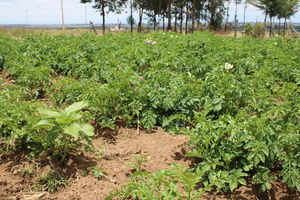
Dangerous pesticides found in Nyandarua potatoes.
Photo credit: Isaiah Esipisu I Nation Media Group
The study notes that Climate change is worsening pest and disease pressures in potato farming, posing a significant threat capable of causing complete crop failure if left unmanaged. Consequently, farmers are increasingly dependent on synthetic pesticides, including various classes, to protect their yields.
The study, which surveyed 275 randomly selected farmers and analyzed 16 raw potato samples, paints a picture of intensive pesticide application. An overwhelming 98 out of every 100 farmers reported using synthetic pesticides, with fungicides being the most prevalent (96.4 per cent), followed by insecticides (68.2 per cent) and herbicides (28.7 per cent).
“Among the pesticides used, fungicides are the most commonly used (96.4 per cent) due to the increased cases of fungal diseases such as late and early blight. Gianessi & Williams (2011) reported that about 93–100 per cent of potato farmers in Kenya exclusively rely on synthetic pesticides to control late blight. This could be due to the recycling of seeds from the previous harvest, intensive monocropping, all-year-round potato cultivation, excessive reliance on synthetic chemicals, and poor plant debris management in the region,” syas the study.
The study adds: “Mancozeb and Metalaxyl are extensively used as compared to other fungicides. This could be attributed to the availability and accessibility of the fungicides containing these active ingredients in the local markets.”
Farmers also reported mixing pesticides, in an attempt to get a new formulation that has high toxicity, and preventive measures if there are pests or other diseases that will attack or an attempt to save on time and labor.
However, the researchers warn that the practice can be dangerous and “may lead to unintended interactions, increased toxicity, and/or it can reduce the efficacy of the pesticides. Also, this use of pesticides is not on target and increases the production costs as well as the risk of high pesticide residues on crops and the environment.
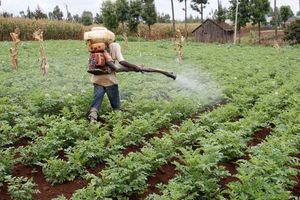
A farmer sprays his Irish potatoes with pesticide in Elburgon, Nakuru County, in November last year.
Photo credit: File | Nation Media Group
“Potato tubers from farmers who adhered to manufacturer instructions for pesticide application, including herbicides, fungicides, and insecticides, had significantly lower residue levels in potatoes. Additionally, mixing pesticides led to high residue levels, potentially due to improper mixing ratios or synergistic effects, where the combined toxicity exceeds the sum of the individual components. This can lead to higher residue levels even if the total amount of pesticide applied remains constant,” says the study.
Another concerning finding was the widespread disregard for recommended application rates. A mere 11 out of every 100 farmers adhered to the manufacturer's instructions, while the majority relied on advice from agrochemical retailers (75 per cent) or fellow farmers (13.32 percent).
“This reliance on non-expert guidance could be attributed to a lack of technical background, scientific training on the use of pesticides, and access to agricultural experts through crop adviser programs which increases the risk of improper pesticide use, and leading to either over-application or under-application. Over-application can result in higher residue levels, posing health risks to consumers, while under-application may not effectively control pests, potentially leading to crop damage and reduced yields.”
Almost all farmers (93.27 percent) also applied pesticides at least once every seven days, creating risks for both human health and the environment, while also accelerating the development of pesticide resistance in pests.
Some farmers also applied pesticides preventatively, regardless of actual pest or disease presence. This practice stems from past experiences of frequent and predictable crop damage due to fungal diseases, coupled with a lack of awareness regarding the importance of scouting fields to confirm pest or disease presence before applying chemical treatments.
Farmers in the study also indicated applying pesticides at various critical growth stages: before planting (61.46 per cent), during emergence and tuber initiation (54.78 percent), at weeding (45.21 percent), and during flowering (51.29 percent), raising concern that they would not allow sufficient time for certain pesticides to break down to safe levels before harvest.
Ms Naomi Njoki Ndung’u arranges potatoes by the roadside in Elburgon, Nakuru County on September 21, 2024. A container of 17kg retails at Sh700, up from Sh450 in the past weeks.
Photo credit: John Njoroge | Nation Media Group
This non-compliance was driven by peak market demand, financial constraints, the desire for higher profits, or a lack of understanding regarding the importance of adhering to post-harvest interval guidelines. Consequently, this can lead to unsafe levels of pesticide residues in the harvested potatoes, posing considerable health risks to consumers.
The study also raises concerns about repeated use of pesticides, leading to the buildup of residues in the soil, and doesn't allow enough time for them to break down, causing them to accumulate in the potato tubers. Applying pesticides at higher-than-recommended rates also contributes to increased residue levels in the tubers, as more pesticide is available for the plant to absorb through its roots and leaves.
Nation caught up with some farmers from the region, who complained that the study appears to offer a blanket condemnation of farmers from Nyandarua County. They also questioned why other potato-growing counties were not included in the study, all while complaining that genuine pest control products are expensive.
“The blanket condemnation is unrealistic. I am a member of a potato cooperative society. we do random farm visits and I can attest that the allegation is false, we read sinister motive in the report,” says Mr Kanyoni, also the chairperson, Ol Kalou Dairy Farmers Cooperative Society.
Ms Emma Nyaguthii, a farmer, said genuine pesticides are expensive, and that they could not readily access them.
“The government and other players in the food chain should do more to educate the farmers on proper usage of chemicals, and ensure that only authorised chemicals are stocked in the agro vets. The misuse of farm chemicals is a threat to jobs opportunity and export markets if the Kenyan produce is blacklisted at the international market,” she said.
“Historically, farmers timed potato harvesting to occur during dry months. Now we are facing a lot of weather uncertainties. Unlike years back when we let the potato stem dry naturally, we now must dehaulm to harden the skin and tuber," says Mr Ephantus Kihiu, another farmer.
Potatoes on sale at Wakulima Market in Nakuru. The fresh produce inflows at Wakulima market have been hit hard as most of the traders adopt a wait-and-see attitude.
Photo credit: File | Nation Media Group
Reacting to the study, Faith Kamore, an Agronomist said fungal diseases associated with extreme cold weather have become more common in Nyandarua, forcing farmers to overuse fungicides to protect their crops. Unpredictable weather has also forced farmers to harvest potatoes prematurely, leaving insufficient time for applied chemicals to dissipate from the tubers or for the tuber skin to harden, which would significantly reduce chemical residues.
She also explained that dehaulming - an artificial method of forcing the potato tubers to mature- has become a common practice, by farmers who fear that rains might come too soon before crop maturity, which will delay the crop at the farms, encourage growth of weeds, make harvesting cumbersome, and affect the next planting season.
“The findings by the researchers amplified the dangers of misuse of farm chemicals, which is not a challenge in Nyandarua alone. It amplifies a need by the Kenya Bureau of Standards and other arms of government to enforce the law,” said Ms Kamore.
“We know that some of these chemicals are banned in Kenya and are unused in their countries of origin. All condemned chemicals should be recalled. Kenyan farmers are just victims of aggressive marketing agents who offer minimal or no information about the dangers of the chemical products,” added the agronomist.
She also explained that commercial farmers use foliar fertilisers, mixed with pesticides, to hasten the growth and maturity of vegetables, as well as give them an attractive colour.
“They do this to cut down on the costs of irrigation. Foliar feeds and pesticides are most misused by these farmers. In fruits, the farmers use hormone-related chemicals to promote flowering, while more foliar and pesticides are used from the formation of the fruit," she stated.
"Normally, fruits and vegetables where foliar is used look very attractive, but have a shorter shelf life. That is why you find some potatoes with very attractive colour when ripe, but their skin is very thin and delicate. Such fruits and vegetables have more water content since they did not go through the entire maturity period,” adds Ms Kamore.
Reacting to the study, National Potato Council of Kenya (NPCK) said they are collaborating with the Kenya Bureau of Standards (Kebs), the Agriculture Food Authority (AFA), Agra, PCPB, and other key industry stakeholders to develop a harmonised code of conduct to ensure quality and safety.
About two weeks ago, Agriculture and Livestock Development Cabinet Secretary Mutahi Kagwe announced a ban on more than 50 pesticide brands, particularly those prohibited in their countries of origin.
Agriculture Cabinet Secretary Mutahi Kagwe.
Photo credit: Lucy Wanjiru | Nation Media Group
The announcement came after members of the parliament called for the dissolution of PCPB, accusing it of protecting agrichemical companies that are linked to harmful pesticides blamed for causing cases of cancer in the country.
The members of Parliament complained that a 2019 petition to withdraw harmful pesticides from the Kenyan market, fronted by Deputy Speaker Gladys Shollei and passed by the National Assembly, was yet to be implemented.
Speaking in Nakuru, however, CS Kagwe said the ban was a show of the government's commitment to promoting safer, locally-produced alternatives.
"The Pest Products Control Board have brought to me a list of chemical products that we have been importing from other countries for use to control our pests... They have told me about 50 products we are going to stop their importation," said Kagwe.
The ban was celebrated in various quarters as a culmination of years of advocacy for phasing out of highly hazardous pesticides, most of which are already banned or severely restricted in the European Union.