West Pokot hunger crisis: Battle against severe malnutrition as families go without food
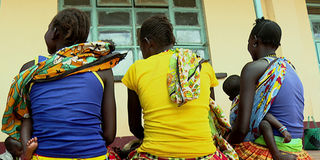
Cheposopon Domokori, Sharon Chepkto, and Chepasanjo Olpatar have a discussion at Masol Dispensary on November 11, 2026.

What you need to know:
- Children in Pokot Central are battling against severe acute malnutrition as families struggle to afford nutritious food, with some surviving on one meal a day.
- Reduced international funding has triggered shortages of life-saving therapeutic foods, threatening efforts to rescue severely malnourished children in remote communities.
From the scorching plains of Pokot Central in the quiet corridors of Masol Dispensary, the quiet devastation of hunger is etched into fragile bodies. The human cost of hunger is written across these tiny, fragile bodies. Thin, bloated bellies press against stretched, pale, and dry skin, while protruding ribs rise and fall with shallow, exhausted breaths.
For countless families here, morning begins not with nourishment but with uncertainty. When flour happens to be available, a pot of gruel is boiled; when it is not, they scavenge whatever scraps they can get, and on too many days, they simply go without food.
Inside the consultation room, a 13-month-old son of Chepasonjo Olpatar rests limply in his mother’s arms. His small frame is painfully thin, his belly distended, and his hair has thinned into a brittle, brownish-rust hue, classic clinical signs of severe undernutrition.
When he cries, no sound projects from his throat; it is a silent, exhausted whimper. Beside him, his mother, weighed down by relentless hardship, bears prematurely greying hair and the gaunt, weathered frame of a woman fighting her own battle with starvation.
In Chepatao village, 23-year-old Sharon Chepkto sits quietly as her eight-month-pregnant belly rests heavily against her frail frame. Already, Sharon, a mother of three, is carrying her fourth child on an empty stomach. By 3pm, as Healthy Nation meets her, she has not eaten a single morsel of food, surviving on grit alone as hunger gnaws at her strength.
For her young children, the day’s only sustenance has been a pot of gruel, following a light supper of ugali and milk the night before.
Cradled against Sharon’s chest is her youngest child, a 19-month-old toddler whose fragile body tells a heartbreaking story of starvation. Weighing just 6.8 kilogrammes, the child carries the stunted frame of a five-month-old infant, with dry, pale skin stretched over delicate bones.
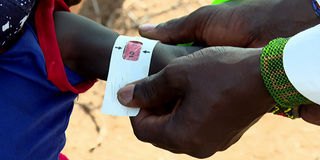
A nutritionist at Masol Dispensary screens a child.
A mid-upper-arm circumference reading of 11.8 centimetres and a weight-for-height score of minus three standard deviations place the toddler in the grip of acute malnutrition. Sharon’s reality is shaped by a cycle of poverty, early marriage, and deprivation that began long before this pregnancy. At just 17 years old, she was married off to an elderly man so that her father could collect reverse dowry.
Having never stepped foot in a classroom, Sharon has never been taught the basics of a balanced diet or the vital role of nutrients in a growing child’s body. In her household, meals consist almost entirely of plain carbohydrates, and meat has been tasted only on countable occasions since she became a wife.
Her 19-month-old toddler has never been fed on protein, leaving the child’s developing immune system and organs starved of the building blocks needed to thrive.
As Sharon prepares to bring a fourth life into the world, her own body is depleted by rapid, unspaced pregnancies and chronic hunger. With one meal a day as the norm and an empty stomach pushing her towards childbirth, she and her children embody the quiet, relentless toll of generational poverty, where a young mother’s lack of education, early marriage, and empty cooking pots threaten two generations at once.
For frontline health workers, these heartbreaking scenes have become a daily reality. At Masol Dispensary, nutritionist Reuben Kisang Kang'ole wraps a colour-coded mid-upper arm circumference tape around a toddler’s tiny arm.
The reading lands at 10.4cm, plunging the toddler straight into the red zone, a direct threat to survival, while his weight-for-height assessment falls below minus three standard deviations, confirming severe acute malnutrition.
“A healthy child of his age should measure above 12.5cm in the green zone, while readings between 10.5 and 12.5cm in the yellow or orange zones signal moderate risk,” Reuben says.
Every Wednesday at Masol Dispensary, mothers gather for malnutrition screening. According to Diana Cherotich, a nurse at the facility, the clinic sees an average of 50 to 60 pregnant women a month, and childhood malnutrition is pervasive.
“Most of the children in this facility are malnourished,” Diana says, noting that in a single month, the dispensary recorded 18 malnourished children, placing both severe and moderate cases on therapeutic supplements based on their weight.
“Families rely almost exclusively on a single-food diet of ugali (maize meal) and cow’s milk. Because livestock is the primary asset, families often have to sell goats just to buy maize flour. Worse, Reuben notes that consuming milk alongside ugali hinders iron absorption, compounding micronutrient deficiencies."
Surge in hospital admissions
Angela Kiprop, a senior nutritionist officer with the International Rescue Committee, explains that this daily reliance on empty calories fuels the upward trend in hospital admissions. “They eat the same food every day, but the food has zero nutritional value,” Angela says. “This is why the numbers are not looking any better.”
As hunger strips away the body’s essential vitamins, minerals, and energy reserves, the physiological toll becomes catastrophic. According to the World Health Organization, malnutrition occurs when the body lacks the basic nutrients needed to grow and maintain vital organ function.
Reuben warns that when children do not eat enough, rapid weight loss compromises their developing immune systems, leaving them defenseless against common infections. “Left untreated, starvation forces the body to consume its own stores of carbohydrates, fats, and proteins. Dry, pale skin erupts in rashes, bones grow tender, gums bleed, and thin, brittle hair pulls out at the slightest touch,” Angela says.
“Severe malnutrition can kill,” she says, noting that prolonged deprivation eventually causes vital organs, including the heart and the brain, to struggle and fail.
In West Pokot, this wasting operates in a lethal cycle with infectious diseases; severely malnourished children succumb easily to malaria, pneumonia, and diarrhoeal diseases, while repeated bouts of untreated fever and diarrhoea rapidly push moderately malnourished children into fatal wasting.
In Masol, women carry the entire economic burden as sole breadwinners, herding livestock and labouring at artisanal gold mining sites while men offer little support.
“Forced to migrate for pasture or work in the mines, mothers frequently abandon exclusive breastfeeding well before their babies reach six months of age, introducing solid foods too early and leaving infants vulnerable to illness,” Reuben says, adding that rapid, unspaced pregnancies deplete maternal health, with mothers often conceiving again before their previous baby reaches nine months old.
Behind the malnutrition statistics lies a profound reproductive health crisis. According to the 2025–26 Kenya Mini Demographic and Health Survey (KMDHS), teenage pregnancy in West Pokot has dropped by more than 10 percentage points since 2022, falling from 36 per cent to 24.5 per cent. Yet, even with this progress, West Pokot still records the highest teenage pregnancy rate in Kenya, more than double the national average of 11.9 per cent.
At Masol Dispensary, Diana sees this reality firsthand: Out of 52 pregnant women who attended the antenatal clinic in a single month, 19 were teenagers, roughly 20 teenage pregnancies every month.
Dr Solomon Kokwo, the West Pokot County Director for Health, welcomed the 10-point decline, noting that four out of every 10 pregnant women used to be teenagers. He attributed the drop to strict enforcement of the Children's Act by the Children's Department and National Government Administration Officers, alongside the government’s return-to-school policy for adolescent mothers.
However, Dr Kokwo warns that entrenched cultural norms, including female genital mutilation, early child marriage, and dowry practices, continue to trap young girls. “Early marriage compounds the problem. Once they get married while they’re still teenagers, all that the man wants to see are children. Dowry plays a role as well. The community pays a hefty dowry because somebody wants to see children. A large number of children also tie the girls down, and they are unable to leave the marriage.”
The 2025–26 KMDHS paints a sobering statistical portrait of the structural deprivation in West Pokot that drives both malnutrition and childhood disease. Across Kenya, the 2025–26 KMDHS reports an under-five mortality rate of 37 deaths per 1,000 live births, an infant mortality rate of 30, and a neonatal mortality rate of 19.
While national basic antigen vaccination coverage among children aged 12–23 months stands at roughly 80 per centdmuga (with 89.9 per cent receiving the 3rd dose of DPT-HepB-Hib and 72 per cent of children aged 24–35 months receiving two doses of the Measles-Rubella vaccine), pastoralist and hard-to-reach counties like West Pokot face persistent threats from seasonal migration, low maternal antenatal attendance, and high rates of home deliveries.
Recognising that clinical treatment alone cannot defeat malnutrition or teenage motherhood, West Pokot health officials are shifting toward multisectoral coordination. Dr Kokwo notes that the county is partnering with organisations such as World Vision to establish a dedicated technical working group.
“We sit with the Pokot Council of Elders so that they can go talk to the people. We involve the NGAO, the prosecutors, the police officers, and the security departments in a more structured way,” Dr Kokwo says.
For Reuben, every weekly clinic remains a race against time, measuring tiny arms, distributing sachets of ready-to-use therapeutic foods (Rutf), and counselling exhausted mothers on how to stretch scarce resources to keep children alive. Even as health workers battle these complex realities on the ground, the supplies needed to pull children back from the brink of death are running dangerously low.
For over a year, reduced international funding has triggered a severe shortage of Rutf such as Plumpy’nut, the fortified, peanut-based paste packed with proteins and vitamins that often marks the difference between life and death.
Following Kenya’s reclassification from a low-income to a lower-middle-income country in 2014, international donors withdrew significant support under the assumption that the government could procure essential medicines through the Kenya Medical Supplies Authority.
Although Unicef remains the world’s largest buyer of therapeutic food, procuring 80 per cent of global emergency supplies and providing facilities in Kenya with six-week treatment courses, supplies on the ground remain painfully stretched.