When nature calls, Bomet Stadium users have nowhere to go

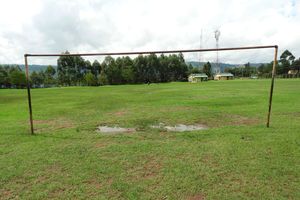
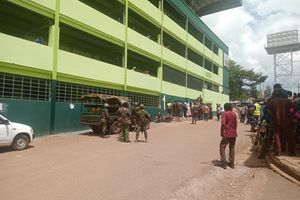
Vandalised toilets at Bomet Green Stadium on November 10, 2027.Stadium users are forced to relieve themselves in nearby open spaces.

On a breezy Wednesday afternoon, James Bett is among hundreds of spectators watching a Bomet APs Football Club training session at Bomet Green Stadium. Halfway through the game, he rushes to the fence between the stadium and the Kenya Industrial Estates (KIE), where he finds other men lined up, using it as a makeshift urinal.
Alice Kitur, another football fan, has the same problem, but as a woman, she has to walk 200 metres to a hotel to use its toilet.
On Sunday afternoons, Irene Chelangat, a mother of three, takes her children to the recreational corner at the stadium. When she needs the toilet, she leaves them in the care of another parent and hurries to a nearby hotel. There, she queues for the pit latrines.
This is the predicament of Bomet residents who use the stadium, a recreational facility at the heart of the township, which is also the county headquarters.
The stadium has four toilet blocks, three for the public and a VIP one behind the main dais. All are clogged and have no running water. They have also been vandalised: doors are broken, pipes ripped off, and the handwashing sinks and cisterns are missing.
The facilities were built in 2014 during former Governor Isaac Ruto’s tenure, when the stadium underwent its first major upgrade in decades. The upgrade also brought a security fence, two gates and a dais. The toilets have since been abandoned by the current county administration.
For more than 10 years, the toilets have not been used because there is no water supply. This is despite the Bomet Water and Sanitation Company headquarters being a few metres away, and its pumping station at Nyangores River a kilometre away. A water tank stands on the block next to the main dais, but it has been without water for several years.
The stadium is surrounded by the County Commissioner’s offices, county police headquarters, county government headquarters, Huduma Centre, Kenya Industrial Estates, Prisons Department, Administration Police residential estate, Imarisha Sacco and several businesses. It has hosted former President Uhuru Kenyatta, President William Ruto, governors, Cabinet secretaries, principal secretaries and other top government officials. It also hosts political rallies, music festivals and sports competitions.
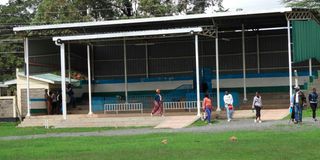
The main stand at Bomet Green Stadium in this photo taken on April 1, 2023.
It has a children’s playground and is a training ground for volleyball and football teams. Residents also use it for exercise. On weekends and public holidays, hundreds of children spend their days there. Couples often seek out quiet corners of the stadium, while other users nap, wait for appointments in nearby offices, or simply pass the time.
Yet the authorities seem unbothered by the public health crisis before them.
Mr Benson Sigei, a public health expert, says relieving oneself in public is against the law and puts the public at risk of waterborne diseases.
“Diseases like typhoid, bilharzia and cholera are passed through open defecation, with the waste washed downstream, putting people at risk,” he explains. Worms can also be spread through public urination and defecation, he adds.
Mr Saitoti Ngetich, a resident, says the county should take action.
“This is a public health crisis that the county government should address as a matter of priority. We cannot be using open spaces to relieve ourselves right at the town centre and next to the county headquarters. This is a shame,” he says. “Instead of having the facilities idle and vandalised, why can’t the county government charge a fee if that will help sort out the public health mess?”
Whenever major events are held at the stadium, organisers put up tents but do not provide mobile toilets. The five mobile toilets bought in 2015 have fallen into disuse. Mr Joseph Sanga, another resident, says none were provided during the recent Customer Care Week, which brought together stakeholders and officers from the county’s five sub-counties, or when more than 200 community-based organisations held an event at the stadium.
“You can imagine the situation when the stadium is packed for a political rally, music festival, exhibition, religious gathering or sporting event. Participants have nowhere to relieve themselves, and even the hotels become overwhelmed,” he says.
The problem was also evident during the recent 15th Mara Day celebrations. Although a few mobile toilets were provided for the week-long event, delegates from Kenya and Tanzania still had to rely on hotels and bars, at a time when the town was experiencing water shortages.
Ms Beatrice Chebet, a trader, says even dignitaries have to leave the stadium for hotels when large crowds gather. Most people who know about the situation, she says, use the toilet before heading to the stadium.
“Bomet University alone has 12,106 students. You can imagine the public health challenges if they gather at the stadium for an event. This is a ticking time bomb that needs to be addressed with the seriousness it deserves,” she says.
She adds that people with disabilities bear the brunt of the problem, as the facilities outside the stadium are not designed to meet their needs.
Mr Leonard Langat, chairperson of the local chapter of the Kenya National Chamber of Commerce and Industry, says the business community is ready to help the county government address the problem.
“This is a business opportunity that the county should open up to local entrepreneurs. They can manage the facilities and ensure they operate 24 hours a day, seven days a week,” he says.
Dr Joseph Sitonik, the county executive committee member for health, said the county government is in the process of handing over the toilets to a group of people with disabilities to manage and charge a fee.
Mr Davis Langat, manager of the Bomet Municipal Board, said the county government is at an advanced stage of transferring the management of the facilities to private operators.
“We want the facilities to be managed independently so that they create jobs and serve the public effectively. This is a service that should be outsourced because the government is not in the business of doing business,” he said.
Follow our WhatsApp channel for breaking news updates and more stories like this.