Ruto reveals diplomatic push that saw Sudan lift ban on Kenyan tea imports
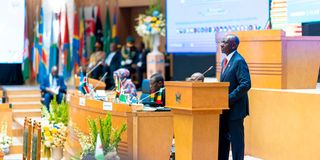
President William Ruto addresses the Summit, he 25th Comesa Summit of Heads of State and Government in Harare, Zimbabwe on October 22, 026.

What you need to know:
- Apart from President Ruto, Kenyan officials involved in brokering the deal included Prime Cabinet Secretary and Foreign Affairs Cabinet Secretary Musalia Mudavadi and National Intelligence Service (NIS) Director-General Noordin Haji.
President William Ruto has revealed diplomatic engagements that saw Sudan formally lift its ban on Kenyan tea imports after 20 months of restrictions.
Details show that the decision came after a series of diplomatic meetings that took place in Nairobi, Harare and Khartoum. The meetings involved top government officials, including President Ruto and Sudan’s Prime Minister, Professor Kamil Idris.
Dr Ruto on Wednesday disclosed how his engagement with Prof Idris on the sidelines of the Common Market for Eastern and Southern Africa (Comesa) Heads of State and Government Summit in Harare, Zimbabwe brokered the deal.


Dr Ruto was in Zimbabwe on October 22 for the handover of Comesa chairmanship to Zimbabwean President Emmerson Mnangagwa.
“I am pleased that Sudan has lifted its ban on Kenyan tea imports, ending a restriction that had been in place for 20 months,” said President Ruto.
“Kenya welcomes and appreciates this decision, which reopens an important market for our tea, restores opportunities for our exporters and supports the livelihoods of our farmers and their families,” he added.
He said the decision "demonstrates what dialogue and constructive diplomacy can achieve." He said the two countries are looking forward to strengthening their bilateral relations, with an aim of ‘expanding trade and working together for peace, stability and shared prosperity in our region.’
The Nation has established that the ban was lifted following high-stakes diplomatic overtures that ran for months.
Apart from Dr Ruto, other Kenyan officials involved in brokering the deal include Prime Cabinet Secretary and Foreign Affairs Cabinet Secretary Musalia Mudavadi and the Director-General of the National Intelligence Service (NIS) Noordin Haji.
The two held meetings with top Sudanese government officials both in Nairobi and Khartoum.
A Kenyan delegation led by Mr Mudavadi first travelled to Sudan for an initial engagement in Khartoum that paved the way for a subsequent meeting that was held in Nairobi.
Sudanese Minister of Foreign Affairs and International Cooperation, Ambassador Mohi-Eddin Salem Ahmed Ibrahim and Mr Mudavadi later held another meeting in Nairobi.
The two teams met President Ruto at State House in Nairobi.
Another meeting between Mr Noordin and Sudan’s Head of State, General Abdel Fattah al-Burhan was held in Khartoum.
The decision is a major boost to Kenya’s tea industry that has suffered losses running into billions of shillings following the ban imposed on March 11, 2025.
Before the ban, Sudan had bought about Sh18 billion in Kenyan tea, making it among the top 10 markets for Kenyan tea. Apart from tea, Kenya also exports food items and pharmaceutical products.
In a November 8, 2026 communication by Sudan Minister of Industry and Trade Mahasin Ali Yaqoub, the country said the lift took effect immediately.
“Based on Transitional Cabinet Resolution No. 170 of 2025 concerning the Transitional Executive Body (its objectives, functions, powers, and units), and after reviewing Transitional Cabinet Resolution No. 80 of 2025 dated 10.07.2025 regarding the appointment of ministers, and based on the Sovereignty Council's letter No. //11.26 dated 02.11.2026 approving the lifting of the ban on tea imports from Kenya, and Cabinet letter No. / / 3/43/6 dated 05.11.2026 regarding the same matter…,” announced the minister.
“This decision shall be called "Minister of Industry and Trade Decision No. (25) of 2026 lifting the ban on tea imports from Kenya" and shall come into effect from the date of its signing.”
The Sudanese government banned all imports in March last year in protest after the paramilitary Rapid Support Forces (RFS), who are fighting the army in a two-year war, were hosted in Nairobi.
When the ban was imposed, the government said it was doing so to preserve the country’s sovereignty and ‘protect its national security.’ The Sudanese government had described Kenya’s hosting of RSF as an act of hostility against its people.
Follow our WhatsApp channel for breaking news updates and more stories like this.