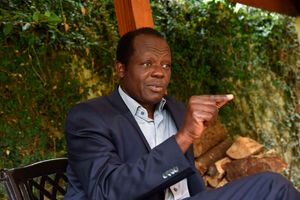
Makadara MP George Aladwa Omwera has failed to stop an Ethics and Anti-Corruption Commission case seeking to recover disputed Nairobi land after the Environment and Land Court rejected an attempt to have the suit thrown out.
Justice Mohammed Kullow dismissed objections by Aladwa, Julgem Communications Services Limited, Mary M’Mboga Aladwa, Jason Omwera Aladwa and Joram Muhoro Aladwa, ruling that their arguments did not provide grounds to terminate the case before a full hearing.
Bunge Sacco Society Limited in also mentioned as a defendant in the case where Aladwa is the third accused, according to the ruling.
In their preliminary objection, they argued that EACC had no authority to institute the proceedings, that its lawyer was not properly authorised to represent it and that the claim had been filed outside the time allowed by law.
Integrity Centre in Nairobi which houses the Ethics and Anti Corruption Commission offices.
Photo credit: Pool I Nation Media Group
They also accused the commission of targeting subsequent owners without first establishing the circumstances under which the property was initially transferred.
But Justice Kullow said these arguments raised factual questions that could only be resolved after examining evidence.
“The Court would, in the present case, have to interrogate the circumstances under which the suit property changed hands, the investigations undertaken by the Plaintiff and the respective roles of the parties before it could determine whether the suit is vexatious or an abuse of the court process,” he said.
The judge added that such matters could not be determined through a preliminary objection, which should be based on a clear point of law rather than disputed facts.
On the question of EACC's lawyer, the defendants argued that he had not produced written authority or evidence that he had been gazetted by the Attorney-General to institute the proceedings.
The commission countered that its lawyer was qualified under Section 9 of the Advocates Act and produced a current practising certificate.
Justice Kullow agreed, saying the law requires an advocate to have been admitted to the profession, have their name entered on the Roll of Advocates and hold a valid practising certificate.
“Section 10(d) cannot, in my view, be read as imposing an additional qualification upon an advocate who already satisfies the requirements of section 9 of the Advocates Act,” he ruled.
The defendants also claimed EACC had taken over the mandate of the National Land Commission, which is constitutionally responsible for managing public land.
However, the judge said EACC has a separate statutory responsibility to pursue the recovery and protection of public property.
“Whether the Plaintiff will ultimately establish that the suit property constitutes public property unlawfully acquired is a matter to be determined on the evidence at trial,” Justice Kullow said.
The five further argued that the case was time-barred because the property had been held by one of the defendants for more than 12 years.
EACC said the claim involved allegations of fraud and unlawful acquisition, arguing that the time limit could only start running when the alleged fraud was discovered or could reasonably have been detected.
The judge said determining when the alleged wrongdoing was discovered would require evidence. He also noted that the law excludes certain cases involving the recovery or protection of public property from ordinary limitation periods.
“I therefore find that the fourth ground of the Preliminary Objection has not been established,” he said.
In dismissing the objection dated November 26, 2025, Justice Kullow concluded that Aladwa and co-defendants had not established a basis for stopping the case at this stage.
The ruling does not determine that Aladwa or the other defendants committed corruption. Those questions will be decided when the substantive case is heard.