Why civil servants and teachers don’t want SHA
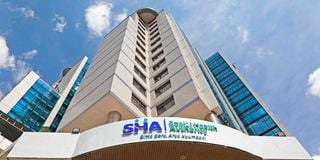
The Social Health Authority building in Nairobi.

The call came while he was at his desk. His eight-year-old son had broken his arm at school.
He rushed to the nearest hospital, pausing only at reception to ask one question: did the facility accept the Social Health Authority (SHA)? He was told it did. Reassured, he let the doctors attend to his son, who was in pain and visibly shaken, and waited.
It was only after the cast had been applied that the situation changed.
He was informed that the hospital’s SHA contract covered inpatient services only — not outpatient care, including the treatment his son had just received.
The bill came to Sh3,850.
When he said he could not raise the amount immediately, security was called. He and his son were held at the facility until 9pm as he frantically tried to find someone who could lend him the money. Eventually, he secured a loan and settled the bill. Only then were they allowed to leave.
The case is one of more than 100 that have been reported to Lawrence Nyaguti, Secretary-General of the Union of Kenya Civil Servants, since the Social Health Authority (SHA) took over from the now-defunct National Hospital Insurance Fund (NHIF).
“Between last week and Monday, more than 100 civil servants have been detained in hospitals,” Mr Nyaguti told Nation, adding that the cases cut across all cadres — including county commissioners, regional commissioners, clerical officers, chiefs and National Registration Bureau staff.
When President William Ruto launched SHA in 2024, he described it as a cornerstone of Kenya’s push towards Universal Health Coverage.
Two years on, that promise is under strain, with unions threatening strikes, legal action and even withdrawal from a system that was meant to transform access to care.
For civil servants, the frustration runs particularly deep, with many arguing that the previous system — though imperfect — was predictable and functional.
Samson*, a regional commissioner who requested anonymity, traces the problems to what he describes as the dismantling of a stable arrangement.
Social Health Authority signage at Mutuini Hospital in Dagoretti South Sub-County, Nairobi, on August 27, 2025.
Before NHIF-backed comprehensive cover, he says, civil servants relied on treatment in public hospitals, supplemented by the Public Service Commission’s “excess of loss” — or ex gratia — fund, accessed through human resource departments. They also received monthly medical allowances to cater for outpatient services.
When the National Hospital Insurance Fund was introduced, the Public Service Commission scrapped the monthly medical allowance and procured comprehensive cover for civil servants. Benefits were tiered by job group, with up to Sh50,000 for dental and optical care, annual inpatient cover ranging between Sh2.5 million and Sh2.8 million, and outpatient limits of between Sh250,000 and Sh300,000.
With the rollout of the Social Health Authority, civil servants were automatically transitioned to the new system. Their contributions — including funds previously allocated under the medical allowance — were channelled to SHA alongside a mandatory 2.75 per cent salary deduction.
What many did not anticipate, however, was the introduction of strict outpatient caps: Sh1,200 at Level One facilities and between Sh2,500 and Sh4,000 at Levels Two to Six.
“It has disenfranchised a large number of us,” Samson says.
“If you are given a maximum spending limit, it changes everything. It is like they are discarding our scheme and treating us like any other contributor. We are effectively making double contributions for reduced benefits.”
For patients with chronic conditions, the changes have disrupted even routine care.
“I have a condition and take drugs that cost about Sh4,000 a month,” he says. “I used to collect a month’s supply in one visit. That changed with the capping. Now I have to go to hospital three or four times a month to get enough medication, or top up with cash if I want to avoid the repeated visits.”
The civil servant attached to the Inspector General’s office — who was earlier detained with his son over an unpaid bill — has since faced another distressing experience.
Recently, the same child fainted while playing and was rushed to hospital by friends. Doctors recommended scans costing Sh2,000 before treatment could proceed. Although the facility displayed signage indicating it accepted SHA, he was later informed that its contract covered maternity services only.
“In that moment, standing in a hospital with my child needing urgent care, I felt the same helplessness all over again,” he says.
“Once again, I had to borrow money — this time from a microfinance service — just to ensure my child received care. Taking a loan in the middle of a medical emergency, when you are supposed to have insurance, is a burden I would not wish on anyone.”
He describes SHA coverage as inconsistent and opaque, with limits that are “often only revealed when you are most vulnerable”.
“As a parent, you go to the nearest hospital trusting the system will support you,” he says.
“But instead, you are met with confusion, unexpected costs and, in my case, even detention. What we need is clear information on which hospitals truly offer comprehensive SHA coverage and what that coverage includes. Right now, in moments when every second counts, that uncertainty is costing us far too much.”
Mr Nyaguti confirmed that the union has been forced to fundraise to help civil servants settle hospital bills. In one case, a regional commissioner was nearly detained over a Sh1,500 claim. In the most severe incident handled by the union, a parent and child were held overnight; the child developed complications due to poor conditions in the facility and required further treatment, with the union stepping in to help clear the additional costs.
He also cited the case of a woman who requires an injection every 24 hours.
“She went to hospital, received the injection, and after 24 hours was told she had exhausted her daily cap and could not be treated,” the union official said. “She called crying, saying that if she did not get the injection, she would die. We had to contribute.”
Teachers are facing similar challenges. Muguwe Macharia, Secretary of the Nairobi branch of the Kenya National Union of Teachers, said SHA has left teachers worse off compared to the previous Minet scheme. He added that the union is considering a strike and possible withdrawal from the provider, citing inadequate capitation, the removal of pre-authorisation and unexplained deductions.
“For level one and two hospitals, teachers are given Sh1,200 per outpatient visit, which is meant to last a week. If you need more, you are forced to top up from your own pocket,” Mr Macharia said.
“The previous Minet scheme allowed pre-authorisation of treatment beyond capitation. You were guaranteed coverage if you followed the process. That mechanism no longer exists.”
At level three and four hospitals, capitation stands at Sh2,500, yet consultation fees alone average Sh2,000, leaving about Sh500 for medication. At levels five and six, capitation is Sh4,000, with consultation costs taking up most of the amount and leaving roughly Sh1,000 for drugs. Procedures are also inadequately covered: an endoscopy can cost up to Sh19,000, but the scheme provides only Sh4,000, forcing patients to meet the balance.
Teachers living with high blood pressure and other chronic conditions say they are now rationed to a week’s supply of medication at a time, meaning they may receive barely half of their required dosage over a month. In optical care, a teacher who purchases spectacles within the Sh40,000 annual limit but later breaks them cannot secure a replacement until the following year — even where funds remain. The balance, they are told, is reserved for dependants.
“I have a teacher who stayed in hospital for two weeks without SHA confirming payment,” says Muguwe Macharia. “Previously, under Minet, verification was straightforward and bills were cleared promptly. Now, teachers are at the mercy of hospitals.”
There are also growing concerns over unexplained utilisation of benefits. “Some teachers have never sought optical or dental services, yet their records show funds have been used,” Mr Macharia says. “I have evidence and screenshots to support this. The question is, who used it?”
He further alleges that fictitious next-of-kin have been assigned to some teachers’ accounts, with SHA reportedly calling these individuals to confirm admissions — names that account holders say they do not recognise.
“It is highly suspicious. We have evidence of this,” he adds.
On inpatient cover, Mr Macharia says the restrictions go further than many teachers realise.
“I may be entitled to Sh1 million, but once admitted, coverage is capped by diagnosis,” he explains. “A condition may be limited to Sh600,000. Once that ceiling is reached, the system treats the benefit as exhausted, even when the overall allocation still shows a balance.”
Under the NHIF arrangement with Minet, the Teachers Service Commission, as the principal member, would settle excess bills after verification. Under SHA, that buffer has effectively been removed, leaving teachers exposed to additional costs.
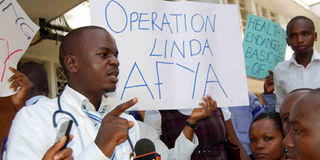
National Chair of the Kenya Medical Practitioners, Pharmacists and Dentists Union Abidan Mwachi,
Doctors have also weighed in. Abidan Mwachi, National Chair of the Kenya Medical Practitioners, Pharmacists and Dentists Union, has criticised the capping of daily outpatient limits, describing it as a policy failure that contradicts the stated aim of reducing out-of-pocket spending during the transition from NHIF.
“Doctors are affected in two ways,” he says. “Hospital owners are complaining of delayed payments, yet doctors are the ones delivering services in those facilities. When owners are not paid, doctors are not paid either. At the same time, doctors are also patients — and parents — navigating the same system when they or their children fall ill.”
Deductions from doctors’ payslips have risen to as much as Sh10,000 per month, up from about Sh1,200 to Sh1,700 previously, combining the standard 2.75 per cent contribution with additional payments to the Public Officers Medical Scheme Fund.
Although total outpatient cover is set at about Sh250,000 annually, the amount accessible per visit is capped at Sh4,000. For an employee contributing Sh10,000 a month — Sh120,000 a year — the practical benefit often reduces to a single Sh4,000 allocation per visit, barely sufficient to cover consultation.
“This is not comprehensive medical cover; it is, at best, a consultation grant,” says Abidan Mwachi. “Once additional services such as laboratory tests, pharmacy charges or imaging are required, patients must pay out of pocket. How does capping outpatient costs at Sh1,200 to Sh4,000 reduce out-of-pocket spending? On the contrary, it undermines the principle of universal health coverage.”
Dr Mwachi also points to a recurring disruption on the ninth of every month, when services become inaccessible because SHA indicates that contributions have not been remitted by county governments.
Salary delays can extend to two months, but once payments are processed, SHA receives the full arrears.
“The responsibility for remittance lies with county governments, but when pressed, SHA officials attribute the problem to the Digital Highway Authority, describing it as a system beyond their control,” he says. “This system can enforce impromptu decisions such as capping, yet it cannot resolve the monthly disruption on the ninth.”
He adds that the issue will be tabled at the union’s annual delegates’ conference on May 9, warning that failure to resolve it could see doctors join teachers in protest.
For rank-and-file officers in the National Police Service, the transition to SHA has proved equally bruising.
Previously, officers were covered under Medical Administrators Kenya Limited (MAKL), a private digital third-party administrator established in 2018 to manage medical schemes for the National Police Service, Kenya Prisons Service and the Teachers Service Commission.
MAKL did not underwrite insurance but handled administration — managing a network of more than 800 healthcare providers, operating a 24-hour call centre, and linking insurers such as APA Insurance and CIC to health facilities to streamline claims, member registration and pre-authorisations.
Its role for police and prison services ended on March 31, 2026, following the shift to the Usalama Cover under SHA’s Public Officers Medical Scheme Fund.
The transition was part of a broader government plan to centralise public officers’ medical schemes under a unified framework for universal health coverage, while addressing longstanding delays in hospital payments that had led some facilities to reject MAKL-managed schemes.
In practice, however, officers say the new system is failing at critical points of care.
“When you go to hospital, you are told you can only spend Sh1,200. Consultation is Sh1,000, leaving Sh200 — which cannot get you treatment,” says one officer, who requested anonymity for fear of victimisation.
Official acknowledgement of the problem has been slow. Police spokesperson Michael Muchiri described the concerns as typical teething challenges associated with a new system.
“I have not heard of such complaints from police officers. This is news,” he says. “With any new scheme, there are bound to be teething problems. I would not want to comment conclusively on the complaints.”
Follow our WhatsApp channel for breaking news updates and more stories like this.