Why thousands of Kenyan children are still missing lifesaving vaccines
Lucy Kihiu, a nurse at Kabatini Health Centre in Nakuru, cheers up a child before she attends to her on May 26, 2026.

What you need to know:
- A total of 400 healthcare facilities, including private and faith‑based hospitals, offer free vaccination services to children in Nakuru.
- Yet, the county is still off the mark when it comes to the percentage of fully immunised children.
At 46, Beatrice Wangari has had 11 pregnancies. She has never attended antenatal or postnatal clinics. She lives in Kabatini, just 22 kilometers from Nakuru town in Bahati Sub-county. Her home is only two kilometres from Kabatini Health Centre, but her faith prohibits her from seeking medical services.
Wangari belongs to an indigenous religious sect known as Kanitha wa Ngai: "Church of God" in Gikuyu. All her children have been born at home and have never received any vaccines. That changed last October, when one of her children, aged four, died at home after falling ill. When Wangari and her husband tried to bury the body in their homestead, the community revolted. This prompted Nakuru County Department of Health officials alongside the local administration to raid Wangari's home.
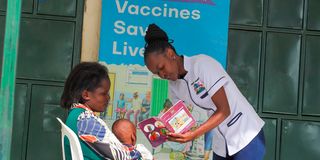
Beatrice Wambui is sensitised on how to take good care of her baby by Lucy Kihiu, a nurse at Kabatini Health Centre in Nakuru on May 26, 2026.
They found her two-year-old daughter, who was also gravely ill. She was diagnosed with pneumonia upon admission to Bahati Sub-county Hospital. They also found Wangari with a two-month-old child who had never been vaccinated.
"We faced a lot of resistance from Wangari and her husband when we wanted to vaccinate the newborn child. We even had police with us because she had opposed the transfer of her ailing child to hospital on grounds that it went against her faith," said Joyce Ejoi, the Bahati Sub-county Expanded Program on Immunisation logistician.
When the Healthy Nation team visited Wangari at home in the company of Ejoi, she was still suspicious of the visit. She still holds the belief that medicine of any kind is a vice that should be shunned. Wangari was measured with her words, always crediting God for the life and health of her other children, the oldest being 17 years old.
"We were able to confirm that her daughters above the age of 10 got the first dose of the HPV vaccine during the mass immunisation campaigns done at school, but they do not have any prior history of vaccination," said Ejoi.
Wangari has also lost a child during birth in previous years due to complications, something that could have been averted had she sought medical attention upon learning she was pregnant.
According to the Nakuru County Department of Health, in 2025 the county recorded a measles outbreak in Bahati and in Njoro along the border with Narok County, indicators that those regions have yet to achieve the World Health Organization (WHO)-recommended standard of 95 per cent fully immunised children under the age of one.
"The pockets of the county showing immunisation gaps are in Bahati Sub-county, where Pentavalent 1 vaccination coverage is at 70 per cent, and Pentavalent 3 coverage is at 74 per cent. These figures tell us there is a substantial number of children who are zero‑dosed or under‑vaccinated," said Wendy Tirop, the county Immunisation coordinator.
A total of 400 healthcare facilities, including private and faith‑based hospitals, offer free vaccination services to children in Nakuru. Yet the county is still off the mark when it comes to the percentage of fully immunised children.
"We had a measles outbreak last year. We had one confirmed case in Bahati and Njoro, and we realised the cases were coming from Narok North, where we do not have a functional facility. So children with measles were crossing over into Njoro from Narok," said Tirop.
Immunisation indicators in Nakuru are measured by the uptake of the Pentavalent 1 vaccine, given to children at six weeks of age. This helps the county determine how well the population can access vaccination services. That figure currently stands at 86 per cent. At 14 weeks, when children come in for the Pentavalent 3 vaccine, the collected data shows vaccine utilisation in the county. In Nakuru, that figure is 82 per cent. The Measles‑Rubella 1 vaccine, given at nine months, shows the county's overall immunisation coverage.
"The number of fully immunised children is 84 per cent. We are 11 per cent below the WHO‑recommended target to ensure herd immunity, which means children are well protected in the event of an outbreak," added Tirop.
Other parts of the county where child immunisation is lagging include Kuresoi and Nakuru West Sub-counties. However, the county is activating community health promoters to trace vaccine defaulters and link the children and their mothers with the nearest facility.
"We have a defaulter‑tracing register because we collect the mother's details and document them even at the village level. Our strategies to improve immunisation services include ensuring all facilities provide these services daily from 8am to 5pm, Monday to Friday. For the 24‑hour facilities, we vaccinate children born in the maternity wing before they leave the hospital. We also ensure we have antigens in stock so that we don't turn mothers away when they come for these services."
Other factors contributing to poor vaccine uptake in Nakuru include ignorance about vaccine efficacy, illiteracy, and faith‑based anti‑vaccination messaging. The county is also employing technology, sending SMS alerts to remind mothers to bring their children for scheduled vaccines.
National schedule
While Nakuru County's vaccination data for fully immunised children is above the national average of 80 per cent — according to the 2022 Kenya Demographic Health Survey — only 29 per cent of children aged 12 to 23 months in Turkana County were fully vaccinated under the national schedule. That figure decreases across arid and semi‑arid counties in northern and northeastern Kenya.
At Lodwar County Referral Hospital, we meet Scholastica Nachuchu, three days after a home birth. She is here to have her child immunised. This is her second child, and she understands the importance of vaccination even though she did not give birth in a hospital.
"I have brought my child to get their first vaccine so that she can be protected against diseases," she said.
Scholastica lives in Lodwar Town, and the Lodwar County Referral Hospital is the main facility where she has always sought vaccines for her children. She is not alone.
"Most of the time, we have incidents of clients coming to the hospital when they don't get the antigen in peripheral hospitals. They usually come here, where they can get all the immunisations at once," said Elizabeth Mwangi, a nurse at the Mother and Child Clinic.
The Lodwar County Referral Hospital is the main healthcare facility that hosts the Central Vaccine Cold Room, from which vaccines are distributed to other health facilities across Turkana County's seven sub‑counties: Loima, Kibish, Turkana North, Turkana West, Turkana East, and Turkana Central.
More than half of the population in the county are pastoralists. This means families move from place to place in search of pasture for their flocks. In this context, health facilities such as Kakuma Sub‑county Hospital come in handy in providing access to vaccines. Mothers brave early mornings and the heat, walking for more than two hours to get their children inoculated.
"I have to leave my house at 6am if I am bringing my child for vaccination. I walk for about three hours to get here by 9am. This is my seventh child, and I am happy all my children have been vaccinated," said Sonakitela Ebenyo.
Melvin Atot is another young mother we encounter at Kakuma Sub‑county Hospital. As a first‑time mother, the information she receives during clinic days is being passed on to the women in her village. "I make sure to listen to the doctor when they are giving the health talk. I know how important the vaccines are for my child, and I usually encourage the women back home to make sure their children get vaccinated.”
Turkana is also home to more than 300,000 refugees in Kakuma, and the county sits sandwiched between Ethiopia, South Sudan, and Uganda. The population of Kenya's largest inland mass remains susceptible to outbreaks of diseases such as polio and measles, since the healthcare systems in the neighbouring countries' relevant border regions are lacking. In the wake of the Covid‑19 pandemic, vaccine hesitancy and a lack of consistent supply of doses have seen some children miss out on vital preventive medication.
"Sometimes here at LCRH (Lodwar County Referral Hospital), we do experience vaccine shortages that can last a couple of days. That is a disadvantage, especially to the child, because vaccines are most effective if given on schedule," said Nurse Mwangi. Six years since the Covid‑19 pandemic, Turkana is yet to recover from its impact when it comes to immunisation access, utilisation, and coverage, according to the County Immunisation Coordinator, Daniel Erus.
"Covid‑19 affected our vaccine coverage. We are enhancing our services to reach 90 per cent, which is the requirement from the national government. We keep tracing those who haven't finished their vaccines. We do defaulter tracing. We have done a lot as a county — we have reached 80 per cent," he said.
Under Kenya's Expanded Programme on Immunisation, every child is scheduled to receive 14 vaccines between birth and adolescence. The main ones are the Bacillus Calmette‑Guérin (BCG) vaccine for tuberculosis prevention, Pentavalent 1‑3, Measles‑Rubella (MR), and oral polio vaccines. But in a county so vast and marginalised, many health facilities here do not have electricity, so the fridges where vaccines are stored are powered by the sun.
"We make sure that these solar fridges are working and are well maintained. We monitor the temperatures of the vaccines before they leave the fridge and when they return. In all our depots, we have remote temperature‑monitoring devices, and if there is any danger, an alarm sounds and action will be taken," explained Erus.
The Turkana County Department of Health says that since 2022, it has nearly doubled the number of fully vaccinated children to about 54 per cent. The county also boasts a huge reduction in maternal deaths; from over 1,000 per 100,000 live births in the pre‑devolution era to about 366 today. The Health department attributes this to an increase not only in the number of health care facilities but also in the number of health care professionals.
"Before devolution, we had 74 health facilities, the majority of which belonged to religious institutions. We have built a total of 354 facilities, with 257 of those being vaccination sites. We restock vaccines every six months, and the immunization coverage is 54 per cent," said Agnes Mana, the chief officer for Preventive and Promotive Health in Turkana.
In the last year, a portable solar‑powered fridge known as the Vaccibox has been helping the county reach children in the most interior parts of Turkana.
"In the past year, 20 of these Vacciboxes have been distributed across Turkana County in off‑grid facilities to reach nomadic populations. They are solar powered and very helpful in reaching locations that are 50 kilometers from the nearest health facility," she added.
The Vaccibox is a globally recognised innovation by Norah Magero, an engineer who was inspired by her own experience of missing out on vaccinations for her child while living in Makueni County. For Norah, creating the solar portable fridge was born out of necessity. She was unemployed, but her skills were able to transform how human and animal medication that requires cold storage can be accessed by those living in off‑grid areas.
"I wasn't the only mother going through this. It led me to think of a simple solution to help last‑mile medical facilities store medication and transport it. When I understood the cold chain challenges, the solution grew beyond my own problem. It was about blood for transfusion, or insulin — items needed at last‑mile health facilities," she said.
Long distance
Magero said that having worked in counties such as Makueni, Kajiado, Homa Bay, Isiolo and others, what she and her team experienced in Turkana was a different ball game altogether, bringing to the fore the reality of the need for a working ecosystem around health care.
"Turkana is everything all in one. There are long travelling distances, infrastructure gaps, some places are not secure, and there are mothers delivering at home or at a health centre who need blood transfusion. So, now we are able to add a real‑time monitoring device that gives updates on the temperature of the Vacciboxes, prompting fast interventions if there are fluctuations that may compromise the integrity of the vaccines," Norah added.
According to the 2022 Kenya Demographic Health Survey, Mandera has the lowest number of fully vaccinated children, followed by West Pokot, Garissa, Wajir, Marsabit, Turkana and Samburu. As one of the counties that heavily relied on donor support, the closure of USAID programmes in Turkana has seen the county work to adjust to the gaps.
"One hundred per cent of mother and child activities on nutrition and outreach was supported by donors, and the impact will be felt by the indicators going down, but we are integrating most of the services," said Ms. Mana.
In 2024, the World Health Organization and UNICEF reported that more than 130,000 children in Kenya missed out on routine vaccines due to lack of access to immunisation services, disrupted supply chains, conflict, and misinformation about vaccines, issues that county governments say they are working to resolve. Kenya hopes to attain the globally recognised goal of having 100 per cent of children aged 12 months fully vaccinated.