Your neighbour's cows could raise your malaria risk: Study finds
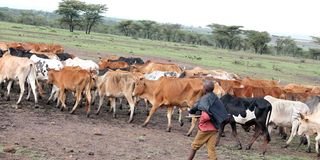
A boy grazing herds of cow in Maasai Mara, Narok County.

What you need to know:
- A groundbreaking study in Kwale County reveals that living within 400 to 600 metres of cattle can more than double a child's malaria risk.
Did you know that you could own no cattle at all and still face a higher risk of malaria simply because someone down the road keeps a herd?
That is the surprising finding of a new study from Kwale County, one that is prompting scientists to rethink a long-standing assumption about the relationship between livestock and malaria.
Researchers from ISGlobal and the Kenya Medical Research Institute (Kemri) set out to determine whether keeping cattle protects people from malaria or actually increases their risk. For years, studies have largely asked a straightforward question: does this household own cattle or not?
This study took a different approach.
Instead of looking only at household ownership, researchers mapped the locations of cattle around each home. For every child tested for malaria, they drew concentric circles of varying sizes around the child's home and counted all the cattle within each radius regardless of who owned them. This meant that a child whose family kept no cattle could still be exposed to animals belonging to neighbours.
The results were striking. Simply owning cattle was not significantly associated with a child's malaria risk. However, when researchers counted cattle across the wider area, the picture changed.
Children living in areas with a higher density of cattle had a 63 per cent higher chance of testing positive for malaria within 400 metres of their homes.
That figure rose to 84 per cent at 500 metres and more than doubled again at 600 metres after accounting for factors including rainfall, temperature, the presence of water bodies, and bed net use. No significant association was found at distances closer than 400 metres.
So, why does the 400–600 metre range matter?
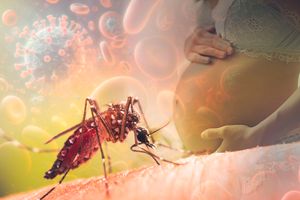
This distance closely matches the documented flight range of malaria-carrying Anopheles mosquitoes in the area. The researchers suggest that cattle may provide mosquitoes with an additional blood source, helping to sustain larger mosquito populations across the landscape. In other words, more cattle could mean more mosquitoes surviving within flying distance of nearby homes, increasing the chances of human–mosquito contact even among families that do not own livestock.
Researchers describe this phenomenon as "zoopotentiation," whereby the presence of animals increases malaria transmission rather than reducing it. This is the opposite of the "zooprophylaxis" theory, which suggests that cattle can act as decoys, drawing mosquitoes away from humans and potentially lowering transmission.
Scientists have debated these two effects for decades. The new study suggests that the answer depends not only on whether a household owns cattle, but also on the number of animals in the surrounding landscape and how close they are to people.
To better understand where cattle actually spend their time, the researchers tracked 70 herds using GPS for approximately two weeks each. Most cattle spent their nights and grazing hours within roughly 100–160 metres of their homes and rarely travelled beyond 600–700 metres, even when moving to water sources.
This gave the researchers greater confidence that the areas used in their analysis reflected actual cattle exposure, rather than theoretical distances alone.
The study drew on data from nearly 6,000 households in Kwale's Ramisi and Pongwe Kikoneni wards. The county has one of the highest malaria burdens on Kenya's coast, and livestock contribute significantly to household livelihoods, meaning that many families live close to cattle, whether or not they own them.
This research was part of the wider BOHEMIA trial, which tested the use of ivermectin in a mass drug administration programme for humans and livestock as a potential tool for reducing malaria transmission.
However, the authors caution against treating the findings as definitive. The study measured malaria prevalence rather than new infections and did not include detailed data on mosquito behaviour. Furthermore, it used data collected before the region's peak transmission season.
Still, the findings highlight a potentially significant gap in malaria control, suggesting that livestock should be considered a shared environmental exposure rather than merely a household-level risk factor.