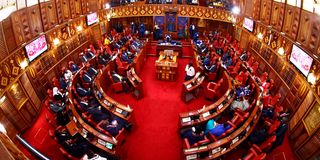
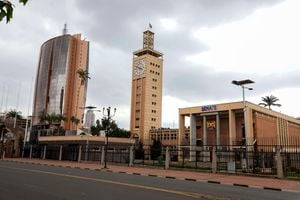
Senators have initiated a fresh bid to expand their legislative mandate, including seeking powers to vet and approve State officers like Cabinet Secretaries and Principal Secretaries.
The Senate, through the Constitution of Kenya (Amendment) Bill, 2025, also seeks to amend the Constitution to provide for the establishment of a County Assembly Fund to empower Members of the County Assembly in their oversight role.
It also seeks to expand the Senate’s role in budget-making, in a proposal that the Senate says would ensure both Houses play an effective role in budget-making.
In a move likely to fuel the existing sibling rivalry with the National Assembly, the Bill proposes to amend Articles 157, 215, 228, 229, 233 and 250 of the Constitution to assign the responsibility of approving or vetting various State officers to both Houses of Parliament.
Vetting and approval of State officers, including CSs, PSs, Ambassadors among others, is currently a preserve of the National Assembly, except for a few instances like the vetting of the Inspector General of Police and Central Bank of Kenya Governor, where they jointly vet with their National Assembly colleagues.
“In line with the proposed amendment to Article 250 of the Constitution, the Bill proposes to amend Article 251 to assign the process of removing from office a member of a commission or of a holder of an independent office to both Houses of Parliament,” the Bill proposes.
The Bill is jointly sponsored by Senate Majority Leader Aaron Cheruiyot and his Minority counterpart, Stewart Madzayo.
“The Bill proposes to provide a framework that would strengthen the existing system of devolution. It aims to do this by aligning the roles and functions of Parliament in a manner that would promote the effective administration of the devolved system of government.”
Further, the Bill proposes to amend Article 173 of the Constitution as a consequential amendment to Article 221 of the Constitution, which requires the approval of the estimates of the Judicial Service Commission by the National Assembly and the Senate.
It also seeks to amend Article 115 of the Constitution to provide for the joint submission of a Bill passed by Parliament by the Speakers of both Houses of Parliament to the President for assent.
The Bill also proposes to amend Article 109 of the Constitution to provide for the origination of any Bill in either House of Parliament, save for a Bill on raising national revenue, which may only originate in the National Assembly.
The Bill further proposes to amend Article 251 to assign the process of removing from office a member of a commission or of a holder of an independent office to the two Houses of Parliament. The mandate is currently a preserve of the National Assembly.
The Senate argues that the Bill, if passed and adopted, would grant both Houses equal power to initiate legislation, either through individual members or committees.
“This would enable the Senate to play a more proactive legislative role and enable it to participate in the consideration of all legislation originating from the National Assembly. By eliminating barriers to introduction of Bills, the Bill supports diversity and improves the legislative mandate of both Houses,” the House argues.
The Senate argues that Article 110(3) has been used to restrict the Senate from participating in numerous legislative processes by contesting the definition of a “Bill concerning counties.”
“This wording has undermined bicameralism leading to frequent legal and institutional battles, including conflicting Supreme Court interpretations on what qualifies as a 'Bill concerning counties' and whether the concurrence process is a condition precedent before introduction of Bills in any House or an optional process,” the Bill notes.