The judiciary has made a lot of progress since the promulgation of the new constitution in 2010, but the perennial complaints of underfunding, case backlog and understaffing persistently nag it.
Two chief justices- Willy Mutunga and David Maraga- retired while still calling for the allocation of more funds to the Judiciary, to enable the courts carry out its mandate and increase access to justice for Kenyans.
The same goes for the current Chief Justice Martha Koome, who has on numerous occasions pleaded with Parliament for the increase of funds.
“For the past three financial years, the Judiciary has consistently received less than 0.92 percent of the National Government Budget—significantly below the recommended 3 percent. This perennial underfunding, especially when compared to the allocations for other co-equal arms of government, has substantially undermined the Judiciary’s efficiency, financial independence, and operational autonomy,” Justice Koome said in her State of the Judiciary Address for the 2023-2024 year.
The report pointed out that from the 2021/22 to 2023/24 financial years, the Judiciary faced a persistent funding shortfall, with gaps of between 47 and 48 percent, each year.
The meagre funding, according to the Judiciary, limits its operations.
“Although the Judiciary made significant progress in enhancing access to justice, reducing case backlog and expanding its infrastructure, it requires adequate funding, staffing and further infrastructural development to sustain and enhance these efforts,” the report stated.
The Treasury allocated the Judiciary Sh22.42 billion in the 2023/24 financial year. The amount increased from Sh18.56 billion in 2021/22 to Sh21.13 billion in 2022/23 financial year and further to Sh22.42 billion in 2023/24 financial year.
In the current financial year, the judiciary was allocated Sh27.8 billion despite requesting for Sh40 billion.
When he came to power, President William Ruto promised to increase the annual Judiciary budget by Sh3 billion, every year to deliver on its mandate.
President William Ruto, Deputy President Rigathi Gachagua, Chief Justice Martha Koome, Deputy Chief Justice Philemona Mwilu, Chief Cabinet Secretary Musalia Mudavadi, Speaker of the National Assembly Moses Wetangula and Attorney General Justin Muturi after the launch of The Judiciary and the Administration of Justice Report for Financial Year 2021/22 at Supreme Court, Nairobi.
Photo credit: Jonah Mwangi | PCS
A huge part of the funding goes to recurrent expenditure while a small fraction is allocated for development, which encompasses new courts stations, renovation and technological infrastructure.
Aside from funding problems, the Judiciary has been operating with a workforce of slightly above 7,000 employees.
According to the Judiciary report, the 7,077 employees translate to 68 percent of the approved establishment of 10,388.
At the moment, it is only the Supreme Court that has the required number of judges. Other courts below are yet to get the required number.
The Court of Appeal, for instance, has 28 judges out of the required number of 70, while the High court has 95 judges yet the required number should be 200.
The Judicial Service Commission (JSC), recently embarked on the recruitment of judges, including the Court of Appeal, High Court as well as judges of the Environment and Land Court and magistrates.
Last year, the process was suspended after the judiciary budget was slashed following protests over the Finance Bill, 2024.
As for the expansion of the court stations, Chief Justice Koome noted that the Judiciary had made important headway in expanding the Judiciary’s footprint across the country.
The CJ stated that the Judiciary’s target is to establish a High Court and courts of equal status (Employment and Labour Relations Court and Environment and Land court) in every county.
Currently, High Court stations have been established in 46 out of 47 counties. The CJ added that during the last financial year, there were 140 Magistrates’ courts operating nationwide.
The latest High Court stations to be established were in Isiolo, Thika, Kibera, Nyandarua and Kwale, raising the number of High Court stations to 46. Nakuru, Kiambu and Laikipia counties have two High Court stations each, while Nairobi has three- in Milimani, Kibera and Makadara law courts.
The judiciary also operationalised 57 mobile courts, reducing the average distance to access these courts to 80 km. Further, a total of 27 Small Claims Courts were established and two tribunals were moved from the Executive to Judiciary.
Despite the setback in funding, Justice Koome noted that courts recorded substantial improvements in the Judiciary’s performance, with the Case Clearance Rate reaching an impressive 99 percent with 516,121 filed compared to 509,664 resolved in the 2022/2023 financial year.
Speaking during the presentation of the State of the Judiciary and the Administration of Justice (SOJAR) Report 2023/24, CJ Koome said that there had been a marked improvement in reducing pending cases, which dropped by 2.16 percent from 649,342 to 635,262.
In the 2023/2024 year, 516,121 new cases were filed and 509,664 resolved, achieving an overall case clearance rate of 99 percent.
Criminal cases made up 57 per cent of total filings, showing a 3 percent decrease from the previous year.
In contrast, the report added, civil cases increased by 3 percent, continuing a four-year growth trend.
The CJ said courts improved efficiency, with a 14 percent increase in resolved criminal cases and a 32 percent rise in civil cases, leading to a reduction in the case backlog.
However, pending cases rose by 1.2 percent from 625,643 to 649,310, particularly affecting the Supreme Court, Court of Appeal, magistrates’ courts, and Small Claims Courts.
“Notably, the overall case backlog decreased by 10 percent, with significant reductions in the backlog for the ELRC, ELC, Tribunals, and Kadhis’ Courts,” the report stated.
She added that to expedite justice delivery and address backlogs, the Judiciary scaled up the “Mahakama Popote” initiative— an innovative virtual court system that enables judicial officers in less-burdened courts to support colleagues in busier stations remotely.
The judiciary also continued to promote Court-Annexed Mediation (CAM) and Alternative Justice Systems (AJS) reforms, which the CJ said led to reduction of the case backlog from 268,116 to 244,267.
“As we look ahead, we will continue to review, refine, and improve all our service delivery points to ensure that the Judiciary remains dynamic, inclusive, and responsive to the evolving needs of our users and stakeholders,” CJ Koome said.
Another issue plaguing the judiciary is allegations of corruption. President Ruto kicked up the storm early last year by accusing the judiciary of corruption.
Although the CJ fired back saying the sustained attacks were acts of intimidation, she later called for a meeting with President Ruto.
Lawyers picked up the cue and filed cases before the Judicial Service Commission (JSC) seeking the removal of some judges over alleged corruption.
In the SOJAR report, the judiciary said a total of 1,115 complaints were received last year, with 93 percent resolved, mostly related to judicial misconduct.
The report said disciplinary actions were taken against judges, magistrates, and staff, ranging from reinstatements to dismissals.
How chief justices performed
Known as a reformist, Dr Mutunga initiated radical transformation of the Judiciary.
When he took over as the first Chief Justice under the new constitution, Kenyans had lost confidence in the Judiciary.
Former Chief Justice Willy Mutunga delivering his inaugural lecture Kabarak University on Friday, January 28, 2022.
Photo credit: Francis Mureithi | Nation Media Group
But Kenyans gained confidence as the reforms at the Judiciary took shape. At first Dr Mutunga tried to demystify courts by initiating judicial matches- where members of the public mingle with judges, court users committees- where stakeholders are involved in suggesting ways of service delivery and improving of performance.
Judges and magistrates too, became confident as the CJ ensured that courts retained their independence, with no interference from him, the Executive or the legislature.
In a book titled Beacons of Judiciary Transformation , Dr Mutunga revealed that he inherited a Judiciary that was designed to fail.
The former CJ revealed that the Chief Justice office operated like a judicial monarch supported by the Registrar of the High Court, with power and authority that was highly centralised.
Accountability mechanisms were weak and reporting requirements absent, he said.
“We are glad that the new constitution has radically altered this ugly structure. We now have a decentralized Judiciary with the Supreme Court and court of appeal having their own presidents and High Court having principal judge at their respective helms,” Dr Mutunga said during the launch of the book in 2022.
Dr Mutunga added that when he came in, he found an “institution so frail in its structures, so thin on resources, so low in its confidence, so deficient in integrity, so weak in its public support that to have expected it to deliver justice was to be wildly optimistic”.
Took over from Dr Mutunga and continued with the reform path and expansion of court stations, to enhance access to justice.
The former CJ, however, faced frustration towards the end of his tenure over budget cuts, disobedience of court orders and the refusal by President Uhuru Kenyatta to swear in judges recruited by the JSC.
Photo credit: File | Nation Media Group
When he succeeded Justice Mutunga, Justice Maraga upscaled the use of technology and promised to modernise the systems and to harness technology to improvement of service delivery.
“In this regard, we have put in place an elaborate plan for the expansion of case tracking systems to all the courts; digitization of the processes in the courts and registries (e-filing, e-payment, e-service, etc.) among others,” he said in one of his state of the Judiciary addresses.
During his tenure, courts were equipped with court recording equipment and the judiciary embraced E-filing System, which provides a platform for law firms, lawyers and litigants to initiate and complete the process of filing cases, online.
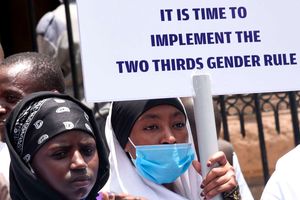
In September 2020, Justice Maraga advised President Kenyatta to dissolve Parliament, over the failure to pass a law to implement the two-thirds gender rule.
Justice (retired) Maraga was acting on six petitions that shad been submitted to his office by Kenyans among them former MP David Sudi and Law Society of Kenya (LSK.
The petitioners had urged him to advise President Kenyatta to dissolve Parliament for failing to pass legislation in accordance with article 27(3) read together with Articles 81(b) and 100 of the constitution.
The constitution states that the state shall take legislative and other measures to implement the principle that not more than two-thirds of the members of elective and appointive bodies shall be of the same gender.
Parliament was required to enact the law within five years of the promulgation of the constitution, as per the Fifth schedule but in a majority in 2012, the Supreme Court ruled that the principle will be achieved progressively.
But more than ten years after the promulgation of the Constitution Parliament was yet to enact a specific legislation to operationalise the provision on gender equality.
The Covid-19 pandemic came with a lot of disruptions but on a positive note, it accelerated the adoption of virtual hearings.
The Supreme Court and Court of Appeal conduct almost all their proceedings online, while other courts use a blended approach.
Martha Koome is an advocate who currently serves as the Chief Justice of Kenya.
Photo credit: Francis Nderitu | Nation Media Group
According to CJ Koome, virtual hearings have significantly reduced barriers of distance and travel costs for litigants and advocates.
After a phased rollout of E-filing, which began in 2020, the judiciary achieved full national roll-out of e-filing in early 2024.
All court filings are now done online, ensuring secure, tamper-proof records and eliminating the loss of physical files—a problem that once plagued the judiciary for ages.
Still on technology, Justice Koome enhanced the Integrated Case Management System (ICMS),, which enabled the Judiciary to monitor cases in real-time, track progress, and identify bottlenecks, to enhance efficiency.
During her recent address, the CJ said the Judiciary was exploring how Artificial Intelligence could enhance judicial operations, through administrative support, case management, legal research, or predictive analytics.
“To ensure ethical, safe, and purposeful adoption, we are developing the Judiciary Artificial Intelligence Adoption Policy Framework to guide integration of AI tools while safeguarding judicial independence, data privacy, and due process,” Justice Koome said.
The CJ also introduced the Mahakama Popote Initiative- An initiative through which Judicial Officers are deployed to resolve cases across the country regardless of the court station in which a case is filed.
This, she explained, is achieved through virtual courts and the e-filing system, and enables the Judiciary to optimise its limited human capital.
During the last financial year, 7,665 cases were handled through Mahakama Popote Initiative, with 6,269 cases resolved, translating to a case clearance rate of 79 percent.
The CJ also launched the E-Judiciary Mobile Application, a platform for members of the public to self-search case information.
The case information they can get include all historical case activities, corresponding case outcomes, provide access to court decisions such as judgements and rulings, check payment status and verify court orders.