For many young people in Nairobi, Friday nights are no longer about clubs, cinemas or playing video games at home. Instead, they are flocking to crowded theatre halls to watch set books come alive through play readings.
At Maendeleo House, which houses Goethe-Institut, the lobby is overflowing with theatre enthusiasts eager to experience Francis Imbuga’s “Betrayal in the City.”
First published in 1976, the drama is set in the fictional African state of Kafira and critiques post-independence leadership, corruption, nepotism, and the betrayal of citizens’ hopes for freedom.
But tonight, it is not just a school text. It is a living performance, curated by Esther Kamba, founder of Playreading Ke, an initiative embraced by a generation rediscovering literature beyond the classroom.
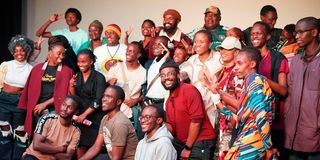
On a stage barely seven metres wide, actors Mugambui Ikiara, Amina Omar, Ndiangui Muya Mwaki, Dommi Mtemi, and Arthur Sanya Muiruri hold the packed audience spellbound. Every seat is taken, throw pillows line the floor, and some attendees sit at the actors’ feet. Outside, another crowd waits for the next session.
Play readings have quickly woven themselves into the lives of young Kenyans. Instead of chasing nightlife, they are braving the cold to chant lines together and reflect on the country’s politics through theatre.
But what is a play reading, and why is it one of the most important parts of the theatrical process?
A play reading is the most basic version of a theatre performance. Actors speak their parts directly from the script, staying in character and bringing plenty of energy, but without much movement or staging. There are no props, costumes, or lighting effects, just the words. To set the scene, someone reads the stage directions aloud so the audience has the context they need.
The cast and crew for Playread Ke's playreading of Francis Imbuga's 'Betrayal In The City' at Goethe Institut Nairobi on February 20, 2026.
Photo credit: Thomas Rajula | Nation Media Group
Lloyd Mwatha, who enjoys plays, brought his sister along. “I’ve been to a play reading before,” he says. “It was a Swahili play called Chozi, about a girl who moved from the rural area to the city. She struggled, even got into prostitution, but eventually found her way back. It was a nice play.”
For him, the turnout is no surprise. “People come because the plays here are free. It’s a great hangout for friends on a budget.”
When the reading ends, the floor opens for reactions. One audience member reflects: “I read this set book as a teenager and didn’t understand it then. Now that I’ve grown up, I do.”
Another, familiar with the actors, adds: “I’ve been on stage with most of them. It’s wonderful to see them perform. These plays are relevant; history repeats itself.”
For others, the performance connects directly to the present.
“Let’s register as voters. Be open to spaces like this where you can share opinions. Don’t just stay home frustrated.”
A first-timer describes the experience: “I thought I was coming to watch a full play. But this opened my eyes. Chanting lines together, it was phenomenal. You’ve changed how I see theatre. It can really be a community experience. I’ll be back.”
Esther Kamba, a Kenyan-Canadian who returned to the country in 2017, explains her inspiration for curating the play-reading sessions. “I’ve been in theatre my whole life, but became professional in 2013. Play readings happen worldwide, but none were here. When I came back, I saw a gap.”
Her first experiment came in 2021, during the Covid pandemic. “Everything was moving digital. I felt an urge to rebel. Theatre needed to remain live, even in its simplest form, helping people understand the production process.”
Curator for Playread Ke, actress and director Esther Kamba (holding microphone) with actress Amina Omar (in cap) during the playreading she curated of Francis Imbuga's 'Betrayal In The City' at Goethe Institut Nairobi on February 20, 2026.
Photo credit: Thomas Rajula | Nation Media Group
She recalls starting with barely five people in the audience. Then 15, and the numbers kept growing. “People are open to sitting together and listening. Dramatic text holds history, memory, identity, and culture. It connects us to something bigger.”
The project began modestly at the Conservatoire at the Kenya National Theatre. Growth came unexpectedly when the Goethe-Institut staff attended and offered space. From there, audiences multiplied.
“Before, the readers outnumbered the audience. Now it’s full. People wait outside hoping someone will leave. We might need a stadium.”
Playreading KE has since expanded to venues like Unseen, Bao Box, the University of Nairobi, and schools. Plays need to be valued again. They’ve been shelved and forgotten. Even literature festivals don’t include play readings.”
Yet demand tells a different story. “There are so many plays to read. It becomes about identity, showing we are not a country of lacking, but of people who think and imagine.”
Beyond “Betrayal in the City”, Playreading KE has staged “Parliament of Owls ” and “The Trial of Dedan Kimathi.”
Set books, once dreaded as exam material, are now coming alive on stages, defining a fun night out. “There’s something in the air. People want to talk about corruption. They want to understand what’s going on. Plays are an easy way to do that,” Esther notes.
Playreading KE has also launched a website featuring upcoming shows, merchandise, and a section for emerging scriptwriters to submit work. The goal is to elevate Kenyan plays globally, giving writers a market for scripts that might otherwise gather dust.