The government is targeting to collect an average of Sh3 billion yearly in music royalties via e-citizen that would then be distributed to Kenyan artistes.
When President William Ruto announced in 2024 that his government plans to start collecting royalties on behalf of the Kenyan artistes via the government digital platform e-Citizen, the announcement was met with huge resentment from various music bodies, with questions arising whether the money will indeed get to artistes, given the history of the platform’s scandals.
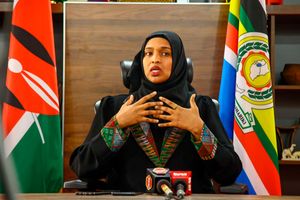
The Recording Industry of Kenya (RIKE), representing local record producers, through its national coordinator, Angela Mwandanda, immediately expressed concerns about the move, stating that e-Citizen lacks the technological sophistication required for accurate invoicing, licensing, and monitoring of sound recording usage, all of which are necessary for the fair distribution of royalties to rights holders.
Angela 'Shinde' Mwandanda is the National Coordinator of the Recording Industry of Kenya (RIKE). She is also an actress and a former member of the Tatuu music group.
Photo credit: Pool
MCSK, a collective management organisation (CMO) representing over 16,000 musicians, also aired its concerns, stating that while the government intends to improve the regulatory environment for rightsholders, the use of e-Citizen as a platform for music royalties distribution does not meet global standards.
“No government in the world collects royalties on behalf of artistes. It's the CMO which has a memorandum of association with the artistes it represents. The government job is to be an enabler, to support the CMO with enforcement and compliance for effective collection. Even if the government is to collect the money, how will it distribute it to artistes without having a database of the artistes?” Richard Sereti, Acting CEO of the Music Copyright Society of Kenya (MCSK), told Nation Lifestyle .
During his presidential campaigns, Mr Ruto courted artistes with grand promises and catchy slogans.
However, the president isn’t, insisting that e-Citizen will start collecting music royalties this year. The president reiterated this message again last week during the Kenya National Drama Festival State Concert at State House, Nairobi.
“To ensure that those in the creative economy earn their rightful returns, we have also taken a major step by migrating the collection and distribution of music royalties onto e-Citizen. For too long, royalty collection has lacked transparency, and that is a statement of fact. In one instance, a collective management organisation collected Sh109 million on behalf of artistes but distributed only Sh13 million. This means that the rightful beneficiaries, the artistes, only received 12 per cent while the cartels, the middlemen, the brokers, and everybody in between took the rest,” Ruto said.
Already, the government says it has collected Sh150 million in royalties from blank tape levy, which was introduced in 2023. However, it has been unable to distribute the money to Kenyan creatives (musicians, actors, producers, scriptwriters, book publishers, and visual artists) because of an ongoing case filed by MCSK that is challenging the distribution of the millions.
Blank Tape levy is a small fee charged on importers of blank media and recording devices into the country, such as memory cards, laptops, smartphones, flash disks, photocopiers, printers, decoders, smart TVs, game consoles, smart watches, flashdisks, or any device able to collect and store copyrighted works. A portion of the price goes toward compensating musicians, authors, and producers for the potential revenue lost when one makes a backup or copy of copyrighted works, such as music or film, for personal consumption.
For more than a decade now, Kenyan musicians have been lamenting on peanut royalties disbursed by CMOs, with the major ones being MCSK, Kenya Association of Music Producers (KAMP) and PAVRISK (Performing and Audio Visual Rights Society of Kenya).
Forensic Audit reports from 2017-2019 commissioned by CMOs regulator Kenya Copyright Board (KECOBO) revealed diversion of millions of shillings and fraudulent transactions by the three CMOs.
Another forensic audit report of 2020-2022 exposed the misappropriation of Sh158 million by the CMOs. For that period, auditors found out that both KAMP and PAVRISK board allowances and staff salaries constituted up to 69 percent way above the total administration cap of 30 percent.
In 2023, MCSK was unable to account for Sh56 million out of the Sh109 million royalties it collected that year. But despite years of complaints from artistes, with many receiving as little as Sh1,200 as royalty payment and continuous misappropriation of the funds by CMOs, there have never been any meaningful convictions of any officials.
According to KECOBO’s senior legal Counsel, Alex Omanga, the legal regime in the country is to blame. “You have to understand the legal regime we have in this country of how collective management of rights is done. Under the Kenyan legal system, we have private companies which are the CMOs which are member driven. They do not belong to the government; they are formed by members. So that organisation then gets a permit from KECOBO to collect royalties. When there is a problem with a CMO, its members have to deal with them because they are the ones who have the articles of associations and elect board members who make decisions on when and how much they will distribute to members. So if the members can’t hold their board members accountable, how do we come in?” Omanga poses.
Dennis Itumbi during the TikTok Empower global launch at KICC, Nairobi on December 6, 2023.
Photo credit: Wilfred Nyangaresi | Nation Media Group
Defending the move by the government to take over the responsibility from CMOs, Itumbi noted that, while artistes do have a memorandum of association with the CMOs, their long plight can't be ignored. “The work of the government is to serve its people. As much as MCSK says it is representing 16,000 members, many of whom are complaining, those members are my clients from the government side. CMOs have had this game going on for far too long. We make trends with our artiste, then they die poor while an official is earning millions. They are resisting the new collection structure because they know they will no longer be able to do with the collection as they please. But, as we speak, we are now at a level where we have moved this collection to e-Citizen. We are even saying because the CMOs have been unable to collect and distribute 70 percent as per the Copyright Act, we will do the collection and give them the 30 percent and distribute the rest to artistes.”
He adds that much of the structure has already been set up, with only a few nuts to tighten.
According to KECOBO’s tabulation, with proper collection, royalties’ collection could hit Sh5 billion.
According to Itumbi, the government has already figured out how to collect the royalties. “Whenever a business is paying for a license through e-Citizen – for instance, a saloon or a bar – it’s at that point where we’ll also be demanding for the royalties to be paid.”