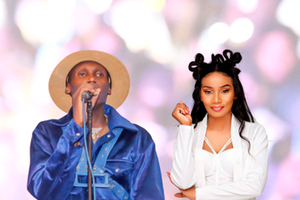
For years, Wanjine, real name Erick Wanjine, was releasing music that barely travelled beyond his immediate circle, songs that helped him find his sound but brought little recognition. Today, the Afro-soul singer says music pays his bills, but the journey there has been defined as much by uncertainty, pressure, and persistence as by hits and streaming numbers, he tells Jackson Ngari.
Before people started recognising your name, how many songs had you released that barely got attention?
I hadn’t really settled into a clear sound back then. I was experimenting with different genres and ideas, trying to figure myself out. There were quite a few songs I released, though most of them aren’t on my current channel. One was called Tempo, and there were others I honestly can’t even remember now. Not many, but enough to shape where I eventually started from.
At what point did you decide music was no longer just a passion but something you wanted to pursue seriously as a career?
When I decided to go vernacular. At that point, it became very clear in my head that this was what I wanted to do. Not just as something I loved, but as a tool that could change my life and, hopefully, other people’s lives too.
Wanjine performs at the Tusker Oktobafest Nanyuki on November 1, 2025.
Photo credit: Pool
Be honest, does your music currently pay your bills, or are there still gaps?
It does. I don’t have a lot of bills, but I do have bills. Whether it fully covers everything all the time is another conversation, but yes, music pays my bills.
What has been your most financially rewarding year in music so far, and what changed?
I’d say 2023 going into 2024. That’s when Wari Wakwa (Kirorerwa) broke through, alongside a few other songs that performed well. Things started changing then.
Many upcoming artistes struggle with monetisation. What income streams actually work for you?
The most important thing for an artiste is information. There are many DSPs and platforms out there, but you have to seek the information. Monetisation today isn’t as limited as it used to be. For me, streaming has worked well, especially YouTube and Spotify.
What’s your secret formula?
There’s no secret. Information. If you’re releasing music, you have to market it. You can’t separate the two and still expect income.
There’s a romantic idea that musicians create every day. Is that true for you?
It depends on where you are mentally. There are times I can’t even touch a pen or pick up a guitar. Sometimes I don’t even want to listen to my own music. That idea of creating every day is romanticised. Every artiste goes through those moments.
How do you bounce back creatively when you’re stuck?
Each time is different. You keep finding new ways to deal with the same problem. It’s a continuous process.
What pressure comes with being seen as part of a ‘new wave’ of Kenyan musicians?
It’s the expectations. It’s like being handed leadership without asking for it. Sometimes you’re just making music to express yourself, but suddenly you’re expected to carry others with you. That pressure can get to you.
Erick Wanjine, who goes by the stage name Wanjine, is a Kenyan Afro-soul singer.
Photo credit: Pool
Afro-soul and R&B don’t always dominate the charts. Have you ever felt pressured to dilute your sound for commercial reasons?
Earlier on, yes. I experimented with many genres. But once I understood what I truly wanted to do, my head became clear.
What’s the hardest financial or career decision you’ve had to make?
Choosing to be a musician every single day. Even when it doesn’t pay. Even when societal pressure is heavy. Waking up and choosing the same thing again and again because you love it.
What part of the Kenyan music industry frustrates you the most right now?
The mainstream systems, especially government-related ones. They’ve never really worked for artistes. The question now is whether artistes are doing anything about it or just complaining.
Mugithi artist Wanjine addressing media during the launch of the Mugithi Carnival on October 15, 2024.
Photo credit: Francis Nderitu | Nation
Outside music, what keeps you awake at night?
Longevity. Art lives forever, but artistes don’t. Longevity is crucial. Not so much relevance, I make music for people who are in that space. If it reaches the masses, that’s a bonus.
Most of your music revolves around love and relationships. Why?
How do you define success?
Success isn’t about having all the money or achieving every goal. It’s peace of mind. You can have everything and still be unhappy. Appreciating the small wins matters.
Did your parents support your music journey at the beginning?
No. Not at all. I was a rebel. But their opinion has changed, they don’t really have a choice now.
Are you working on a larger project right now?
Yes. I have both collaborative and solo projects coming. I’m trying to incorporate activism into my music. One project may focus on mental health, another on love, and another on activism. There’s a clear trajectory in how things will unfold.
Is music production expensive in Kenya?
Yes. Music production is expensive everywhere. Quality equipment costs money, and the systems don’t really support artistes. You have to get to the other side first before you can help someone else.
Erick Wanjine, who goes by the stage name Wanjine, is a Kenyan Afro-soul singer.
Photo credit: Pool
Are you worried about AI replicating or plagiarising music?
Not at all. I’m excited by AI. It’s a tool that can enhance creativity. I’ve used it to speed up processes, like extracting stems, but not for composing.
So, five years from now, how do you want people to describe Wanjine, as a hitmaker, a cultural voice, or something else entirely?
Kind of both, and a superstar. I want to add some colour. That’s what I’ve been working towards. Even when I decided to go vernacular, that choice in itself separated things. Whether I’m singing R&B or exploring other sounds, the vernacular element is always there. I want to be a voice of change. I want to be a voice that hits, and a voice that heals. I want to be an artiste who is also human. It’s very easy for an artiste to get into a bubble and forget who you are because of society, expectations, and everything around you. As an artiste, you’re a giver. You give so much of yourself that sometimes you forget who you are.