You began acting at just six years old, what do you remember most about stepping onto your very first set?
My mum had been chosen to do a role in a show called “Wingu la Moto” and they were looking for a daughter for her. They auditioned several children but could not find a good match. My mum asked if she could bring me to audition and they agreed. Before that, my only interaction with art was when my mum did set books at the Kenya National Theatre. If she had no one to leave me with, she would take me with her. I remember enjoying watching the shows and sometimes joining her on stage when children were needed in the crowd scenes. I loved being part of it and when I auditioned for “Wingu la moto”, I was confident and got the lines right. They picked me and that is how my acting journey began.
My mother played a huge role in shaping my interest in acting. Watching her perform and being around her work inspired me deeply and made me fall in love with the craft.
What was it like being the youngest person on set, did you feel intimidated, or did it feel like home right away?
I do not remember ever feeling uncomfortable or out of place. It always felt like home and exactly where I was meant to be.
It taught me discipline and the importance of passion and hard work from an early age. Growing up in the industry made me confident and helped me understand that acting is both an art and a responsibility.
How has your approach to acting evolved as you have transitioned from child roles to more complex, adult characters?
Maureen Kahuha.
Photo credit: Pool
When I was younger, it was easier to get roles because there were less children actors. As an adult, the competition is bigger, so you have to work harder, gain special skills and build your own brand to stand out. It has been challenging, but I love the challenge.
Is there a particular role that pushed you outside your comfort zone and helped you grow as an actor?
Every role I have done has pushed me and taught me something new. I am rarely typecast, so each character feels fresh and challenging in its own way.
I learnt not to be afraid of silence in a scene. Sometimes silence speaks louder than words. I also learned to stay truthful to the character and react naturally, instead of forcing emotions or lines.
Do your characters ever follow you into real life, or do you find it easy to leave them on set?
Most of the time, I do not carry them with me, but sometimes it happens, especially when I have played a character for a long time. The brain takes every experience as truth, so it can be hard to switch off. But with time and knowledge, I have learnt how to separate myself from the character.
I would say Mkamzee Mwatela, Sanaipei, and Nice Githinji. They have inspired me in acting, in business and in life. I have also learnt a lot from them through friendship and work.
I am passionate about telling real stories about the youth issues: like toxic relationships, drug abuse, contraception, mental health, early pregnancies and gender-based violence. That is why I love Mid Young Crisis, because it uses its platform to talk about real youth experiences.
Looking ahead, what is next for you; any dream roles, genres, or creative projects that excite you right now?
Right now, I am doing theatre and rehearsing for a new show. Performance at the Kenya International Theatre Festival. I plan to tour universities with my stage show to reach more young people and share important messages.
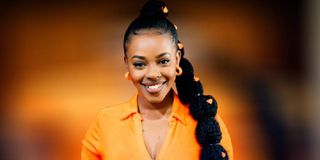
Makena Kahuha during the Women in Film Awards on May 11, 2021.
Photo credit: Francis Nderitu | Nation Media Group
One of my biggest shows is “Country Queen” on Netflix, where I played Young Akisa. Another is “Subterranean”, where I played twin sisters Kate Adema and Lucy Adema, one of my most challenging roles. I also acted in a Danish film called Liberty, shot in South Africa and two short films, Burnt Forest based om post-election violence of 2007/2008 and Is This Your Daughter based on a true story of a young girl who was just trying to pursue her passion, but her parents were so against it
For many actors, the creative side comes naturally, but how have you learnt to turn your craft into a sustainable career?
To be honest, it is still challenging, but I have learnt that acting is not the only job an actor can do. You can train others, do voice acting, or produce. Exploring different opportunities helps me stay creative and make a living from art. There are so many other opportunities for us to showcase or to use our talent other than stage and TV. So when we find such opportunities, we jump on them. There are ways to actually keep ourselves creative and keep us on our feet, and even sustain us so that we are able to do this craft for a longer time.
I call myself an art entrepreneur because I produce stage shows. It is about creating your own opportunities and employment instead of waiting for roles.
Is acting in Kenya currently paying the bills, or do you have to find other ways to earn?
To be honest, the only thing that I do is acting and influencing are the only things paying my bills. I know I am privileged because not many actors can say the same. It is not easy for everyone, but I am grateful. Just because I am living off of it does not mean that it is easy or possible for everyone to live off of it. I am truly, truly privileged and for that I'm very grateful and I acknowledge it. But yeah, it is not easy for everyone,
When you are not acting, what other projects or passions do you pursue?
I am currently learning sign language. I also love reading novels, watching films and plays, attending concerts and enjoying Kenyan music and art. I am both an artist and a consumer of the creative industry.
What has been your biggest lesson about the business side of entertainment contracts, deals or payments?
Because we do not have strong structures, every contract teaches you something new. I have learnt to pay attention to the business side and educate myself by talking to other actors and learning from how other African countries manage their film industries.
There has been a rise in young people joining film and production, what do you think is driving that growth?
I think it is the fearless attitude of young people today. They are not afraid to start, to be seen trying or to ask for collaborations. We have also learnt from the generations before us, who paved the way and made it easier. The internet and access to global content have also helped us learn and grow faster. It is truly a good time to be a Kenyan artist.