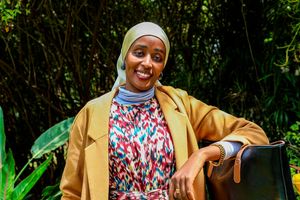
At 24, Leshao Sopia Leshao has found an unusual way to make the climate crisis personal.
A musician, civil engineer and climate justice advocate, he moves between love songs, cultural storytelling and music about the struggles facing pastoralist communities.
With more than 100,000 YouTube subscribers and millions of views, he is using that growing audience to take the realities of climate change from his home in Narok to international climate spaces like COP (Conference of Parties).
Where did that connection between music, culture and the environment begin?
I was brought up in Narok, and from an early age I understood the relationship between people, livestock, wildlife and the land; partly through listening to traditional Maasai songs and stories.
In our culture, we pass knowledge, history, and values from one generation to the next. Over time, I began to realise these experiences could shape the music I create and the messages I share with others.
That is why I chose to sing in Maa. I want people to hear our language and experience our culture through music.
Leshao Sopia Leshao,24, is an artist who has found an unusual way to make the climate crisis personal.
Photo credit: Pool
When did music become something you wanted to pursue seriously?
My musical journey began around 2019 when I was still in secondary school. I started taking it more seriously in 2022 while at Meru University pursuing a course in civil engineering. I graduated in 2024.
Over time, I developed a sound that brings together contemporary music and traditional Maasai rhythms. Being named Rift Valley Male Artist of the Year was an important milestone for me because it encouraged me to take the craft even more seriously. I have also had opportunities to share my work through many platforms.
When did climate change become personal to you?
It has always been personal because I come from a pastoralist community. In Narok, almost everyone in my village has a story about what is happening. There are stories of droughts that have turned grazing lands into barren dust, floods that have swept away homes, and livestock losses.
These changes affect water, pasture, food security and household incomes. They can also contribute to conflict over shrinking resources, school dropouts and other social problems.
I kept asking myself what I could contribute using the skills and opportunities I had. I am not a climate scientist, but I am an artiste, and I have a voice and a platform. I realised that there are people who may not be inspired into action by a scientific report but can be reached through a song.
Music can put a human face to the statistics. It can make people think about the family behind a drought figure, the pastoralist behind a livestock loss and the culture behind a disappearing landscape.
Tell me about the climate songs you have created.
Through my collaboration with Spring of the Arid and Semi-Arid Lands, SASAL, we developed two climate-focused songs, “Esipata Oloing'ange” and “ESIANA”.
The former talks about our land, its beauty, the birds and wildlife that live there, and the importance of protecting that environment. But it also carries a warning. If we do not take care of the environment, our livestock and our culture are also at risk.
You performed at COP29 in Baku and COP30 in Brazil . What was it like taking this message into one of the world's biggest climate spaces?
COP was a very different environment. There were thousands of people from governments, civil society, researchers, activists and different organisations. But in such a crowded space, not everyone gets noticed. I found a way to make people stop and listen. I’d put on my red and blue shuka, wear my Maasai beads, sing and dance. People would gather around the pavilion.
It became almost a daily routine. One of the most interesting things is, people would join the dance even before they knew what the song meant. After I had attracted an audience, I would explain what I had been singing.
You were performing and advocating at a time when civil society space at COPs were becoming increasingly restricted. Did art give you another way of speaking?
People, especially young people. When I see a young person deciding, “Let me try something different,” instead of waiting for someone to come and save them, that gives me hope. I also get hope from music itself. I’ve seen a song travel further than I could ever travel physically.
Best compliment you’ve ever received about your music?
Someone once told me that when I sing in Maa, they may not understand every word, but they can feel what I’m saying. That really stayed with me. Because for me, music is not just about understanding the language; it’s also about the emotions.
What does your engineer brain notice that your musical brain doesn’t?
My engineer brain is always trying to calculate things. (Laughs). Even when I’m enjoying myself, there’s a small engineer somewhere in my head asking, “But how is this standing?” So basically, one side of my brain says, “Feel the music,” and the other says, “Please check the calculations.”
What’s the most unexpected place someone recognised you?
Definitely in some hood in Mandera. I had travelled there to buy some goats and, honestly, I thought I was completely off the radar. Then suddenly, I hear someone shouting, “Here comes Leshao!”
What would you sing to someone who says climate change is not their problem?
I probably wouldn’t start by arguing with them. I’d sing them a story about something they already care about; food, water, their home, their family, their future. Because climate change can sound like a very big scientific conversation until you realise it is sitting right on your dinner table.
What song would you want your grandchildren to hear one day?
Each of my songs carries a different chapter of my life. But if I had to put one song in their hands, it would most importantly be “NKAATINI Olmurani Otongile.” I wrote it when I was at one of the lowest points of my life. It is a conversation with myself about life: my past, the future and everything in between.
When I sing it, it takes me back to my childhood, to the experiences that shaped me, and to my journey as a Moran. And of course, after all that, I hope they’ll also say, “Aki, Grandpa was actually cool!”
Can a love song be activism too?
Absolutely. Love is probably one of the oldest forms of activism. When you sing about loving someone, you’re already talking about care, responsibility and connection. And if we can care deeply about another person, we can also learn to care about the land, our communities and the environment.