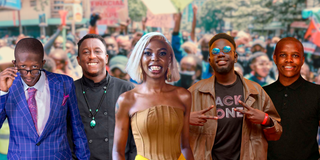
Kenya’s Gen Z and millennials are combining forces to blame the country’s woes squarely on the political class while shunning tribalism. From paid chants to hashtags for unity, young Kenyans are using TikTok, X, and Instagram to demand accountability and dismantle tribal politics.
Gone are the days when civic engagement in Kenya meant dusty town halls and long lectures. Today, TikTok, Instagram Reels, X, WhatsApp, and Facebook are populated arenas where public education, accountability, and protest thrive. With over 75 per cent of Kenyans aged below 35 years being the majority, these platforms shape civic discourse like never before.
Comedian Timothy ‘Njugush’ Kimani.
Photo credit: Pool | Nation
Creator comedians like Crazy Kennar, Mluo, Njugush, and activist individuals like Boniface Mwangi, Adelle Anyango, Wanjiku Stephens and Shoba Gatimu transform constitutional clauses, county budgets, and political hypocrisy into bite-sized videos that fly across screens. As one comment on a viral reel put it: "Social media is no longer just shaping politics, the question is how?"
In June 2024, Gen Z led the #RejectFinanceBill2024 movement on humour-laden TikTok to explain hidden taxes. The result? “#OccupyParliament” emerged online, then on the streets, forcing the government to remove the Finance Bill. Online activism turned offline policy-making.
Celebrities leading the civic movement
Celebrities are now leading civic battles. Their influence helps spread messages far beyond young audiences and into more conservative households. On TikTok, creators call for voter registration. On X and Instagram, they openly shame friends who don’t vote. Reels show protesters chanting politicians’ names in unison. These everyday civic actions gain glam when influencers step in.
Lawyer and activist Morara Kebaso during an interview at Fairmont The Norfolk Hotel in Nairobi on August 22, 2024.
Photo credit: Bonface Bogita | Nation
Activist Morara Kebaso has used social media as his platform to break down tribal stereotypes. During the run-up to the Saba Saba protests in July 2025, we saw, "I am not anybody's project … I am my own man, made by the Kenyans who stand with me," he declared on X.
"All those leaders … Gachagua, Linturi, Kalonzo … they cannot change Kenya… Generation Z must become leaders," he urged.
Through both his serious and humorous personas, Kebaso underscores coming together, "Not all Kalenjins are bad," Morara told Kenyans who wore tribal labels. Even without a direct online transcript, his tone on a shared reel made it clear that he was not going to allow ethnicity to determine corruption.
When popular TikToker Mike Muchiri was arrested while on an Instagram LIVE session, around the Kasarani area last year, he managed to livestream his detainment. In 30 minutes, lawyers mobilised via social media and had him released. His video not only trended—it showed the real-time, live power of activism online.
Rapper Octopizzo during a past performance.
Photo credit: File | Nation
Musician Octopizzo urged fans to act, “If you can post a selfie, you can post the truth.”
Actress and humanitarian Lupita Nyong’o reposted messages condemning tribal profiling and urged youth to “vote smart, not tribal.”
Disproving the 'token' politician strategy
One of the cruellest patterns happened where the political class paid the “common mwananchi” Sh500 to Sh2,000 to chant their names. These videos went viral. On TikTok and Instagram Reels, we saw individuals waving coloured flags as they took coins and then became silent when asked about policies.
Re-posted on X by @vinguard254, commenters decried,
“They chant not because they believe, but because they were paid.”
Within hours, parody videos flooded platforms mocking politicians who rely on paid praise instead of earned support. The result was a burst of online civic consciousness. People began urging each other to register to vote with renewed urgency, turning humour into a powerful tool for public engagement.
The likes of Crazy Kennar, who produces comedy skits with a theme of social issues and the plight of the youth, and Blessed Njugush, who fuses everyday humour with subtle political satire, have been at the forefront of this change.
Alvin Oduor, better known as Mluo, is combining humour and music to make a name for himself in Kenya’s creative scene.
Photo credit: Pool | Nation
Mluo, whose sharp, satirical remarks regarding what's currently trending, has joined the bandwagon too, providing witty criticism of leadership and politics through relatable material. These producers have promoted civic awareness through popularised humour and satire employed to undermine political expectations and provoke debate about voter engagement and accountability.
“Don’t be a token, be a voice,” became the new slogan.
This revelation sparked a chain reaction of cynicism and activism. People began doing two things: live-streaming demonstrations, and riling voter registration "voice matters" through viral hashtags that invited friends to vote.
TikTok's partnership with Kenyan NGOs has also combated disinformation. Peace-building hashtags like #TikTokForPeace fact-check political reels, which are nudging users to halt, reflect, and verify before sharing.
"A lie travels fast, but now, the truth has faster Wi-Fi," joked a TikTok teacher from Kisii.
Breaking down tribal distractions
The political class had tribalism as its distractor card for years, but 2024 and 2025 saw this change, online blogs and satire breaking it. One-sided blame by senior politicians on specific communities after Saba Saba ignited counter movements. An online uprising #WeAreAllKikuyus erupted. TikTok influencers belonging to Luo, Kamba, Somali, and Luhya communities posted messages of unity.
TikTok
Photo credit: Shutterstock
Creators shared stories of everyday Kikuyu folk supportive of diverse justice campaigns. Cross‑ethnic exchanges (“I’m Kamba, and I stand with my Kikuyu brothers”) flooded the comment sections.
On Instagram Reels, we watch two strangers, one Luo, one Kikuyu, share a hug at a demo, chanting, “Tribalism ends with us.” That same week, TikTokers used #VijanaTumechoka to call out all forms of tribal hate, exposing how ethnicity funnels power for the few.
Reels and TikTok now amplify chants from street protests and broadcast to the world. These are not just protest songs —they name politicians, call out injustice, and affirm people's power.
Celebrities like singer Stella Mwangi and actor Nick Mutuma joined the online movement, using their followings to fight tribal narrative and political tokenism.
“Stop labelling Kenyans by tribe,” urged Anthony “Raskazone” Raso on X.
Protest as performance, performance as protest
Kenyan streets are now echo chambers of screams that often begin as virtual soundbites. In the streets outside Parliament, youth mouthed the names of MPs in support of the finance bill and chanted "SHAME!"
Videos of these acts were uploaded throughout TikTok, often with remixed soundtracks or cut-up reactions, turning protest into political art.
"Haki yetu, si ya ukoo ni yetu sote."
These chants are now political slogans, born in the streets and nurtured online.
Political misinformation is countered on social media, and users reveal fake clips, demanding evidence.
Online literacy is taking root, validating that public debate in social media can be confusing but also immediate, self-correcting, and non-reversible. As one commented, "A 30-second clip can take down a clause in the Constitution better than a 100-page report ever could."
Faith, art, and the new digital pulpit
Civic education is no longer restricted to NGOs and textbooks. It’s in sermons. In lyrics. In reels.
Religious leaders like Rev T Mwangi hold online sermons urging believers to vote, speak truth, and reject tribal hatred.
“You cannot pray for a better Kenya while voting for the same broken system,” he said during an Instagram Live with over 15,000 viewers.
At the same time, artistes are lacing their work with protest messages. A Gengetone hit by Wakali Wao had the chorus:
“Woiyee, si tribe bana ni tax tunalilia!”
With just a smartphone, civic education is now decentralised, fast, and greatly impactful. Streamed detentions, broken promises, live-streamed protests behind closed doors. Identity politics are being challenged by fact-checkers, satirists, and solidarity videos across tribal lines.
As hashtags like #WeAreAllKikuyus trend globally, local unity sends a loud signal— our people come first, not your ethnic marketing schemes.
Every time you share, post, fact-check, vote, or chant, your efforts contribute to Kenya's digital civic revolution. You introduce transparency, solidarity, and civic power, one clip at a time.
Power is no longer in ivory towers—it’s in your pocket. This is Kenya’s future unfolding, live on social media, and we’re all part of it.
What used to be whispered in classrooms is now chanted on sidewalks. What used to be debated in community halls is now trending worldwide. From TikTokers resisting fake news to trending reels calling for national cohesion, young Kenyans are leading a revolution online. The age of digital civic power is here. It does not ask for approval. It just clicks "post.".