The populous Mt Kenya region has in the last three successive presidential elections joined forces with Rift Valley to sweep to power President William Ruto and his predecessor, Mr Uhuru Kenyatta .
Mr Kenyatta’s victory in 2013 and 2017 — the nullified presidential vote in August and the repeat poll in October — as well as Dr Ruto’s ascent to power in 2022 were largely influenced by the combined forces of the two blocs, which were at one point popularised as the “tyranny of numbers” by political analyst Mutahi Ngunyi.
Similar arrangements — in which political alliances are built by bringing together prominent leaders from various ethnic blocs with promises of sharing government positions — also played up in past presidential elections, including in 2002 when Mr Mwai Kibaki swept to power through a combined force of political bigwigs that delivered their voting blocs.
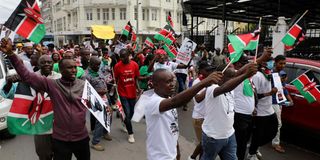
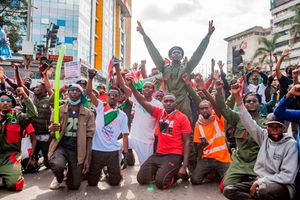
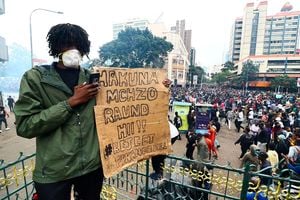
But this traditional political arithmetic is threatened going into the 2027 General Election as Gen Zs, who have in the past stayed away from politics or fallen into line to vote along regional and ethnic lines, are taking up an active role.
Born between 1996 and 2012, this group of young Kenyans is emerging not just as a voting bloc, but as a cultural and political movement. Since the pro-reforms protests that erupted in June last year — mostly mobilised through social media — they have largely refused to identify with any of the major political players, who have historically rallied the country along ethnic lines. The young Kenyans style themselves as leaderless, partyless and tribeless — a distinction that analysts believe has advantages at the moment but could be a drawback closer to the elections if there is no consensus on the candidate to support.
A significant number of the Gen Zs will have hit the voting age in 2027, analysis of the 2019 census data produced by the Kenya National Bureau of Statistics (KNBS) shows. Coupled with others between the ages of 18 and 35 years, the bloc has the capacity to be potent.
Four in five of the Gen Zs, or more than 14 million, will be eligible for voting, an increase of this cohort that were old enough to register as voters in 2022 when Dr Ruto was elected partly on the back of youth economic empowerment.
Kenyans aged between 18 to 34 years will be at 17.8 million, reflecting the predominant role they will play in deciding the country’s political trajectory from 2027.
Photo credit: Nation Media Group
In the 2022 elections, Dr Ruto won by polling 7,176,141 votes against Mr Raila Odinga’s 6,942,930. In that election, there were a total of 22.1 million registered voters, but only 14.3 million voters turned up to cast their ballot, meaning close to eight million voters failed to participate in the crucial exercise.
A report by Independent Electoral and Boundaries Commission (IEBC) showed that the youth turnout in 2022 was remarkably low. The same report showed that there were 8,811,691 registered voters aged between 18 and 34 — constituting 40 per cent of total number of voters ahead of the 2022 poll. This implies that their numbers alone were enough to tilt the outcome.
Political analyst Javas Bigambo said that the youth have to coalesce around ideals while making decisions in the next poll for their power to be felt in the country’s governance.
“The evinced lesson is that Gen Zs will have historical influence in the 2027 elections and subsequent ones,” he said.
“The potency of their power and influence can no longer be ignored, and now they realise that they don't have to be mobilised by any politician. Now they should master the art of political power control and access, but most importantly, to coalesce around ideals, not sheer anger and amorphousness,” he noted.
A possible resolve by the group to rally around ideas and shun personality cults and blind following of regional kingpins is likely to radically upset the country’s political architecture.
Analysis of past voting patterns has shown how certain areas have always voted as bloc depending on the direction taken by their kingpins.
In 2022, when both Mt Kenya and Rift Valley rallied behind Dr Ruto, the two blocs delivered nearly to the last man.
The 10 Mt Kenya counties and seven from the North Rift collectively handed Dr Ruto 4.5 million votes, translating to 63 per cent of his total votes, according to the 2022 election data by the IEBC.
Laikipia, Tharaka-Nithi, Murang’a, Kiambu, Nyeri, Kirinyaga, Nyandarua, Embu, Meru and Nakuru collectively gave the President’s nearly three million votes. With 2,938,309 votes from the 10 Mt Kenya counties, Dr Ruto topped up with 1.6 million votes from the seven Rift Valley counties.
In the 2013 poll, Mr Kenyatta polled 6.1 million to secure 50.07 per cent of the national vote to avoid a run-off while Mr Odinga bagged 5.3 million. Mr Kenyatta barely went over the 50 per cent mark by only 800,000 votes. There were a total of 14,352,533 registered voters, with the IEBC recording 85.91 voter turnout, representing 12,330,028 votes.
Mr Kenyatta would, in 2017, widen the lead over Mr Odinga to 1.4 million in the presidential vote whose results were, however, nullified, occasioning the repeat vote. In the 2017 poll, the IEBC records showed 19,611,423 registered voters. Mr Kenyatta garnered 8,203,290 (54.27 per cent) against Mr Odinga’s 6,762,224 (44.74 per cent).
An analysis of the two polls indicates that the wins for the TNA-URP coalition in 2013 and Jubilee Party in 2017 could not have come without the huge voter turnouts averaging above 90 per cent in the two bastions of Mt Kenya and Rift Valley.
It further showed why the Mt Kenya bloc comprising Kiambu, Murang’a, Nyeri, Embu, Kirinyaga, Nyandarua, Laikipia, Meru and Tharaka-Nithi, as well as Nakuru were crucial for both victories.
By 2017, the eight Rift Valley counties of Uasin Gishu, Elgeyo-Marakwet, Nandi, Baringo, Kericho, Bomet, West Pokot and Samburu that overwhelmingly voted for Jubilee had 2.5 million registered voters.
For Mr Odinga, Nyanza, Western, Coast and Ukambani consistently voted for him in 2013, 2017 and 2022.
According to 2022 IEBC data, Mr Odinga garnered a total of 769,424 votes from the three Ukambani counties of Machakos, Kitui and Makueni as a result of the support by Wiper leader Kalonzo Musyoka.
Dr Ruto polled 250,070 in the region. The three counties have combined registered voters of 1.7 million as per the 2022 IEBC roll.
In the same election, the Western region counties of Vihiga, Kakamega, Bungoma and Busia had a cumulative 2,217,948 registered voters. Of the numbers, Mr Odinga polled 843,893 votes against Dr Ruto’s 513,506.
Dr Ruto beat Mr Odinga in Bungoma after he polled 255,906 against the former prime minister’s 145,280. The Bungoma win for Dr Ruto was credited to National Assembly Speaker Moses Wetang’ula, who has remained influential in the county.
Anti-government protesters protesting along Moi Avenue in Nairobi on July 23, 2024.
Photo credit: Bonface Bogita | Nation Media Group
Mr Odinga’s traditional Nyanza base of Kisumu, Migori, Homa Bay and Siaya had at least 2,161,262 registered voters in the last election. Kisii and Nyamira had 637,010 and 323,283 registered voters, respectively. The two counties were largely behind Mr Odinga’s candidature, with Mr Odinga polling 371,092 in Siaya, 419,997 in Kisumu, 399,784 in Homa Bay, 294,136 in Migori, 265,078 in Kisii and 129,025 in Nyamira.
University lecturer and political analyst Prof Macharia Munene said: “Gen Zs are likely to erode the influence of the so-called regional kingpins. They will no longer enjoy the influence that they have wielded in the past elections.”
“They don’t recognise those people. They are likely to inspire more people to ignore the so-called kingpins. This would definitely have a major impact in the 2027 elections,” he said.
He, however, noted that some of the political leaders may still have some influence.
Prof David Monda, a United States-based political analyst, describes the youth as a potent force for social change—but notes that ethnic mobilisation will still influence the 2027 polls.
“The difference is it will not be the sole and preponderant determinant of voter choice. Kitchen table issues that transcend ethnic identity are also becoming very important. In this regard, while politicians will be working on their tyranny of numbers statistics to win office, they also have to address issues key to the Gen Z's like the economy, good governance, justice for extrajudicial killings and transparency,” said Prof Monda.
“The key here is the Gen Z wave could be the swing vote in determining close elections. But, ethnic mobilisation is still a factor in Kenyan politics,” he noted.
Kitui Senator Enoch Wambua described Gen Zs numerical strength as a powerful tool that can radically alter the country’s governance and leadership.
“This is a community of interest bound together by the hardships they have endured at the hands of irresponsible and unreasonable leaders. They have drawn the line in the sand and are demanding greater levels of accountability from leaders,” said Mr Wambua.
“Thanks to this awakening, the use of the tribe as the most important tool for political mobilisation has suffered a major blow,” he noted.