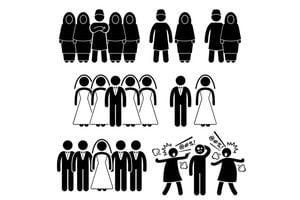
I am in a Christian marriage. I recently discovered my husband's plan to marry a second wife. The constitution is clear: Christian marriages are monogamous. Can I sue him for bigamy?
The law grants every individual, upon reaching the age of majority, the right to marry someone of the opposite sex based on mutual consent. Article 45, Clause (2) of the Constitution allows people to choose whether to marry or remain single. Additionally, Clause (1) of the same Article defines the parties involved in a marriage. According to Section 3 of the Marriage Act, marriage consists of two or more consenting adults of opposite sexes who voluntarily choose to commit to one another as husband and wife. There are several types of marriages, including monogamous and polygamous arrangements. Monogamous marriages involve only one wife and one husband who commit to each other for life. In contrast, polygamous marriages allow a husband to marry multiple wives. On the other hand, polyandry, where a wife marries several husbands, is not accepted in Kenya.
The Marriage Act defines various forms of marriage under Sections 17-49, including those celebrated and consummated according to Christian, Islamic, Hindu, and customary doctrines, as well as those processed by the state law office in the civil registry. Each of these unions possesses specific religious and ritualistic characteristics, which can affect their legal recognition if not appropriately executed.
In Christian marriages, two essential ritualistic elements establish their identity. Firstly, the parties involved must be of the Christian faith, regardless of their denominational differences. Secondly, both individuals must agree to the principle of monogamy, which is fundamental to all Christian teachings—each Christian union is based on the commitment of one husband and one wife.
Section 59 of the Marriage Act outlines how marriage can be evidenced in Kenya. The most common method is the production of a marriage certificate issued under this statute. If the original marriage certificate is unavailable, a certified copy can be obtained from the state law office that handles marriages. Another option, related to the first two, is to present an entry from the marriage register maintained by the state law office (Attorney General's office).
Before considering any wrongdoing on the part of your husband, who, according to your email, may be leaning towards taking another wife, it is important to review the grounds for dissolving a Christian marriage as specified in Section 65 of the Marriage Act. The most significant ground, especially since Christian unions are considered monogamous, is adultery. Importantly, it does not matter if such actions occurred only once; it is viewed as an act of betrayal within Christian doctrine.
One important aspect to consider is cruelty in its various forms. When cruelty is inflicted upon a spouse or their children, whether through mental or physical harm, it is considered a serious issue. This cruelty can also manifest through acts of adultery, which can lead to significant emotional and mental distress. It is commonly understood, both socially and perhaps religiously, that marriages are meant to create and maintain an environment where conjugal rights are fulfilled, regardless of effectiveness or satisfaction levels.
Within this context, sub-sections (c) and (d) of Section 65 may be misinterpreted as suggesting baseless claims of adultery, especially if sexual fulfillment is viewed as a fundamental aspect of marriage. Lastly, if a marriage irretrievably breaks down, as evidenced by the ongoing manifestation of these issues, including adultery, it highlights the need for recognition of the problems at hand.
The Marriage Act has established several offences, with bigamy being one of them, well elaborated in the Penal Code. Section 171 considers any person who, while having a living husband or wife, goes through a marriage ceremony that is void due to the presence of that spouse, is guilty of a felony. This offence carries a penalty of up to five years of imprisonment. It is important to note that bigamy is only recognised if it can be proven that a person entered into a new marriage while still married to another, within the context of Christian, Civil, or Hindu marriages.
In addition to bigamy, Section 85(1) of the Marriage Act states that any person who makes a false statement in a notice of intention to marry, as outlined in Section 25, commits an offence. The penalties for this offence can include imprisonment for up to two years, as well as a fine not exceeding Sh2 million. The judge or magistrate has the discretion to impose either or both penalties.
However, the court requires evidence that must satisfy the trial court to the required standard. In civil remedy, on a balance of probability, while in criminal law, the threshold is beyond a reasonable doubt.