Esther Kyalo is not your ordinary 30-year-old. She grew up a staunch catholic and rose to become a nun but today, she is a nurse, having left Sisterhood for a different calling.
Growing up in a strict Catholic family, Esther was introduced to the faith from a very young age. She became an outstanding child in church, singing, reciting poems, and even acting as Mother Mary in Christmas plays in church while dressed in a white gown. Along the way, she fell in love with the attire.
Around the age of six, Esther suffered stomach complications that led to her admission at Bishop Kioko Catholic Hospital. There, she met Catholic sisters and found herself admiring not only how they cared for patients but also their attire.
“Actually, the very first impression was the Habit (the white, flowing attire worn by nuns). It was pretty. The pleats were always crisp and well ironed. I actually told my dad that when I grew up, I’d become a (Catholic) Sister and a nurse.”
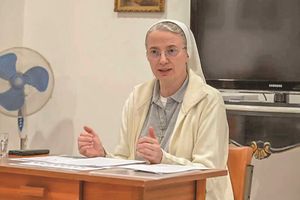
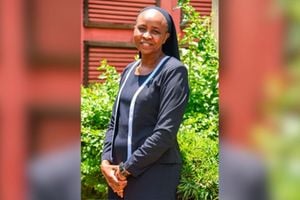
Esther Kyalo, who was once a Catholic nun, during an interview at Nation Centre in Nairobi on July 30, 2025.
Photo credit: Sila Kiplagat | Nation Media Group
Throughout childhood, she remained active in church, learning more about her faith and attending catechism classes. But when she reached Class Eight, Esther got into a relationship with a man and began to feel conflicted about her future.
“We agreed with him that the only reason I would leave him is if I decided to become a nun. He understood because he was also in a Catholic-sponsored school, actually, in a minor seminary. Deep down I believed he would become a priest once he finished high school.”
When she joined St Catherine Lima Girls, a Catholic-sponsored school, she continued her church activities.
“We didn’t have Sisters in school, but we had opportunities to go to mass every morning, plan church activities, set up the altar, and interact with the priests at the parish.”
Her uncle, a high school teacher, is the one who encouraged her to attend that school, and her parents preferred she study closer to home in Machakos due to her health.
“I had stomach issues and was on medication. My parents were afraid of how I would cope if I went very far from home. My uncle knew several teachers and could call to check on me or visit anytime,” she recalls.
Due to her active role and commitment in the school’s church, Esther became chairlady of Young Christian Students (YCS), leading all Catholic students from Form One to Four. She organised which schools would visit theirs and which ones they would visit, planned Catholic events in Machakos County, and taught catechism to other students.
The more she got involved in church activities, the more she wondered whether or not to join Sisterhood.
“I really enjoyed my teen hood, and began feeling attracted to boys. I was an adolescent in Form Two, and it wasn’t just about what we were taught in catechism. In fact, we were taught about the different vocations – religious, married, or single life. The catechist emphasised choosing what made you happy,” she says.
Esther was aware that becoming a nun meant breaking up with her boyfriend. After finishing Form Four, she attended Come and See seminars for young girls in the convent, which allowed her to see what Sisters did daily, interact with them, and learn about their way of life.
“I would attend the programme for a week, go back home, then attend another one in a different congregation. You are advised to visit different congregations.”
While Esther’s parents allowed her to attend, her mother was strict.
“Wewe enda seminars zako lakini nisisikie ukisema unataka kuwa Sister (You go to your seminars, but I don’t want to hear you say you want to be a Sister).”
Her father was more relaxed and never directly discouraged her, but she sensed some reluctance.
Her boyfriend continued his studies and planned to join university, and although they remained in contact, Esther assured him that her programme visits didn’t mean she had decided on Sisterhood.
Esther Kyalo during her time as a Catholic nun in Mombasa.
Photo credit: Pool
“At some point he told me jokingly that if I chose to be a Sister, then he would become a Father.”
Three months and three Come and See programmes later, two of them with the Daughters of the Sacred Heart, Esther decided to pursue Sisterhood. She wrote a letter requesting to join their congregation. Her parents, influenced by a deacon friend, eventually accepted her decision.
Asked why she picked that congregation, Esther says, “Their outward appearance. As an 18-year-old, I thought they looked so happy. I loved the colour of their habit. It looked pretty, had two pleats, was well ironed, and they would tie their veil behind the ears.”
Within a month, Esther received a call from the Council of Sisters, inviting her to join the congregation in January 2013. In August, the Sisters visited her home to introduce themselves and answer her parents’ questions.
“My parents allowed me to sit in the meeting. My mum asked whether they needed to pay fees, how the system ran, if they needed to send me upkeep money, what would happen if I changed my mind, and because I was not allowed to carry my phone, how they would know I’m okay. The Sisters explained it was a way of life and that minimising contact with the outside world helped one detach and focus on prayers, but assured them they could call once a week.”
That week, Esther met her boyfriend to break the news.
“He broke down and cried, and at some point, I regretted telling him.”
In January 2013, Esther packed her clothes and essentials and left for the formation house in Ruiru, joining 14 other girls. By March, one of the girls had left the convent, but the journey, Esther realised, was personal and private between oneself, the council, and the formator.
Diagnosed with stage three Leukemia
“The convent was more of a school. By 5.30am, we were supposed to be in the chapel for morning prayers. Thereafter we would go for Mass, have breakfast, do manual work for about an hour or two—either tending to the chickens, rabbits, cows, the farm, cooking in the kitchen, cleaning the house, or arranging the priest’s vestments if the Mass was in the house.”
After manual work, classes followed, then midday prayers, lunch, personal prayers, a compulsory siesta, more classes, evening prayers, supper, and finally, some recreational time before bed at 10.30pm.
Esther found the routine manageable and felt sure she would see Sisterhood to the end, inspired by a particular Sister who lived in the nearby community. Her parents visited and approved of the place. After cutting ties with her boyfriend, she stopped contacting him altogether.
By December, before leaving for home, she wrote a letter requesting to move to the next stage – postulancy in Karen. Postulancy was a period of deeper formation and discernment before entering the novitiate.
“Novitiate is the next stage after postulancy, so a lot is expected. We grew a lot. Also, during this time, mum informed me that my ex-boyfriend had joined the seminary in a congregation in Tanzania.”
The formator also wrote an evaluation of each postulant, which guided the Council’s decisions.
“There are five in the council, so if the decision is contested, they vote, and if you get three out of five votes, then you move to the next stage. If you get less, then you repeat.”
In 2014, Esther lived her dream. She wore the skirts with pleats like the Sisters, a blue shirt, and felt proud. She adapted to the programme but started having doubts as her father’s health worsened at home.
She told the Sisters, who called home to check on him. Eventually, her father was diagnosed with stage three Leukemia, and although they prayed for him, she sensed the inevitable. He died in July.
After the burial, Esther’s mum kept in touch, often in tears or expressing regret. She wished Esther had stayed home to support her against relatives who threatened to evict them and to help with the financial burden.
“I kept on praying, encouraging her and hoping for the best while still in the convent.”
When Esther returned for the novitiate, the group had shrunk to fewer than 10. Novitiate was intense, especially the canonical year, when they didn’t leave the convent at all.
“I went through it well, managed to be selected among those going to the second year and I was happy because this was my last year of formation aside from the troubles at home.”
At the end of 2016, Esther invited close family and friends to witness her profess her vows.
“I remember them being so happy for me that I was now a Sister. We say our vows to chastity (you should not have intimacy with anyone), poverty (you don’t own anything at all), and obedience (you can be sent anywhere to do anything).”
For her first mission, Esther was sent to a children’s home in Kawangware.
The routine was similar to formation, only now, instead of manual work, she went to her place of work.
Esther Kyalo, who was once a Catholic nun, during an interview at Nation Centre in Nairobi on July 30, 2025.
Photo credit: Sila Kiplagat | Nation Media Group
You still had a formator assigned, but usually, she wasn’t in the same community. Esther’s formator was still in Karen even after she moved to Satellite, Kawangware.
Every year, Esther would write a request to proceed to the next stage, and her formator’s report depended on input from Sisters she lived with.
“A convent is not a heaven that people go to and you are cleansed of your femininity, jealousy, rumour mongering among other vices. You can be in a community of three Sisters and two dislike you for whatever reason. I personally feel so many people abandon their vocation because of petty things.”
During her time at the children’s home, Esther often heard, “Uko mrembo hivi unafanya nini huku (you are so beautiful, what are you doing here?), why are you wasting your life?”
“They would not cook when it was their turn, they would come late for prayers. I found it very weird, especially now that I had just come from formation and things there were flowing so smoothly,” she says.
She couldn’t report them, as the Sister Superior seemed intimidated by them. She shared her concerns with her formator, and was transferred to a community in Likoni, Mombasa, to take care of the guest house.
There, she lived with two other Sisters, including a friend from her formation and an older Sister.
Wrote a request to leave the convent
“But then, the desire to rethink my decision was becoming very intense. First because of the experience I had in Kawangware and back at home, mum was really going through a hard time. Every time I called, she would say, ‘Why don’t you just come and help me out?”
Esther’s stress began to affect her prayer and community life. She developed stomach ulcers and sometimes received money from home.
She felt her new formator was unsupportive, especially after sharing something private that was then discussed with a seminarian without her consent.
She stopped opening up to her formator and, when a close Sister was sent away, lost her main confidant.
“I just had to face it alone. When November 2017 came, the council was waiting for my application for the renewal of vows, and I wrote a request to leave.”
The decision shocked everyone. Esther was summoned to Nairobi by the Superior the same day her letter came.
“I packed all my clothes. I knew I wanted to leave the place, so I packed everything and I came out of the community with my suitcases. By the time I got to Nairobi, they had already made calls asking why I was leaving.”
In Karen, Esther met with the Council but asked to speak only with the Superior, since her formator was present.
“She apologised and told me that if I had told her earlier, she would have changed the formator. She felt my family situation or formator was not supposed to cost me my vocation, but I had already made up my mind. She told me they would give me a week to pray and even got me someone to journey with me but at the end of the week, I still wanted to go home.”
The Mother General hoped she might reconsider, but Esther stood firm. She reassured the Mother General that if she felt lighter and ready, she would return.
“They prayed for me and called my mum to come to Karen. The council made it clear that I did not do anything wrong, it was my personal decision, and they were open to receiving me back if I chose to.”
Her mum felt guilty for sharing her struggles, thinking it influenced Esther’s decision to leave. During the meeting, Esther locked herself in a room, overwhelmed by the attention her departure caused. The process of leaving took less than a month.
Leaving Karen for Machakos, Esther struggled most with removing her habit and veil, as part of chastity was that no one was supposed to see her bare head. The Superior allowed her to leave with the habit, and, if she wanted, spend the night there to think. The Sisters gave her some money to buy civilian clothes.
“When we got to the Machakos community, I removed the habit, wore ordinary clothes and went home. At home, it was a bit hard for my siblings because they were used to my Sister title, but they warmed up,” she shares.
The transition was tough, especially with clothing. That Sunday, Esther told her church congregation she had made a personal decision and was no longer a Sister.
“They did not make it hard for me because I assured them that if all went well, I would go back and if not, I would remain there till God allowed me to get married.”
The news spread fast. Esther was recommended to teach English and Literature at a local high school a week after leaving the vocation.
Around the same time, her ex-boyfriend learned she had left, and left the seminary himself within three months.
In early 2018, Esther called her uncle to explain her decision and her interest to pursue nursing. In March, she joined Kenya Medical Training College (KMTC) in Kitui. Esther struggled with how to dress—she stood out in her long dresses.
“I really struggled with dressing because I was the odd one out with my long dresses to an extent fellow students would ask whether I was a Catholic Sister, which agitated me,” she says.
A friend helped her adapt, buying her crop tops and trousers and encouraging her to wear them in the hostel until she felt comfortable. By the second year, she wore trousers, and by third year, she wore crop tops confidently.
Even in Kitui, the Bishop let Esther stay active in church, teaching Sunday School and youth seminars. In college, she taught catechism and shared lessons from her time in the convent.
“I still went to daily mass and I pray the rosary till today. There are things you can’t abandon after going through formation. I still wondered whether I should have just remained in the convent because at the end of the day I was still doing the same things. But by this time, I was close with the bishop and he would remind me that discernment is a journey,” she shares.
“No, because the convent made me who I am today. The congregation formed a whole personality in me to an extent I feel if I didn’t go through formation, I would not be the person I am. Case in point, now that I am a nurse, I have been told so many times by my patients that how I handle them is different and unique. My colleagues have nicknamed me ‘the kind nurse.’”
Having experienced both worlds, Esther believes religious life is sweet despite the challenges. The real question is whether you are pleasing Jesus, which should be the goal for all believers, but life sometimes gets in the way.
“I have not tasted marriage yet, but I would not compare the two. I also would not go back because I made a bold decision that took a lot of courage. I am supporting my family but more importantly, I have not lost my relationship with God.”
Now that Esther is opening up about her story, her groupmates remain in touch, supporting and encouraging her, even reposting her story.
To girls considering Sisterhood, Esther advises, “Pray. Listen to who is guiding you and if you feel this is what you want, go for it. You will definitely enjoy it if you give it your all.”