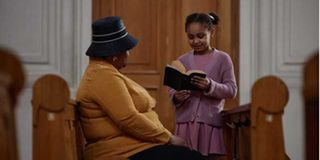
Many parents assume their children will grow up sitting beside them in the same church pews, singing the same hymns and sharing the same faith community. That is what Esther Wanjiku expected when she introduced her daughter to her church in Ongata Rongai.
Until she discovered that her child, who is deaf, felt lost in services. As she grew older, her daughter stopped settling in church, preferred staying at home and, before long, was asking to worship somewhere else.
“I realised my daughter couldn’t follow what was happening in church because she couldn't hear. At that time, we didn’t even share a language. She couldn’t hear me, and I didn’t know how to sign,” Esther tells Parenting.
Unknown to Esther, a team from a different church had befriended her daughter. When Esther was away, they used to go to her home, teach her daughter how to sign, and talk to her about their church.
“When I was on leave, I realised there was a group from Jehovah’s Witnesses church who used to come to my house. One time, they found me and said they wanted to talk with my daughter. I was shocked. When I resisted, they told me that they were not strangers to my daughter. I got angry and asked them why they would come to my house to see my daughter without my knowledge.”
Esther told them they were not welcomed in her house, but they insisted that they had to preach to her daughter before they leave. Being a Christian, she later allowed them into her house while keenly observing what they were doing.
“I could see that my daughter was focusing on whatever the group was saying. The following Sunday, I went with my daughter to our church as usual. Unfortunately, that day she disturbed me a lot, to an extent that we had to walk out before the end of the service. She kept telling me that we should go to Jehovah’s Witnesses church.”
Although Esther was uncomfortable going to a different church, she softened her stance and began taking her to the church she wanted.
“I felt it could be a turning point for our family, so we went. That Sunday, she settled well, but then I had to think of my next move.” Esther enrolled on sign language classes so that she could communicate with her daughter. One of her teachers introduced her to St Andrews PCEA church in Nairobi, where there are sign language interpreters. Although the church is very far from their home in Ongata Rongai, Esther began taking her daughter there, and she liked the church.
“My daughter is now a registered member at the church,” she says.
Esther, however, has remained a member of her home church in Ongata Rongai. That means mother and daughter go to separate churches.
“When I take my daughter to her church, I remain very idle in the car. Sometimes I look for a place to go for the three hours she is attending service, but I don’t tell her that I have gone away because if I do, she will get angry or scared. I just make sure I am at the parking lot by the time my daughter comes out of church. I have been doing that for four years now, ” Esther says.
Sometimes, Esther wakes up early, attends the first service at her church before dropping her daughter at her church, a routine that keeps her from being as committed to her church as she would like to.
“When I tried to let her go alone, she got lost, and it scared us. We are just now teaching her how to use public transport, although she is complaining a lot. I’m planning to take some leave from work so I can help my daughter learn the route. We’ll start by taking matatus together from Ongata Rongai to Nairobi, then walk from the Railways bus stop through the city to St Andrews PCEA church. We’ll repeat the trip several times until she feels confident, because she can’t master the route in just one attempt,” Esther explains.
Even as she hopes her 26‑year‑old daughter will one day become independent, Esther is encouraged by the changes at her Ongata Rongai church.
The introduction of sign language interpretation has begun to bridge the communication gap, a milestone she celebrates not just for her family but for other parents raising deaf children. For many of them, the language barrier had kept their children away from worship, but now they too can participate fully in church life.”
“My daughter still goes to St Andrews where there are many deaf congregants. That helps her to interact socially, and they also have a sign language service unlike in Ongata Rongai where we have a normal church service with someone helping with the interpretation. I believe that in future she will come back to our church.”
Jane Makana worships at Salvation Army church. Her eight children worship at different churches.
Photo credit: Pool
Esther’s experience is echoed by Jane Makana, a mother of 10 who has worshipped at the Salvation Army church since childhood and had all her children baptised there. But things began to change when one of her daughters joined a boarding primary school. Immersed in the school’s Catholic tradition, the girl started attending services there, and gradually, her spiritual path began to diverge from her mother’s.
While she had assumed that her daughter would be happy to attend Salvation Army church during school holidays, she still insisted on only going to Catholic church even when schools were closed, a decision that came with an extra cost for her.
“Catholics start their church services very early, while at the Salvation Army we start a bit late, at 9am. That meant I had to give my daughter fare to go to church because there was no Catholic church near our home. When I didn’t have fare, she would miss church,” Jane says.
Her daughter has never gone back to the Salvation Army. Her other children have also moved from Salvation Army church to other churches.
“My second-born daughter got married to a Catholic and adopted that denomination. Except my third- and seventh-born, my other children all go to different churches. I have taken it positively because they are adults,” the mother of eight says.
Janet Atieno is another parent with a similar story. She and her firstborn son were not living together when he joined high school.
“One day, when we were talking on the phone, he told me that he had changed churches. When I asked him why, he told me that the Pentecostal church was closer to my relative’s house where he was living at the time. I asked him whether it was his independent decision or someone forced him, and he told me that it was his own.”
That move caught Janet off-guard, and when she investigated the reasons for her son’s decision, she discovered something interesting.
“My son tells me he prefers the Pentecostal church because there he can pray out loud and even cry as he pours his heart out to God. Earlier this year, he dropped out of college, where he was studying construction engineering, after I fell ill and could no longer support his needs. He says those are the burdens he brings before God during the praise and worship sessions. In the Catholic church, prayers are more general, and he feels he cannot express his struggles in the same way,” Janet explains.
“All my other children go to Catholic church. I think my son moved away because of peer pressure. I decided to give him time to worship the way he wants,” Janet says.
According to Bishop Grace Omundi of Neemaland Ministries International, there is no problem when children choose to worship in different churches from their parents, so long as those churches are teaching Jesus Christ as Lord and preaching the true gospel.
Bishop Grace Omundi from Neemaland Ministries International, encourages parents to pray so that God directs the steps of their children as in the book of Proverbs Chapter 3.
Photo credit: Pool
“Some churches run youth outreach and retreat programmes that take children outside the usual church setting. Young people enjoy these kinds of interactions, which may be missing in the churches their parents attend. When they join such programmes, they feel happier, connect with peers who speak their language, and build friendships. That sense of belonging is not always available in their parents’ churches,” Bishop Grace says.
She adds that while every parent would love to worship in the same church as their children, it isn’t always possible. Factors such as jobs, urban living, and the rise of boarding schools often make that desire difficult to achieve.
“Many times children spend much of their lives away from home, surrounded by friends who introduce them to different churches. What matters most, Bishop Grace says, is not whether they worship in the same church as their parents, but whether those churches are teaching Jesus Christ. For children in boarding schools, it is often impossible to come home every weekend to worship together, so parents should focus on guiding them toward places where Christ remains at the centre.”
“Parents should ask their children what they learned in the churches they attend and continue to pray that God guides their steps. If we insist that they must only worship where we do, many will simply stop going to church. Instead, we pray for God to direct them wherever they are, in schools, universities, or workplaces, because at some point in life, they will move away from us,” Bishop Grace adds.
“It’s ideal when parents and children can worship together in a church they both love, because it brings unity to the family. But that doesn’t always happen. We don’t live in a perfect world. Sometimes a church offers youth programs that children enjoy, and parents have to compromise by allowing them to attend a different church,” says evangelist Matthew.
He adds that parents who allow their children to worship in different churches are not any less devoted. In fact, they can strengthen their bond by occasionally visiting the churches their children attend, even if it’s just once in a while.
“Let’s focus on what unites us rather than on denominations,” he says. “We are all ordained in Christ and believe that He died for us. In reality, children will sometimes choose different churches, and that’s part of life.”
Matthew notes that some children are drawn to churches with younger pastors or leaders who preach in ways that feel more relatable to them. These differences often explain why children choose to worship apart from their parents. What matters most, he emphasises, is not the specific church they attend but that they are growing spiritually.
"Look at the 12 disciples. None of them would have become followers of Christ if all they did was sit in synagogues. They got that because they spent three and a half years in the company of Jesus."