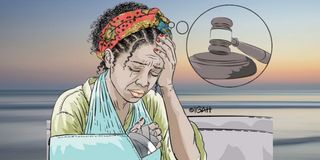
My daughter is experiencing severe domestic violence from her husband. She has not shared full details of the incidents in which she has been assaulted, but I recently learned that she suffered an injury to her arm and had to seek urgent medical treatment. The doctors have indicated that she may never regain use of her right hand. As a family, we want to understand the legal pathways available under Kenyan law to protect her and pursue justice.
While the law cannot directly resolve fear, shame or emotional conflict, it provides safeguards that strengthen a person’s courage and capacity to confront situations that might otherwise fuel stigma within a less informed community.
The Kenyan Constitution affirms human dignity as an inherent right under Article 28, making any action that tampers with, threatens or diminishes humanity illegal, unconstitutional and inhuman.
All forms of violence are treated as affronts to the law. When violence, regardless of context, results in bodily harm, physical destruction or emotional distress, as in your daughter’s case, several legal mechanisms activate to ensure protection, accountability and redress.
The family may pursue both criminal and civil pathways. Although applied separately, these avenues form a responsive framework that may lead to justice as envisaged in Article 48 of the Constitution.
The Prevention of Domestic Violence Act (2015) stands as statutory testimony of societal concern for respect of human rights within unions, whether strictly legal or socially recognised. The Act acknowledges that victims and survivors of domestic violence require not only protection but also a meaningful hearing of their spoken or unspoken cry for redress, determined to the most successful legal conclusion.
Importantly, it recognises fear, trauma, stigma, emotional ransom and shame as real obstacles to deterring perpetrators. It therefore allows a third party to commence proceedings on behalf of a survivor. This reflects the operational intention of Article 22(1) of the Constitution, which empowers anyone to approach the court whenever there is a living or emerging reality indicating violation of the Bill of Rights. In legal terms, it grants locus standi to everyone, meaning the matter need not directly relate to the person moving the court.
Application of the Prevention of Domestic Violence Act is often accompanied by the Penal Code, the Marriage Act (2014) and the Sexual Offences Act, depending on the nature of harm. Grievous bodily harm is an offence against the public interest.
Under Sections 4, 231 and 234 of the Penal Code, an offender is liable to life imprisonment. This position was affirmed in John Oketch Abongo v Republic [2000], where the court held that injuries resulting in long‑term disability constitute grievous harm. Additional court orders may include restricting the perpetrator’s access to the survivor, removal from the matrimonial or shared home, prohibition of communication, and safeguarding of children where applicable.
Criminal proceedings require a formal report to the Directorate of Criminal Investigations (DCI), which undertakes investigations directly or through delegation. These investigations must be supported by a completed P3 form issued by a medical officer indicating the type and degree of harm.
Once investigations are complete, the matter is referred to the Director of Public Prosecutions, whose constitutional mandate is to decide on charges. The case is subsequently placed before a judge or magistrate for determination, ensuring even the alleged perpetrator receives a fair trial as espoused in Article 50(2), as a right.
Regardless of whether criminal proceedings are preferred, it is legally permissible to pursue a civil claim seeking compensation where permanent injury is medically proven. If the court finds the claims credible, it may award damages covering current and anticipated medical treatment, loss of earning capacity, and monetisation of pain, suffering and emotional distress.
There is also the option of invoking the Marriage Act (2014), which recognises cruelty as an indisputable ground for divorce or separation. In seeking dissolution of the union, the petitioner may request limited access by the perpetrator to herself and the children, alongside custody, maintenance and protection of her rights to matrimonial property.
Division of such property, however, requires application of the Matrimonial Property Act (2014). Several court decisions affirm this position. In Dr. LAG v. Dr. KOG (2026) the court held that physical violence undermines the safety, sanity and dignity of a survivor spouse. Similarly, MGD v ADA (Divorce Cause E007 of 2025), it was established that domestic violence affects the welfare of children and requires no proof of direct harm.
Vulnerability, as envisaged by Kenyan statutes, is never an excuse or ground for those in positions of power to perpetrate discrimination, criminality or torture. Article 29 of the Constitution, read together with Article 27, firmly asserts this principle.