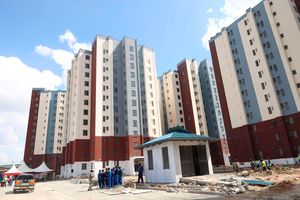
For years, the dream of home ownership has remained elusive for millions of Kenyans. Rising land prices, expensive mortgages, high construction costs and rapid urbanisation have pushed decent housing beyond the reach of many families.
In Nairobi and other major towns, tenants continue to spend a significant portion of their income on rent, while informal settlements expand as demand for housing continues to outpace supply. Successive governments have attempted to address the housing deficit, estimated at more than 200,000 units annually, but few initiatives have attracted as much attention, support and controversy as President William Ruto’s Affordable Housing Programme.
The housing agenda once again took centre stage during the reading of the 2026/27 Budget, with the government unveiling an ambitious financing strategy aimed at accelerating the construction of affordable homes across the country. At the heart of the plan is a bpay slipsold proposal to mobilise nearly Sh238 billion through Housing Levy collections, sale of completed units and a new borrowing mechanism known as securitisation. Supporters view it as the most serious attempt yet to tackle Kenya’s housing crisis.
Critics, however, warn it could deepen long-term financial obligations carried by workers whose payslips already bear Housing Levy deductions. The question now is whether this push will finally make home ownership affordable for ordinary Kenyans or create a debt-driven housing model whose effects will be felt for decades.
Housing has become one of the pillars of the Kenya Kwanza administration’s economic transformation agenda. Beyond shelter, the government views housing as a driver of job creation, industrial growth and broader economic development. The construction sector has traditionally been among Kenya’s strongest economic engines. Every housing project generates employment for engineers, architects, masons, plumbers, electricians, transporters and suppliers of building materials.
President William Ruto lays the foundation stone for an affordable housing project during the launch of the Konza Technopolis in Makueni County on October 13, 2025. Looking on is PS Charles Hinga.
Photo credit: PCS
For this reason, the State frames housing not just as a social intervention, but also as an economic stimulus programme capable of circulating billions through the economy. Kenya produces only about 50,000 housing units annually against an estimated demand of 250,000 units. The gap continues to widen, fuelling overcrowding, rising rents and the expansion of informal settlements.
For example, according to the Kenya National Bureau of Statistics (KNBS), the government completed 1,655 affordable housing units last year, and this marked a 50.7 per cent decrease compared to the previous year when 3,357 units were completed.
While completed numbers fell, the KNBS noted that over 138,400 units with an estimated construction cost of Ksh 385.8 billion were still under construction.
This year, the Kenya Kwanza government plans to construct 500,000 housing units.
To address this gap, the government introduced the Housing Levy as a mandatory contribution from both employees and employers. Workers contribute 1.5 per cent of their gross salary, matched by employers, with funds channelled into the Affordable Housing Fund.
For the government, the levy offers something previous housing programmes lacked: predictable and continuous financing. For many salaried Kenyans, however, it represents another deduction in an already strained economic environment, yet despite public debate and legal challenges, the levy remains the backbone of the housing programme.
The latest budget proposals signal a shift in scale and ambition. The Ministry of Housing plans to mobilise nearly Sh238 billion through a combination of Housing Levy collections, housing sales (50 billion), development partner support and securitised borrowing (Sh100 billion). One of the most significant developments emerging from the housing financing plan is the proposal to securitise future collections from the Affordable Housing Levy, a move that could fundamentally change the lifespan of the deduction on Kenyan workers’ payslips.
According to parliamentary and Treasury-linked discussions reported in the 2026 budget cycle, the government is considering borrowing against future Housing Levy inflows to raise approximately Sh100 billion. The idea is that future monthly deductions, currently set at 1.5 per cent of gross salary for employees, matched by employers, would serve as security for lenders financing the Affordable Housing Programme.
Mukuru affordable housing project units in Nairobi on May 10, 2025.
Photo credit: Bonface Bogita | Nation Media Group
If implemented, the arrangement would effectively convert the Housing Levy from a short-term funding mechanism into a long-term repayment instrument, tied to debt obligations that may extend beyond the current administration. The plan is intended to bridge a funding gap estimated at about Sh118 billion required to sustain ongoing affordable housing construction across the country.
While government officials argue that securitisation will accelerate delivery of housing units by unlocking capital upfront, critics say it could “lock in” the levy for years, making it politically and financially difficult for future governments to reverse or abolish it without compensating lenders. This has fuelled growing debate over whether the Housing Levy is gradually evolving from a development contribution into a permanent payroll deduction embedded within Kenya’s fiscal structure.
According to Tsalwa Waburiri, an Architect and former President of the East Africa Institute of Architects, the intention behind the programme is sound, but its impact depends on scale and planning.
“Affordable housing cannot be just a wish list; it is a reality we must deal with. But for it to work, we need a critical mass,” he says.
“If you look at the units completed or in the pipeline, they are still very few compared to a population of over 50 million people. At this stage, the impact on rental prices is minimal. In the long term, if sustained, it will be felt.”
On financing, he supports securitisation in principle.
“Securitisation is a good approach, especially for infrastructure. It allows long-term funding and guarantees continuity. Combined with the Housing Levy, it can support large-scale delivery.”
“We are focusing too much on houses and not settlements. A proper programme must include schools, hospitals, markets, parks and social spaces. Otherwise, we risk creating future social problems.”
One of the biggest questions in the property market is whether the programme will ease rental pressures. In theory, increased supply should reduce rent growth by improving housing availability; however, experts caution that the effect may not be immediate.
Most affordable housing units are targeted at ownership rather than rental markets, limiting short-term impact on rental supply. Over time, however, resale and rental of units could expand available stock, particularly in high-demand urban areas. Neighbourhoods receiving large housing projects may experience slower rent growth compared to areas with limited new supply.
The debate on sustainability
While the government insists the financing model is sustainable, critics question its long-term viability.
Waburiri argues that the Housing Levy may not be sustainable because it places the burden on a small segment of the population.
“You are targeting employees to fund housing for the entire country. That is not sustainable in the long run.”
He contrasts this with earlier models such as the National Housing Corporation, which directly implemented government-led housing programmes.
“We had a more structured approach before. Today, we are raising money first before fully understanding demand.”
“In some rural counties, housing is being constructed where people already own homes. Without proper needs assessment, some units risk becoming white elephants.”
Homa Bay affordable housing project in this photo taken on May 29, 2025.
Photo credit: George Odiwuor | Nation
Another major concern is occupancy rates. While thousands of units are under construction across Nairobi, Mombasa, Kisumu, Nakuru and Eldoret, full public data on occupancy remains limited.
Waburiri notes, “We need transparency on numbers, how many units are completed, how many are occupied, and where demand actually exists.”
The programme also raises questions for private real estate investors. While construction firms and suppliers benefit from increased activity, private developers in the middle-income segment may face competition from government-backed housing priced below market rates. However, the government maintains that demand far exceeds supply, meaning there is room for both public and private players.
A section of the Vihiga Affordable Housing Project in Majengo, Vihiga County, on March 19, 2026.
Photo credit: Alex Odhiambo | Nation Media Group
Beyond economics, the programme has sparked a deeper philosophical debate. Waburiri suggests that Kenya’s approach should shift from “housing” to “settlement planning.” He argues that successful urban living requires integration of social amenities.
“If you don’t provide parks, schools, and recreation spaces, people will end up in bars or overcrowded informal spaces. Housing alone is not enough.”
He cites emerging trends in Nairobi estates like Kileleshwa and Kilimani, where residential zones are increasingly mixed with commercial activity due to population pressure.
Ultimately, the success of the Affordable Housing Programme will not be measured by funds raised or units announced, but by whether ordinary Kenyans can transition from renting to owning homes. For some, the programme represents long-awaited hope in a housing market that has priced them out for decades. For others, it raises uncomfortable questions about long-term financial commitments tied to their payslips.
As construction cranes rise across Kenyan cities, the question is: Will the Housing Levy become a pathway to home ownership or a permanent deduction financing a dream still out of reach for many?