Felister Wanjiru, 35, has two children. Every time the Christmas season comes around, they pack their bags and join more family members in Limuru for the season celebration. There, they make merry, catch up, and sometimes, bring out old family albums and reminisce about the good old days.
“There’s an album with photos of my siblings and me as we were growing up and one with photos of our parents when they were young and rocking the afro hair and high-waisted trousers,” she recounts fondly. “There are also photos of my friends and me from when we would go to the nearest town on Sundays and take photos. I even remember the studio we used to go to – Kaka Studio. It had the usual setup: curtains and some flowers on a stand, and there we would be making funny poses.”
And though it is not necessarily a tradition, Ms Wanjiru believes that every time they huddle up to flip through the frozen memories and the stories that they keep, it strengthens their bond as a family.
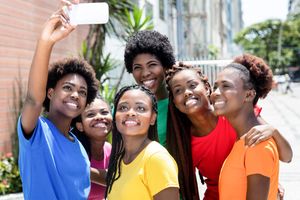
A family takes selfies.
Photo credit: Shutterstock
“There are happy memories, but there are others which are tough. I lost my brother and uncle some time back, and the only way we can remember them now is by looking at their photos,” she reveals. “It still hurts to see someone whom you loved and is no more. But it’s good, even for the children, because although they never met my brother or my uncle, they can now recognise them whenever they see their photos.”
Unsure whether photo albums still exist today, Ms Wanjiru expresses sadness over the changing times.
“I think the photo albums were better than scrolling through a phone gallery. It was interesting to look at them and hear the stories behind the pictures, but they were also the only welcome visitors would get when they came. Now, there is no way someone will come to your house, and you give them your phone and tell them to scroll through the gallery while you prepare their tea. Our photos these days are only for our eyes unless you decide to post them.”
But while it’s true that the album culture is not as vibrant as it once was, it hasn’t completely died off. There is a small but devoted community that is still keeping it alive. Among these devotees is Sharon Waga, 54, who has been printing and storing photos in albums for the last 26 years.
“From the day I got married, I had an album for my wedding. Then, as my children came along, I had one for each of them. Over time, I’ve just kept adding to these albums,” she says.
The roots of this habit, she traces to her late father.
“My dad loved taking photos. He didn’t even need a special occasion to do it. For him, any moment was a photo moment. I remember there were times when we would have just gotten home from church, and he would gather us in the garden for a photo,” she reminisces. “And he loved using the Polaroid camera, you know, the one that removes photos on the spot.”
Naturally, all these photos would need somewhere to be kept, so it comes as no surprise that Ms Waga grew up surrounded by photo albums. Though they didn’t hold much value for her at the time, seeing the role that the photographic records played when visitors turned up at their door, she came to understand them as conversation starters.
“It was such a natural thing to do that whenever you went to someone’s house, you’d almost demand to be given the photo albums before anything else.”
But their family albums didn’t just spark conversations with visitors; they were also ‘dad’s way of storytelling.’
“Whenever there was a power outage, my father would call for the albums to be brought out, and he would gather us around this bright Optimus light that we had. He’d then proceed to tell us (with much detail and passion) the stories behind each photo,” she recalls with a nostalgic laugh. “One photo would bring a whole story, and he would want you to pay close attention to everything he was saying.”
Ms Waga and her siblings would go to bed later and laugh. But fast forward the years, and she was the one doing the same with her children.
“As my children were growing up, we used to look through our family albums quite a bit because I wanted them to understand what life was like before. They also had a lot of questions. They were curious about things like my wedding, what it was like, or my daughter would want to know what her older brother looked like as a baby and such things,” she says.
Her children are all grown now, and the family no longer gathers around their albums as much, but Ms Waga says that she still looks them up on her own every now and then.
“I lost both parents. My mum passed away before the digital age, so there aren’t any digital photos of her anywhere. So, whenever I miss her, I find that I go back to the albums to look at her pictures. But I can’t say that I use them much now unless something happens and I find a reason to do so.”
But with all the digital storage options available today, why does the more analogue approach still appeal to Ms Waga?
“I find something quaint and interesting about having a book with pictures in it,” she states.
Her sentiment remains true for the different versions of the album available today: the older plastic ones in which pictures could be slotted in or removed, and the more modern ones where photos are printed on the pages and the album is made to look like an actual book.
“When you have an album, you can write stories in it. For example, if you look at my children’s albums, I’ve written things like, ‘this was the day he took his first step’ or ‘this was the day he grew his first tooth’. It’s some sort of journal, and I don't think that’s something I’d be able to do digitally,” she notes. “There’s just this feeling that comes with turning those pages that clicking a button can’t do. But maybe it’s just that I’m very analogue as a person. I also don’t enjoy reading electronic books.”
Another thing she appreciates about the albums is the authenticity and spontaneity of the captured moments.
“With digital photos, you rarely get to dwell on a photo. We take five snapshots of the same thing and scroll or swipe looking for the best one. They’re very refined and all about sharing the moment. But when you look at the albums, the photos there were taken as is, with someone smiling, another frowning, and when you went back to look at them, it would be something to laugh about. For these, the primary motivation is capturing and keeping the moment.”
Offering another scenario to support her preferences, Ms Waga speaks about her son’s wedding photos.
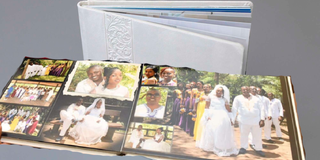
“He sent me a link with about 700 photos. I remember there were about eight pictures of the same scene at one point. I found it so tiring to be honest, I’ve never quite finished looking through them. But for their wedding album, they did the modern one that’s like a book; it was only a few pictures of every important stage of the wedding. It was made up of a few pages, but it was enough to get the whole wedding story.”
But even with her preferences firmly set, Ms Waga does not necessarily believe that we are losing something important by going digital with the preservation of memories.
“Whether we like it or not, the digital age is here. But maybe instead of throwing out everything, we could use the digital to enhance what the past was. So, for example, it’s interesting how my son’s wedding album and mine are totally different. When you look at his album, nobody needs to tell you how the wedding went; the whole story is sequentially spread across the photo book. And with the way it’s been made, nobody can move a picture from page two and take it to page 28 like in mine and mess things up. So, it’s still an album but enhanced,” she explains. “I have a grandson who is just about to turn a year old. I imagine at some point when he is older, it would be so nice to spend an afternoon just looking through pictures and telling him, this is your great-grandfather, this is your grandfather, and this is your daddy when he was a baby. I think it adds some value and flavour.”
Chebet Ouma, regularly brings out the family photo albums to show her children how her journey through the years has been.
Photo credit: Pool
Chebet Ouma, 43, who has about seven albums with her during our interview, backs up her every word with a supporting flip through her stash of memories. When I ask when she started keeping her photos in an album, she rummages through the pile and delicately spreads one open.
“This is the first album,” she says. “These are photos from my campus days in Kenyatta University, but I actually have some from primary and high school in here.”
Tilting the album to me, she points out a shorter, skinnier version of herself in a group of bright-eyed children. “This was 1990, Sunday school. I used to live in Mombasa, born and bred there till 1994.”
Leafing through the slightly tattered pages, she happily goes down the rabbit hole that is her memory, eventually moving on to more recent albums. Every so often, she’ll leaf through multiple albums just to show the transformation of some of the characters in her albums. In the latest album, one that’s only a few weeks old, she looks exactly as she does during the interview, except her mood was more somber in the frozen moment as she laid her brother to rest.
“I like to store them physically like this because it takes me a while to look for them on the phone. With albums, it's easy; I know this one is for this year, and so on. Besides, Google keeps telling me that my storage is full, which is why even now, I want to develop some more and just have them physically.”
“Some of these pages are torn, and others have missing photos because of the visitors and my children. Some of them don’t know how to handle these albums well,” she says.
The albums usually come to life whenever Ms Ouma is talking about her past and the journey to where she is now. Though random sometimes, this mostly happens when schools have just opened or when they’ve just closed.
“And why, when schools open? So we can show them how we also struggled to get to where we are. As for when schools have closed, that one is just to show them how we lived.”
Revisiting her past like this, Ms Ouma says, always lifts her spirits, no matter if she’s bored, worried about something, or missing loved ones who are no longer in this world.
“Initially, my go-to photos were my children’s photos, but now the ones I always want to check out are my wedding photos,” she says. Ms Ouma feels we are losing something important with the digitisation of photos.
“Someone will tell me, ‘Oh, you can save them in a flash drive,’ but how many times do you get to look at that? I always say, if it’s not on paper, it didn’t happen.”
Dr Linda Maina, 46, concurs.
Dr Linda Maina, believes that photo albums still hold a lot of value, and that we might be losing something important by going fully digital with our photo storage.
Photo credit: Pool
“It is very easy to retrace your memories when they are on paper. With the digital ones, it can be difficult because sometimes you don’t even remember the date or the year, or you could delete them accidentally, or maybe even your phone could crash, and you end up losing everything,” she argues. “I also remember how our parents would sometimes pass on some photos to us, but with the digital ones, I think we’re losing that aspect.”
Dr Linda’s earliest photographs are from her days in primary school, but she insists that when it comes to photographs, her husband is the more passionate one.
“He makes sure he has a camera at every point. Now, even when we go to functions, he is the one who captures all our moments. And then because he treasures the photos so much, sometimes he even locks away the albums.”
Still, they often come out.
“It is a form of bonding with the family because with every photo, there is a story. And as you explain the story, it allows for interaction,” she says. “It also makes you remember the past, and then you are able to compare with where you are at now.”
As far as challenges go, the only ones Ms Maina could think of were the wear and tear of the albums, the cumbersome nature of turning this way to view the photos, and theft.
“People steal photos. And then when you go to their places, and they show you their albums, you’re like, ‘Ah, these photos look familiar!’ My sister and I are also guilty of this. She used to steal mine, and I would steal from my mum.”