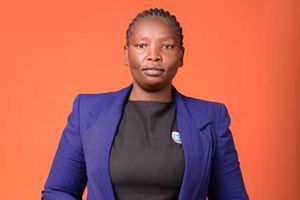
She scored a D in the Kenya Certificate of Secondary Education (KCSE), a grade that in many Kenyan homes is quickly written off as failure. But Beryl Odhiambo says that grade tells only a small part of her story.
Behind it is a girl who was once at the top of her class. However, a father who walked out on the family, leaving her mother to fend for them alone, and the challenges that came with it, took a toll on her final exam performance.
“In primary school, my report cards never showed anything below 400 marks out of 500,” Beryl recalls. “Every closing day, I remember the loud claps, certificates, and everyone praising me for being the best student. I wanted to become a doctor.”
Then, at 14, everything changed.
“My parents separated, my dad went his way, and my mother shouldered the burden of caring for us, my four siblings and I.”
“I was in Grade Seven at a very good public school when my parents separated. My mum had to transfer me to a small school in a slum where she could afford to pay school fees. Initially, we used to live in a two-bedroom house, but all six of us had to move to a single room,” she says.
Meals were not guaranteed, and even paying fees in the cheaper school became a struggle for Beryl’s mum, who was doing menial jobs like laundry and house work.
“The challenges affected me, and I scored 377 out of 500 marks in my KCPE exams. Still, I was the top student in my school.”
Beryl and her family relocated to her mother’s home in Siaya County. Her younger siblings enrolled in primary schools while Beryl’s plans to join a national school, Loreto Girls High School, faded.
“I had an admission letter which I just kept in the house,” she says. Beryl joined her mother in doing odd jobs in the village to support her younger siblings.
“Three years later, when my former classmates were going to Form Four, I found a job. The organisation I worked for offered to pay for my KCSE exams, which I readily agreed to, even though I did not have any secondary education. I registered as a private candidate and began looking for learning materials. I sat the exams and scored Grade D.”
With her KCSE certificate, Beryl enrolled for a certificate course in logistics and storekeeping before pursuing a diploma in social work and community development. She is a programme officer at Lean on Me Foundation, an organisation that aims to empower girls and teach them about their sexual and reproductive health.
“I started as a volunteer, teaching young women about their health, and I keep advancing in my career.”
Beryl’s journey is not an isolated case. Last year, nearly 482,039 KCSE candidates got a D+ and below (D, D, or E grades), a grade which can have a significant impact on a student’s academic and career options. But it does not necessarily close all doors.
Thomas Kibet got Ds in his science subjects, which he felt kept him from becoming a doctor. He says he was used to getting good marks in the Kenya Certificate of Primary Education (KCPE), but once he got to high school, things changed.
Thomas Kibet.
Photo credit: Pool
“I scored 329 out of 500 marks in KCPE in 2007. That was during the post-election clashes, so I could not go to the school I was called to because it was far from home.” Kibet’s parents secured a slot for him at Kericho Tea Boarding Secondary School. However, school fees was an issue.
“I am among those who benefited from the free primary education under former president, Mwai Kibaki. Otherwise, I could not have even made it to Class Eight.”
Kibet was lucky to get a sponsor for his high school fees. He excitedly reported to school, ready to learn.
“I thank God for the sponsor. The agreement was that he would pay my school fees while my parents provided my other school-related needs, but it was a struggle. My family could not afford anything. I remember there was a time, during half-term break, I was stranded in school because I couldn’t raise the Sh150 transport home.”
That day, one of his teachers gave him the bus fare, and he went home. Such challenges were common, but he stayed resilient and completed high school.
“I wanted to be a surgeon, and I needed at least a B+ mean grade. To date, I have never known why I failed in chemistry and mathematics, which are core subjects. I scored a C- in KCSE,” he says.
As his classmates proceeded to university, Thomas started doing casual jobs like construction and farming to raise money for college.
“I wondered what course I would pursue now that I could not study medicine. I settled on a diploma in fisheries at the Kenya Wildlife Research Training Institute. In the entire college, there were only six students taking the course. That same year, I tasted fish for the first time,” says Thomas.
Thomas persuaded his parents to sell a quarter acre land to pay for his admission and first semester fees. He joined, but due to a lack of fees, he kept deferring his classes. He finally graduated in December 2024.
“I am ready for a job, and I’m looking forward to doing a degree course in Natural Resource Management to complement my diploma.”
For Jane Kemunto, 25, poor KCSE results signalled the beginning of a different calling.
“My parents diligently paid my school fees, but I failed. I don’t like talking about my KCSE grade. It was D minus. Most people spoke negatively after they learnt of my poor KCSE performance,” she says.
Jane now competes in the women’s 10,000, 5,000 and 800 metres races, and she has won a number of medals.
“After high school, I stayed home for about three years. In 2023, I met my role model, Kenyan 400m record holder Mary Moraa. She encouraged me, and from that day, she has been giving me opportunities in the athletics world.
In many Kenyan households, a child who scores low marks is often treated as the ultimate failure. Yet education experts say poor results rarely come down to lack of ability alone. Poverty still locks many learners out of schools with adequate learning materials and proper facilities, while in some cases, the syllabus is not fully covered. Add to that poorly managed exam environments, inadequate preparation, strict marking, overconfidence, anxiety and indiscipline, and the outcome becomes easier to understand.
Njeri Maria who holds a bachelor's degree in Community Development says that there is a need to celebrate students regardless of their KCSE results.
Photo credit: Pool
“We need to change our mindset. Students who score As are not necessarily the best for society. For instance, when I was in school, my teachers noticed that I was good at leadership and talking with people. Through that, I became a school representative and later school president and now I’m utilising my leadership skills in society,” says Njeri Maina, founder of Njeri Maria Foundation, an organisation that works with children with cerebral palsy and neurodevelopmental disability in Nairobi, Kiambu, and Meru.
Joshua Ndunda is the sports and games administrator at Multimedia University of Kenya.
Photo credit: Pool
According to the sports and games administrator at Multimedia University of Kenya, Joshua Ndunda, there is another world beyond Form Four results.
“The society needs to value children’s talents, not just their grades. This will encourage them to know that by using their skills, they can measure up to other professionals,” he says.
“Talent pays. Some athletes and actors earn much more than employed PhD holders,” adds Ndunda.
Vincent Kipchirchir scored A with 82 points and holds a Bachelor's degree in Electrical Engineering. He is the current Network Product Manager at Huawei Technologies Kenya.
Photo credit: Pool
With a little help, some children manage to turn their grades around. Back in primary school, Vincent Kipchirchir was often at the bottom of the class. Judging by his performance in primary school, few of Vincent’s teachers would have imagined that he would go on to become one of Kenya’s youngest tech managers.
“I was often the last student in primary school. It felt bad to constantly be at the bottom of the class,” he says.
His older siblings, who had performed well themselves, took him under their wing. They came up with a strict study routine, lights out at 9pm and early mornings that began at 4am for revision. Slowly, the effort paid off. His grades improved, and when he finally sat his KCPE exams, he scored 403 out of 500 marks. When he joined high school, he enjoyed science subjects and was the top student in chemistry. He attended several science contests.
“I scored an A in KCSE. I was very happy because I knew that I would pursue a course of my choice at university,” says the Kapsabet Boys’ High School alumnus.
After high school, he was accepted into the Equity Leadership programme powered by Equity Bank, where he was taught how to handle corporate problems as a leader. Together with other top-performing students, Vincent was offered a job as a teller in the credit department.
He initially wanted to study medicine, but settled on a Bachelor’s degree in Electrical and Electronic Engineering at the University of Nairobi.
“I knew that apart from coursework, I needed an extra skill so that I could get an edge in the job market, which is why I started networking aggressively. During that time, I learned about the ICT academy at the university, which I joined.”
There, he learned of the Huawei ICT competition and registered. He won both at the campus and national levels. The win led to an opportunity for him to work on a project for the regional competition, which his team also won.
“In May 2024, when I was in my fifth year, I went to China, where I competed with students from all over the world, and my team won,” he says.
Vincent graduated with a Second Class Upper. “I joined Huawei, starting as a technical personnel network engineer, then transitioned to my current position as the network product manager.”
With the global award under his belt, Vincent returned home and focused on completing his studies. But, he still applied for the Huawei graduate training program. This meant that by the time his schoolmates were looking for internship opportunities, he was already learning core skills in his industry.
“I graduated with a Second Class Upper grade, and I was grateful that I had a job by the time I was graduating. I joined Huawei, starting as a Technical Personnel Network Engineer. I supported our major internet service providers in Kenya. I then transitioned to my current position as the Network Product Manager at Huawei Technologies Kenya.”
Vincent unwinds by engaging in fine arts such as drawing, a talent he has nurtured since primary school.