The law requires every vehicle to carry a first aid kit.

The law requires every vehicle to carry a first aid kit. That is okay. But what should be in it…to save a life? Muraia
Carrying a first aid kit in your car is a jolly good idea. But making it legally compulsory is more about emphasising a message than delivering medical aid. Especially if the law doesn’t specify what should be in the kit or educate its potential users.
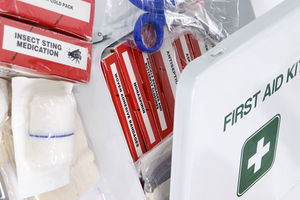
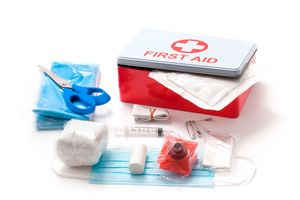
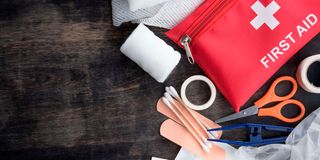
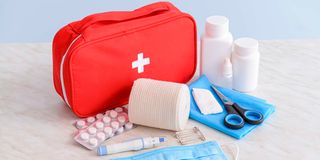
An aspirin? A sticking plaster? Some antiseptic cream, perhaps, and pills in case someone in the vehicle gets the runs? A safety pin, a needle, some cotton thread, a pair of scissors, and a bandage? Some eyewash and antihistamine? By all means, pack all of that, and more, to help deal with all the little troubles that can arise on a safari.
But that’s your choice. Not a legal issue. No one is going to die if you don’t carry these remedies (and anyone with a severe toothache might rather be dead anyway). If you want to pick just a single item, a mobile phone (and perhaps some rubber gloves).
Where first aid could and should have legal status is when dealing with life-threatening injuries from an accident. And when that happens, anyone who knows what she or he is doing might welcome but won’t need a first aid kit, and anyone who doesn’t know what they are doing shouldn’t try to use one.
Basic first aid “knowledge” is the essential and arguably only first aid kit that might help keep someone alive until an ambulance and paramedics (second aid) or a fully equipped operating theatre (third aid) arrive…with oxygen, defibrillators, blood transfusions, adrenaline, immobilising collars…
The law requires every vehicle to carry a first aid kit.
Emergency first aid is what you can do before that to prevent an avoidable death.
For the full details, talk to an expert. But for the cardinal principles, it is axiomatic that to avoid death, you need to sustain the essentials of life. If you can.
The essentials are breathing, an adequate blood supply and a heart/pulse to pump it. If breathing is not happening, you need to get it started or substituted with all possible haste, and to do that, you need to know how to position the patient, how to prevent choking, and preferably how to administer artificial respiration and/or CPR (get the heart beating and the lungs pumping). The value of a first aid kit (without a defibrillator) in those respects is about zero.
If there is major blood loss, you need to stop it, pronto, by applying pressure to the wound and possibly a tourniquet (if the bleeding is from a limb). If there’s no pulse, CPR is urgent. Again, the absolute need for a basic first aid kit is nil. Though some sterile pads and a bandage to hold them can be helpful, their “urgent” job can be done with all sorts of other materials that will be at hand. Start with your shirt.
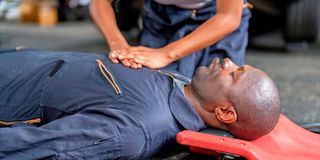
First aid.
Consciousness is a good sign and can be helpful in managing the patient, but it is not essential, and, again, you will not find it (or any means of restoring it) in a minimal first aid kit.
Beyond those most basic things, it is more important to know what you should not (repeat not) do, than to know what you might try to do (usually the less the better). With some injuries, randomly moving a patient can do more harm than good. Indeed, it could kill someone who might otherwise have survived.
While breathing, bleeding, pulse and consciousness are being attended to, priority attention should be given to managing the scene – getting someone to call for expert help, others to warn on-coming motorists – and keeping the injured person warm, calm and reassured.
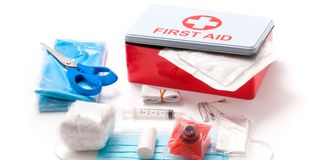
First Aid kit.
What the law should do is insist that these principles are taught and tested. Knowledge of them should definitely be carried in every vehicle. They are immeasurably more important and more likely to save a life than a first aid kit.