For a tenant paying rent, a shopkeeper running a business or an investor putting millions of shillings into an apartment block, one of a building’s most important features may be difficult to see — whether it has been properly inspected and cleared for occupation.
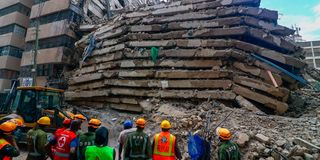
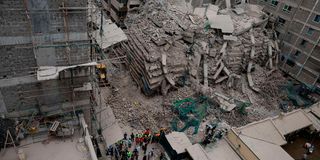
Emergency personnel work at the site of a building that collapsed in Eastleigh, Nairobi on October 23, 2026.
Photo credit: Reuters
That distinction came into sharp focus in Eastleigh, Nairobi, on October 23, when a multi-storey building under construction collapsed along 9th Street. While work was ongoing on the upper floors, businesses were operating on the ground floor. Nairobi Governor Johnson Sakaja subsequently, said the building did not have an occupation certificate , raising questions about how people had been allowed to occupy premises in a structure still under construction. For tenants, traders and investors, the consequences of a building collapse can be far-reaching. These can include destroyed stock and damaged belongings; interrupted business; lost rental income; disputed insurance claims; and lengthy legal battles.
Governor Johnson Sakaja interacts with a youth during his tour at the scene of the collapsed building in Eastleigh.
Photo credit: Wilfred Nyangaresi | Nation
George Arabbu Ndege, president of the Architectural Association of Kenya (AAK), says the incident highlights the danger of treating a live construction site as a place ready for people to live or work. “Ordinary live building sites are hazard zones that require careful management and controls to avoid accidents and injuries to construction workers, neighbouring properties and the general public,” he says, noting that it is risky to live in or conduct business from a building under construction. A Daily Nation investigation published on October 25 reported that building collapses in Kenya had killed 30 people and injured 58 in five years.
One central issue in Eastleigh is the difference between permission to develop a property and permission to occupy it. Sakaja said the county approved an application in October 2024 to change the property’s use from residential to commercial-cum-residential. However, he said architectural plans subsequently submitted for the proposed development had not been approved. The governor said the county had forwarded its report to the Directorate of Criminal Investigations for further investigation. The National Construction Authority (NCA) identified 9th Street Plaza Limited as the developer and Stromax Holdings E.A Limited as the contractor listed in its records. Emmanuel Mwangi Maina was listed as project architect and Joseph Muturi Mugu as structural engineer. The authority said the proposed development was registered on July 30, 2025. Its initial statement did not establish whether inspections had been conducted before the collapse or whether the project had previously been flagged for safety violations. Ndege says a building should be occupied only after construction is complete and the consultants have inspected and commissioned the building works and services. Known defects should be recorded and attended to by the contractor and subcontractors. The architect then issues a Certificate of Practical Completion, on the basis of which the developer applies to the county’s Development Control office for an occupation certificate. Ideally, the county should also inspect the completed project. Ndege says the rules can be undermined by pressure to earn rent quickly, the housing deficit in major cities and poor enforcement. Many tenants, he adds, do not know what evidence to request to establish a building’s quality and legal status. He places primary accountability on developers, saying some may collude with corrupt county officers to avoid scrutiny. County and national governments, as well as relevant State agencies, also share responsibility for inspections and enforcement. The business of letting premises, Ndege notes, is generally outside the responsibilities of design consultants. However, occupying a building while it is under construction is illegal unless a partial occupation certificate has been issued. Such phased occupation must be considered at the design stage and supported by a robust plan. Safety arrangements must separate tenants from construction workers, machinery and materials, using measures such as hoarding and clearly defined access routes. Without these safeguards, the presence of shops or residents is not proof that a building is safe. Florence Nyole, Commonwealth Association of Architects (CAA) Vice-President for Africa, and immediate past president of the Architectural Association of Kenya (AAK), says building collapses cannot be addressed through enforcement alone without confronting weaknesses in professional oversight, structural design and construction practices. She identifies inadequate engagement of qualified professionals, questionable structural engineering solutions in multi-storey buildings, and poor concrete mixes and steel reinforcement design as some of the concerns that undermine building safety. She says these failures can expose occupants, property owners and investors to risks that could be prevented through proper professional involvement and adherence to engineering standards. Nyole also points to gaps in government oversight, alleging that inspectors from county governments and the National Construction Authority (NCA) can face interference that undermines their ability to enforce building regulations. She says Nairobi's approval of high-rise developments must also be guided by zoning restrictions and infrastructure capacity, with roads, drainage and other essential services planned before areas are intensified through densification. However, Nyole identifies corruption as a fundamental obstacle to accountability, arguing that large developments should not be able to proceed without the knowledge of relevant authorities. "There is no way a 14-storey building can go up unnoticed. Someone is being paid to look the other way,” she says.
Michael Ochieng of Engineering Consult says: “Structural safety starts with a design that accounts for the loads a building is expected to carry.” A geotechnical investigation establishes the ground’s characteristics and informs foundation design. Engineers then design foundations, columns, beams and slabs to transfer loads safely. Contractors must follow approved specifications, use quality materials and install reinforcement correctly. Concrete must be mixed and cured properly to achieve the required strength. “The complicated part is the construction itself,” he says, stressing that every structural member must be built to specification. He cautions that these are general engineering considerations, not a conclusion about the cause of the Eastleigh collapse. That must be determined through a technical investigation. Dr Damaris K. Oyaro, a civil and construction engineer and a member of the Institution of Engineers of Kenya, says the Eastleigh building collapse should not be attributed to a specific structural failure until a comprehensive forensic investigation establishes the cause. She explains that multi-storey buildings can collapse due to inadequate reinforcement, poor concrete quality, faulty foundations, overloading during construction, premature removal of supporting formwork or unauthorised structural alterations. She emphasises the need for progressive inspections at critical construction stages, proper documentation and accountability among developers, contractors, consultants and regulatory authorities. For tenants and property investors, she advises verifying approved structural drawings, occupation certificates, construction records and professional credentials, and seeking an independent structural assessment where necessary. "Structural safety must be demonstrated by evidence, not assumed from appearance. A building may look sound on the outside, but its safety depends on proper design, quality materials, competent construction, documented supervision and regulatory inspection," she states. Kelvin Laichena, director of Space Consult, says safe construction requires coordination among the client, architect, structural engineer, geotechnical engineer and contractor. Foundation decisions should be based on soil investigations, while structural designs must account for the intended use, expected loads and applicable standards. “A contractor’s professionalism is demonstrated not only by the ability to build, but also by the willingness to refuse unsafe instructions,” he says. Reinforcement should be inspected before concrete is poured, materials tested where required, and records kept. A building’s apparent progress is not a reliable measure of safety.
For investors, overlooking approvals can create costs well beyond repairs. An unsafe or unlawfully occupied property may face evacuation, enforcement action, delayed occupation, interrupted rental income and disputes over responsibility for losses. Buyers of off-plan apartments may face further complications if a developer fails to complete the project, departs from approved plans or cannot obtain the necessary occupation approvals. Ndege warns investors against being carried away by advertising hype or unusually low early prices. He says a built-environment professional can be an investor’s best ally, yet some buyers try to save money by avoiding consultants and later face consequences of poor feasibility studies and due diligence at the project’s inception and design stages. “Under many circumstances in Kenya, investors get fixated on the early savings by avoiding consultants, but end up with long-term burdens associated with poor feasibility and due diligence at project inception and design,” he says. Ndege says the housing deficit is no excuse for abandoning due diligence. A qualified professional should assess a project, whether it exists only on paper, is under construction or is complete, checking its quality and suitability for the intended use. Before paying, buyers should request county-approved architectural and structural drawings, a Certificate of Practical Completion, an occupation certificate, the title deed and an official ownership search. Verify the property’s legal standing with the county planning and development control office, and confirm the architect, engineer and contractor are registered with BORAQS, EBK and NCA. Check utility connection approvals from Kenya Power and the water provider. A lawyer can verify ownership and review contracts; an independent architect or engineer can inspect the property and assess documents. For an off-plan purchase, investors should review the sale agreement, completion timetable, payment milestones and provisions covering delays or failure to complete. They should not rely on brochures or verbal assurances. Independent legal and technical reviews can identify risks while there is time to reconsider the investment. Tenants can ask landlords or property managers to show relevant approvals. Commercial tenants should be especially careful because deposits, renovations, equipment and stock can represent substantial investments, while forced closure interrupts income. A lease does not prove that premises can lawfully and safely be used for their intended purpose.
Responsibility for a building’s safety is shared, but the roles are not identical. Developers must provide resources for compliant construction; consultants must meet their design and supervision obligations; contractors must execute works according to specifications; and regulators must carry out their statutory duties. Ndege stresses that design professionals have limited authority beyond projects for which they have been meaningfully commissioned. It is the local authority’s responsibility to stop incomplete or poor-quality buildings from being occupied without the required clearance.
A partial occupation certificate can be issued where phased occupation was properly planned during design and adequate safeguards are in place. Without such authorisation, a building under construction should not be occupied. The Eastleigh investigation must establish who owned the property, who was responsible for the works, whether construction followed approved requirements and whether obligations were breached. Until findings are available, it would be premature to attribute the collapse to a particular failure or person.
Ndege says the public needs accessible information about what to look for when choosing places to live, work and play. Even a partly or fully completed building can pose health or safety risks. AAK runs public awareness initiatives, including Mulika Mjengo and Healthy Homes and Guidelines, to help people make informed choices and resist developers who cut corners to collect rent quickly. He argues that enforcement should involve multiple agencies rather than relying on professional bodies alone. In Nairobi, a coordinated team involving county planning officers, Kenya Power, Nairobi Water and Sewerage, business-licensing enforcement and security personnel could help identify buildings unfit for occupation. Ndege questions why business licences and official utility connections may be issued to premises that have not been cleared for occupation. He says a building found occupied without an occupation certificate should be inspected immediately for structural or spatial defects. If problems are minor, the county should order regularisation; if major safety concerns are identified, occupants should be evacuated. Utility connections should be cut to discourage unlawful occupation. Ndege also supports a public register of buildings certified for occupation. AAK has previously written to Nairobi County Government asking that development submissions be made public so residents can identify the developers, contractors and consultants involved in projects. Tenants, buyers and traders can verify ownership, request approvals, check occupation status and seek independent professional advice. Investors should treat due diligence as protection for an asset and its future income, not an avoidable expense. The lesson from Eastleigh is that a building should not be judged only by its height, location, rental potential or apparent completion. Its safety and legal status matter just as much. Until Kenya closes the gap between building regulations and enforcement, the cost of ignoring that distinction may be borne by the people who trust these structures with their homes, livelihoods and investments.