As Kenya’s cost of living continues to climb, an unlikely hero has emerged on the dinner table — matumbo. Once considered a low-cost protein option, cow tripe is now a sought-after delicacy in both households and eateries across the country.
According to the Kenya National Bureau of Statistics (KNBS), the price of matumbo has jumped by nearly 34 per cent in the past four years—from Sh260.46 per kilogramme in 2020 to Sh344.92 in 2024 — underscoring a significant surge in demand.
What was once an overlooked by-product is now the go-to meat alternative for thousands of families struggling to make ends meet.
For Nairobi butcher Charles Wamugunda, who has worked in the trade for over a decade, the shift is visible at the counter.
“When I started out, matumbo wasn’t this popular,” he says. “Now, I sell more matumbo than regular meat. People can’t afford beef anymore,” Mr Wamugunda said.
He sources his stock from Kiserian and Dagoretti slaughterhouses and confirms that even wholesale prices have risen.
“It’s a ripple effect. Prices go up at the source; we adjust ours. And then there are City Council levies that we didn’t pay before. It’s affecting our profit margins.”
The business environment has also changed, with additional taxes eating into his profit margins.
“There are taxes we have to pay that we didn’t before. We never used to not pay the City Council when they came here. These days we pay them, so our margins reduce,” he adds.
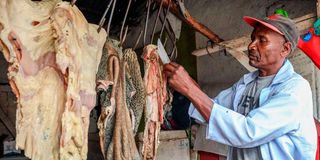
Cow tripe on ale at Menchriz Matumbo butchery in Kibera, Nairobi County on September 18, 2024.
Photo credit: Bonface Bogita | Nation Media Group
He notes a growing preference for mixed matumbo, which was very common in poor households, which now fetches Sh370 per kilo, while unmixed parts of the offal and cleaned portions go for as much as Sh450.
In Nairobi’s Central Business District, butcher Dancan Kamau tells a similar story.
“Ten years ago, I sold matumbo at Sh150 a kilo. Today, it’s double that,” he says. “Customers have switched from beef to matumbo. It’s cheaper and easier to cook.”
Though Mr Kamau sources matumbo from his own livestock, he says the margins have tightened.
“Costs have risen across the board, from inputs to staff salaries. It’s not as profitable as before.”
Still, demand is high. On a good day, Mr Kamau sells between 80 and 100 kilos of matumbo.
“For example, if a father used to buy beef for his family and now he's struggling financially, he’d rather carry home matumbo instead of going with nothing. Those who used to buy beef are the ones who have shifted to matumbo now. In tough times, people swap their preferences,” he adds.
Affordable and nutritious
At the Kenya Meat Commission (KMC), Lydia Mandila, the sales and marketing manager, confirms the spike in demand.
“We’ve seen tremendous growth in matumbo sales, especially in low- and middle-income areas,” Ms Mandila says. “It’s affordable and nutritious.”
Ms Mandila notes that while beef remains the KMC’s primary product, matumbo has become a profitable by-product—though its availability is directly tied to the volume of cattle slaughtered.
“Out of 130kg of processed beef, you only get about 13kg of matumbo,” she says. “So the more we slaughter, the more offal we can supply.”
She also highlights logistical efforts they have had to make to meet growing demand, including investment in refrigerated trucks and cold rooms for safe distribution across KMC outlets.
She, however, says there are seasons when matumbo sales drop, especially during the festive seasons when people lean more toward prime cuts.
“But generally, we’ve recorded tremendous sales and profits in that category. We even do targeted distribution, sometimes going into estates and low-income areas to meet demand,” she told Nation Lifestyle .
“Take Ladhies Road [In Nairobi], for instance; by 10am, there’s often no matumbo left. Everyone now flocks there since the Burma market is a bit slow,” she says.
Despite the heavy demand, she says KMC is doing what it can to ensure a steady supply.
Danson Wanderi displays chunks of meat and matumbo at his butchery in Kibera, Nairobi County on September 18, 2024.
Photo credit: Bonface Bogita | Nation Media Group
“We slaughter about 300 livestock per day, but that’s not always enough to produce sufficient matumbo for all families. Sometimes, we also don’t get high-quality matumbo from all slaughterhouses. For instance, in pastoral areas where deworming isn’t consistently practised, the offal may not meet the market standard, so it gets diverted to make meat and bone meal.”
On the logistics side, KMC says it has had to invest in infrastructure to handle matumbo on a large scale.
“We’ve invested in refrigerated trucks, and all our outlets have cold rooms and deep freezers. Matumbo is highly perishable, so we handle it with care. There’s a whole separate area for cleaning green offal. We even separate the green, white, and red offal, the matumbo, mara (cow intestines), kidneys, and liver, to avoid cross-contamination.”
Ms Mandila says KMC sees matumbo not just as a passing trend but as a growth product, even internationally.
“We’ve had export markets express interest,” she says. “That’s why we’re investing more in cold storage. But before we ship anything abroad, we’re keen to meet the needs of the local market first.”