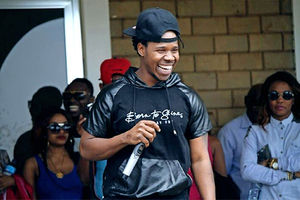
From local poetry competitions in Nakuru to sold-out international shows in the US and The Netherlands and over 100,000 social media followers, Willie Oeba has built a career on hope, consistency, and storytelling. His fourth studio album, “Yellow Paper Bag”, launches on December 12, fusing rap, music, and poetry.
Nation Lifestyle caught up with the poet to talk about turning poetry into a well-paying gig.
Over 50 pieces, before anyone really paid attention. I’ve been doing spoken word since 2004 while in Class Four, performing poetry at music festivals. In high school, there was no one to write for us, so I started scripting my own compositions.
Two pieces took me to the nationals. After high school, I just kept writing. The first piece people really noticed was “Tribute to Mama,” and that was in 2015. That’s when people began saying, “This guy is actually doing something.”
I was raised by my mum, and she has gone through so much. I wrote the piece through my eyes—her struggles, resilience, and strength. It’s still one of my favourite pieces 10 years later. Even today, if I perform somewhere and skip it, people ask for it.
In primary school at Bondeni Primary in Nakuru. We were big on music and drama festivals. There was a boy called Samuel Oduor—he was the favourite, always going to nationals. I was his number two, just a backup. One year, he got sick, so I was supposed to replace him. He eventually showed up, but the judges decided to let us all perform—and I came first. The teachers couldn’t see whatever the judges saw in me. Even I didn’t see it. That pushed me to pursue poetry: if someone saw something in me before I saw it in myself, it meant something.
Honestly, no. I used to think a single moment would change everything—like going on “The Trend” on NTV. But you go, you come back, and life continues. Success is a small, continuous effort. Even when King Kaka sent me the Wajinga Nyinyi beat in 2019, I thought that was the big “I’ve made it” moment. But after you do the project, you realise you have to keep going. My journey has been a sum of consistent steps.
In 2017, I was almost shot dead for mistaken identity. It was my mum’s birthday, I was going to pick her a cake, and I was profiled because of my dreadlocks and having two phones. A drunk plainclothes officer cocked a gun at my head. I knocked it away—my whole life flashed before my eyes. I sent the video to Boniface Mwangi. Later, I asked myself: Why must I send this to someone else? Why not use my art to speak for people who can’t? That moment changed everything. I shifted from love poems and entertainment to social justice.
Yes. Every single day. My phone’s notes are full. I always carry a notebook because I love writing by hand. I write whenever inspiration hits, even outside, just now, around 12.40pm, I was writing.
I stay in my element. My work requires composure and peace. Some days are good, others terrible, but I don’t let myself be thrown off balance. Even overexcitement can distract you more than disbelief. So I stay centred.
Every day. But I remember why I started. My mum’s resilience inspires me—she’s been bedridden for about three years, survived a stroke, and knee surgery, yet she’s still sharp, organising gatherings and full of life. Consistency is the only thing failure can’t keep up with.
When I remember performing at the Apollo Theatre in Harlem, Broadway, in the US, touring in The Hague, doing sold-out shows in Amsterdam, The Netherlands —things I never imagined—it keeps me going. If I could do that in a place where no one knew me, what about at home?
I run ISM Academy—the “ism” coming from lyricism—which mentors spoken word artistes and pushes the craft from a “scene” to a financially autonomous industry. I want a day when poets won’t be asked, “Apart from art, what else do you do?”
We started it in January 2023 in Kawangware. Spoken word can feel like a secret society—boardrooms, closed events—yet the message belongs to the people. Matatu stages and routes are where the real audience is.
Long before the Gen Z protests, we were doing spoken word in matatus, saying we’re “injecting.”
Now “injecting” has become a whole culture. Even politicians quote it. That’s our small contribution.
They told me I couldn’t carry my phone or record anything because it was a state visit, and for me, whoever controls the narrative wins. If I can’t document what I’m doing, then what is my presence there for? Even though the fee was good, I declined. Sometimes it’s not about the money; it’s about the name. A good name is better than riches.
No. People didn’t know about it because the invitation was confidential. I simply declined by email. I was supposed to travel on March 12 for an event on the 18th, flying KLM through the Royal Dutch Embassy. They even wanted to reschedule the flight. But when I really thought about it, I realised that even though I would have done something meaningful, my appearance there risked pacifying the very people who believe in what I stand for.
Because when I perform inside matatus, people share the videos widely — retweets, Instagram, TikTok — sometimes over a million views. People believe in the message. They believe I’m speaking for them. Even the small acts of support matter: Someone in a matatu can hand me Sh30 — a person who probably needs it more than I do — just because the message resonated. You don’t take those things lightly.
If I showed up to that state gathering with no recording allowed, people wouldn’t know the context. They might think I’d been bought off. Meanwhile, people who actually attended were heavily criticised online. The community felt: “We told this King not to come because of extrajudicial killings, he came anyway, met the president despite that — so why did you go?” My presence would have been seen the same way. And without the ability to document it, I’d have no way to control the narrative.
Exactly. If I can’t have even a small clip to show what I was doing there, what does my presence serve?
It was good money. My rate card for such events — because I perform with a band — is upwards of Sh250,000 to Sh300,000. But again, sometimes it’s not about the money.
What’s your weakness — bling, shoes, or gadgets? How many do you own?
Shoes. Shoes, shoes, shoes. That’s my weakness. I don’t care much for gadgets — I keep one phone until it literally dies. I’m not into accessories or watches; I’ve lost too many. But I love shoes.
Even in Europe, yes, they have freedom of expression, but certain topics are “too offensive,” especially when you mention God. I had a line in my spoken-word piece for the NATO Summit at The Hague, published by the Dutch national paper. The editor tried to remove the word “God.” I told him: “I know Europe treats this topic differently, but where I come from, God means something. So it’s either all of it, or none of it.” The piece was published intact. Creative freedom is everything.
Many times. In 2020, I released “Dear Mr. President” during Covid. In 2022, I released “Uhuru Maliza Uende.” I was talking about extrajudicial killings and disappearances, “the regime must go.” But some people thought I was campaigning for Raila because of the timing.
Even the team that funded me for that piece later asked me to pull it down because, by 2022, their political alignment had shifted. They said it no longer represented their interests. I told them, “You funded it, but this is my creation.” I refused to take it down.
Still, creative freedom first. Without it, not even the money will come.
Yes. Kenyan rap has competed before. Around 2007–2010, even as far back as the early 2000s, we were ahead. I talked to Mr Lenny — he told me how Issa died just after they’d recorded together. That era was powerful.
One challenge in Kenya is that Nairobi is like the New York of Africa; cosmopolitan, westernised, full of expatriates. We absorb everything. But in Tanzania? They play Tanzanian music, 99.9 per cent of the time. Same in Nigeria. Only in Nairobi do you hear maybe 40 per cent Kenyan, sometimes even 20 per cent. Yet Kenyan music has always had quality.
Music is a game of perception. I didn’t like GengeTone’s messaging, but I respected the fact that it took over Nigerian and South African airwaves temporarily. That was powerful.
Everything I do comes from the belief that we are workers, not saviours. Master builders may not see the end of their work, but they lay foundations. We are prophets of a future not our own.
So my work is about inspiring hope. Showing young artistes that poetry can be a full-time career, that spoken word can headline shows, that words can be used for social change. I wanted to succeed as a poet first before branching into rap, to prove that you don’t need to be “a failed rapper” to do poetry — or vice versa. I’ve been paid more for poetry than many mainstream artists earn. I say this so young poets can believe in their craft. If you have 1,000 true supporters, you can survive. Build your niche.
What keeps you awake at night — ideas, ambition, or worries?
Ideas. Ambition. Goals. And sometimes, yes, worries.
Tell us about your upcoming album — the name, the concept behind it, and when it officially drops.
This is my fourth studio album; it’s a musical. They say music goes to places that words cannot, and this time I’m taking the words along with the music. I’m fusing poetry, music and rap together, and the main concept behind the project is heavy lyricism. I’m intentionally bringing poetry back into rap.
The album is very timely. It’s coming at a moment when people need hope, consistency and a push for change. That’s why it’s called “Yellow Paper Bag”. The title came to me one night at around 4 a.m. when I was at The Hague, where I also recorded part of the album. I woke up with the idea, and by the time I looked at the clock, I had already written the title piece.
The yellow paper bag is inspired by my mother. She was a vendor in Nakuru selling curtains, bedsheets and duvets, and she would come home with just enough for us to eat that day — bananas, maize flour, sugar. Every time she stepped out, the yellow paper bag was hope. Seeing it return meant we would eat. That symbolism of hope, resilience and consistency is what shaped this album. In one line, this album shows that consistency is the only thing failure cannot keep up with. Yellow Paper Bag officially drops on December 12 at the Kenya National Theatre during my annual concert, a tradition I’ve kept since 2016.