Luos, unlike other communities, have some of the most unique ways of mourning the dead.
Upon death, a lot of rituals are performed at the home of the deceased to conform to cultural beliefs and which are different from what other people are used to.
One of the long-held customs involves taking the body back to the deceased’s home and allowing it to “spend the night” in the living room, but ensuring it is taken out before dawn.
According to Luo elders, putting the dead in the house is meant to accord the deceased the last respect.
Nyandiko Ongadi, the leader of a faction of the Luo Council of Elders, told Nation , “when someone dies after building a house, they have the right to be in it even though they are dead and cannot speak. It is therefore a norm to put bodies in houses of the deceased before they are buried.”
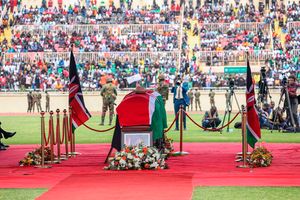
The body of former Prime Minister Raila Odinga at Nyayo National Stadium in Nairobi for the State funeral service on October 17, 2025.
Photo credit: Lucy Wanjiru | Nation Media Group
Luo burials, too, must take place at the ancestral home, never in public cemeteries, which are seen as discarding the deceased and denying them belonging.
Mr Ongadi adds that failing to return a body to its ancestral home is considered taboo, one that may invite misfortune or the deceased’s spirit to haunt the family.
On most occasions, bodies arrive home a day before burial, mostly in the afternoon, so that people can view the dead and allow family members to mourn, perform rituals which are considered crucial for honouring the deceased and ensuring a peaceful transition to the afterlife.
Even if the deceased lived in a rented house in town, Luo customs dictate that the body must first spend a night there before being transported to the village for another night, a symbolic last return to both homes of their life.
However, Mr Ongadi says Luo customs do not forbid burying a person on the same day their body is collected from the mortuary.
“It is even better to bury the body on the same day it is taken from the mortuary to reduce expenses. The bottom line is that the body must be put in the house for a brief moment when burial is on the same day,” he said.
That belief is shared by Jarongo Okumu, a council member from Kanyamwa in Ndhiwa, who warns that skipping this ritual may have lasting consequences.
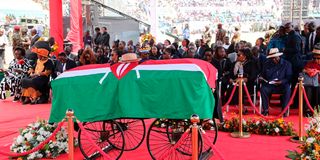
Mama Ida Odinga and her children Rosemary and Raila Junior pay their respect to former Prime Minister Raila Odinga at Moi International Sports Centre, Kasarani in Nairobi on October 16, 2025.
Photo credit: PCS
“Some of the people who are faced with challenges in life may have had their families skip a ritual during the burial of their parents or grandparents. Failure to put the body in the house may be a leading cause of problems,” the elder said.
The tradition comes with precise rules, including timing. The body must leave the house at 6 am, just as people rise to begin their day. For men with multiple wives, the body is placed in the first wife’s house.
In some circumstances, the first wife may have died before her husband, and their house was damaged to an extent that it cannot be occupied.
Mr Okumu said the damaged house must be repaired before the body is put inside for an overnight stay.
“People sometimes die before they construct houses. His or her family members must build a house for them where their body is put at night. Even a small structure with a roof will do. The body must spend the night under a roof that belongs to them,” he said.
Samuel Ocholla, an elder from Kayambo in Ndhiwa, says the act of placing a man’s body in his home symbolically “unlocked” the house for other men to enter, especially those expected to inherit the widow.
Luos used to believe that widows should get married after the death of their husbands, and there were people in some villages who were known to inherit widows.
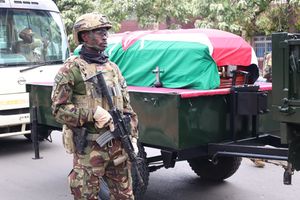
The late Prime Minister Raila Odinga's body arrives at Nyayo National Stadium in the company of Military personnel on October 17, 2025.
Photo credit: Billy Ogada | Nation
The main role of the men was to offer emotional support to the women who sometimes lost their husbands at a young age.
“It was believed that if the body was not brought into the house, no other man could enter it,” he explains. “That would have prevented the widow from being remarried or having children with other partners.”
The practice of widow inheritance has since faded, largely due to awareness of sexually transmitted infections, particularly HIV/Aids, but the ritual of body “sleeping” in the house endures as a sense of belonging and release.