On the final morning of our short break in Malindi, Lut and I decided to visit the Falconry of Kenya, which was within walking distance of our hotel. I have come to appreciate and enjoy birds.
Well, actually, the fascination started early for me – watching the twittering ascent of skylarks over the field behind our farm house near the British Boston. Or marvelling at the way kestrels could hang in the air as they looked down for mice among the cabbages.
Mind you, the mainly-brown birds in Britain are far less varied and colourful than the ones in Kenya. We have done hundreds of bird walks with Nature Kenya, on open plains, secret woods, high hills and the edge of lakes. We have learnt to treasure the haunting call of fish eagles, the regular nesting of two augur buzzards in a tree at the bottom of our garden, and the gathering of bronze mannikins at the tray of grain that I can see from my study window.
The name Falconry of Kenya is an impressive one isn’t it? And we went there hoping for the excitements we had felt at a falconry in the south of England on one of our return visits to the UK. There, the falcons and hawks were well looked after; they were well trained; they flew high and wide before returning to the gloved hand of the falconer.
Traditional falconry is an ancient and revered sport, where birds of prey are released to hunt other lesser birds in the sky. In the Arab countries it is still practised as a sport. Once, in a hotel in the coastal town of Berbera in Somaliland, I met with three young princes from one of the Gulf states. They were sleeping in a specially erected tent and their Sakar falcons were resting outside on fancy stakes, and looking as well-groomed and as well fed as their noble masters.
As for the Falconry of Kenya, this is how it is being described in one of the Kenyan safari companies’ adverts: ‘Discover the enchanting world of falconry in Malindi, where majestic birds of prey await to captivate your heart and mind. Experience the thrill of spotting variegated, rare and endemic birds while contributing to their conservation.’ But it is nothing like this. Enchanting world? Not at all. We found the place cramped and dirty.
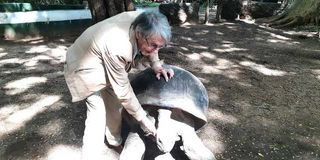
The only animal in free space was a giant tortoise, which we were told is 200 years old. Otherwise, there were a few crocodiles in a small pool with leaf-strewn and muddy-coloured water. There is a long row of small glass tanks that have a variety of snakes, such as puff adders, black mambas and pythons, that had no room to stretch or nothing to slither up. Some of the glass of the tanks was cracked and all the glass needed a clean.
Where majestic birds of prey await? They wait, yes – in cages, such as eagle owls and scops owls. Even worse, many, such as harrier hawks, goshawks and tawny eagles, were under shelters and tethered on fouled wooden stumps with thin ropes that were little more than a metre long.
To captivate your heart? Yes, to make me very angry. This is no way to treat eagles or owls – or any birds for that matter. Conservation? We were told that many of the birds had been brought in injured. We saw one tethered fish eagle with a badly-healed broken wing. A fish eagle! Had it received the kind of treatment it needed? We were told that they have a policy of returning birds to the wild. But our guide was very vague about this scheme, and there was no evidence such as a policy statement or photographs.
Anyway, returning such birds to the wild is not just a matter of letting them fly away; it must be handled with more thought and care than that. And as for falconry, there was a palm nut vulture that had been trained to fly about three metres to take a small piece of meat from your outreached and gloved hand.
We were glad to get out of the place. We decided to go back to the same beach bar we had visited the day before – the one the other side of a leafy headland that shields Formula One boss, Flavio Briatore’s Billionaire Resort and Retreat. We needed to be in an open, expansive and bright place.
Now, I am not one for swimming in the sea or bronzing my body with sunshine. For me, the pleasure was reading again one of my favourite travel books, Bill Bryson’s Notes from a Small Island, keeping cool with a glass of chilled prosecco, and watching the birds flying free over the waters.
It was the low season, so there were only a few people on the beach, and among them, were two middle-aged, bare-chested and bronzed Italians in shorts. We knew they were Italians because the barman told us so. When we got back to Nairobi, I did a little internet research on how Italians first came to be in Malindi. I asked ChatGPT about the story of Italians being there. Its answer was the establishment of the Luigi Broglio Space Centre developed during the 1960s.
Italy chose the Kenyan coast because its location near the equator is ideal for satellite launches. Italian engineers, scientists, and technicians lived and worked around Malindi, creating the first sizeable Italian community. There was no mention of what happened to the large community of Italians when Somalia got its independence from them in 1960. I had assumed that some of them would have moved south to Malindi. So I asked ChatGPT if this was so. The answer was Yes. It seems that the quality of ChatGPT responses depends on the precision of the prompts that you give it.