Lut and I had a slow start to our two nights’ break in Malindi. We left our house at 8.30 am, took the Express Way by taxi, only to find that our flight would be delayed – by two and a half hours, as it turned out.
Our Jambojet Dash aircraft didn’t live up to its name. So it was an early dinner at our hotel and, after all the hassle, I indulged myself with the top of the menu item – an excellent grilled lobster.
We were not in Malindi for its sun, sea and sand; we were there to take its Historical Circuit of four monuments: the Malindi Museum Heritage Complex, the House of Columns Reference Library, the Portuguese Chapel and the Vasco da Gama Pillar – all now part of the National Museums of Kenya.
We had booked a hotel in the town rather than at the beach. It was Saffron Garden, a reasonably-priced hotel set in a large garden with the shade of mature and tall trees. We had a spacious and comfortable room, furnished in a Swahili style. But why do many hotels and restaurants have music playing all the time? I would rather be hearing the chirping of birds or even the hum of distant traffic.
The following day, after a filling breakfast, we started the tour at the Heritage Complex, where we paid the entrance fee covering all four monuments. The Complex is an imposing building with a long history. Built in 1890, it was first an office for the Imperial British East Africa Company. During the colonial times and also after Independence, it was the District Commissioner’s office. It was gazetted as a National Monument in 1991, and the National Museums of Kenya renovated the building, and it was opened to the public in December 2013.
Its main exhibitions are on the Mijikenda and Taita/Dawhida people – with a wide range of traditional artefacts related to religious practices, preparation of foods, hunting and weapons. There was only one other person visiting the museum while we were there – a young woman from Kiambu who was working in Malindi. I asked her why she was at the Heritage Complex. ‘Because I am interested in history,’ she said.
We drove on and decided to give the House of Columns a miss. Built at the same time as the Heritage Complex, it was Malindi’s first hospital. After being the office for a number of organisations, it is now a Reference Library, according to the poster promoting the Historical Circuit. We were not in the mood for reading old documents.
However, I have since learnt that we made a mistake, because it houses the Malindi Coelacanth, the highly rare 77-kilogram, 1.8-metre-long ‘living fossil’ caught by a commercial trawler off the Malindi coast in November 2001. This species was previously believed to have been extinct for 65 million years.
On to the Portuguese Chapel. This dates way back to the 1490s, and the arrival in Malindi of the Portuguese explorer, Vasco da Gama. On his voyage to India, he left a group of soldiers in Malindi in order to establish a Portuguese trading station there. And so the Chapel was built, along with stores, barracks, houses and offices. It is reckoned to be the oldest Christian church in East Africa.
After the Portuguese left Malindi in 1593, little or nothing is known about the Chapel for 300 years. But burials began again there from the 1890s up to 1958. Now, the Chapel is well cared for by the National Museums of Kenya, assisted by the Malindi Museum Society and the Kenya Horticulture Society.
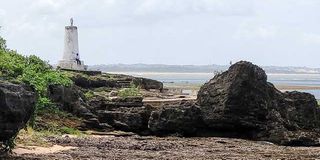
The last of the four monuments was the Vasco da Gama Pillar. We were very surprised when we got there. The last time Lut and I had seen it, it was in open ground – and quite lonely. Now, there is a long and nicely paved walkway. But let me say a little about its history.
As already mentioned, Vasco da Gama visited Malinda twice: the first, on Easter Sunday, April 15, 1498; the second, on his way back from India the following year. Perhaps it was because he had found such a warm welcome at Malindi that he ordered the pillar to be erected.
On its top, it had a cross bearing the Portuguese coat of arms. The pillar itself was made with the limestone from Portugal that Vasco da Gama’s ship carried as ballast. Over the years, it became weathered and eroded, so in 1973, a protective concrete cone was built. In 1935, the pillar was gazetted as a national monument, and the National Museums of Kenya have carried out a number of restoration measures.
The existing sea wall has been reinforced, a sandy track to it has become an access road paved with cabro blocks, and a public toilet has been built. Before this happened, on our previous visit to the site, there was no-one else at the pillar.
This time, there must have been over 20 visitors – all young Kenyans. I asked an askari if this was unusual. ‘Not at all,’ he said, ‘This place has become very popular for local tourists.’ Among them, we saw the young woman we had met at the Heritage Complex, the one who had told us that she was interested in history.
Now at the end of the Historical Circuit, I asked our taxi driver if he could take us to one of the beach bars for a drink and a snack. The one he chose was close to the Billionaire Resort and Retreat, the exclusive five-star beachfront hotel owned by one of the most flamboyant of the F1 team managers, the Italian businessman, Flavio Briatore. This prompted thoughts about whether Malindi is still living up to its nickname, ‘Little Italy’.
On previous visits, I was often greeted in Italian. The manager of our more modest hotel reminded us that we were visiting in the low season. Nevertheless, she agreed that the Italian presence is less; many of the children of Italian resident families have moved away; the foreign tourist population is more mixed, and local tourism has increased. Fortunately, there are still many restaurants providing pasta dishes and pizzas.