It’s happened again – another ghost visitor. I was having an after-lunch coffee on my terrace at home. He was wearing a big slouch hat, baggy fawn trousers and an olive-green shirt. I didn’t recognise him at first. Then I remembered, from his many photographs, that Ewart Grogan often wore such a slouch hat.
‘Welcome,’ I said, ‘Are you Ewart Grogan?’
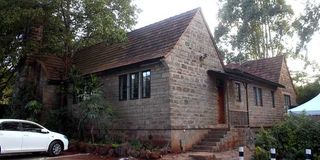
‘His ghost, yes. And I understand from a number of our After-life Kenyan Ghost Club that you enjoy talking with us about times past in Kenya. I hope you will grant me the favour too. Right now, I am on my way to have a look at my Chiromo House that was moved stone by stone to what they call the Karen Blixen Coffee Garden. Karen – she was quite a girl, wasn’t she? But I’m giving you a heads-up – isn’t that what people say these days? I could see you here tomorrow. Is that OK?’
‘I will be very honoured,’ I said.
And so I had time to find and check a book about Grogan that someone gave me some years ago – someone whose wife was related to Grogan’s wife, Gertrude, who might be better known here than Grogan himself, because she founded the Gertrude’s Children’s Hospital.
Ewart Grogan.
Photo credit: File | Nation Media Group
The book by Leda Farrant is called The Legendary Grogan: Kenya’s Controversial Pioneer. He was legendary because he walked, as his own book says, from the Cape to Cairo; he was controversial because, however much he contributed to colonial Kenya’s economic growth and political maturity, he once gave a public flogging to three young rickshaw men who had disturbed and frightened his sister and her woman friend. I also refreshed my memory by looking at his entry in the excellent website, Europeans in East Africa.
Grogan’s walk was made during the years 1898 to 1900. When his ghost joined me at coffee time on the terrace the following morning, it was the first topic I was keen to discuss. I asked him why he did it.
‘It was to convince Gertrude’s father, who had pointed out that I had achieved very little to be thinking of marriage. I guess it was to impress Gertrude herself; I also thought it would be a great adventure!’
‘And in all those things you were successful,’ I said, ‘However, having read Leda Farrant’s book about you, I see there is a map that shows your walk actually started at the port of Beira, quite a way up the east coast of Africa,’
‘That’s true. Perhaps I should have said I traversed Africa, south to north, by foot and by boat.’
‘But it must have been a tremendous challenge – one you write about very graphically in your own book From the Cape to Cairo.’
‘It was very, very tough, what with sheer exhaustion at times, a badly infected foot, occasional desertion by porters, being nearly killed by Dinka warriors, and the lack of water in the desert lands north of Uganda.’
‘I can only imagine all that. There is one passage I can identify with, having experienced some survival camps: “How many people realise what these things mean? How many people have ever caught the exquisite flavour of bread and butter, the restless luxury of clean linen, the hiss of Schweppes? “’
I asked the ghost why he chose East Africa, when he had been invited to settle in South Africa. I had read that it was after a chance conversation with a Canadian friend called Edward Lingham, who told Grogan about ‘a new and wonderful British possession’. He really knew nothing much about the country, but the two men had the same sense of adventure, so they decided to go and try their luck.
There’s no doubt that the gamble paid off. He acquired thousands of acres of forest in the Rift Valley, land near the Kilindini Harbour, a prestigious house he called Chiromo near the river and other property in Nairobi; he built Grogan’s Castle in Taveta.
He was successful in business and farming; he quickly became a most effective spokesperson for the white settlers; he was a European elected member of the Legislative Council; he enjoyed a rather lavish and rakish social life.
For the ghost, I quoted what Elspeth Huxley wrote in her Out in the Midday Sun: ‘He was a handsome Irishman, then in his 60th year, tall and upright with remarkable blue and penetrating eyes, dark arched eyebrows, greying hair and an inexhaustible flow of talk. Words poured from his lips like wine at some Bacchic orgy.’
‘If I wasn’t a ghost I would be blushing,’ he said. ‘Elspeth was a good friend.’
I then asked if we could talk a little about the incident that might not have spoilt his reputation among the diehard settlers, but it certainly did so for those of future generations who read about his life in Kenya.
‘I came to wish I hadn’t done it. What happened was this. My sister and her friend were going to visit my wife, Gertrude, in hospital. They took a rickshaw. The three young Kikuyu men responsible for it decided to have some fun.
They might have been drunk. The one who was doing the pulling threw the shafts of the rickshaw up in the air and the two women were bounced as the rickshaw hit the ground.
Then, with shouts and laughter, they raced on far too fast. When they eventually stopped, they roughly pulled the two women out of the rickshaw. But my anger was not just about what those men did.
It was a time when I was furious about the foolishness and incompetence of the government officials in Kenya and back in Britain. They were more interested in the welfare of Africans than in the needs of the settlers who the government had invited to build the country.’
I got to know Sir Michael Blundell well, a settler who had also been a member of the Legislative Council and a liberal who played a vital role in the transition period that led to Kenya’s independence.
I quoted what he said about Grogan in his Foreword to The Legendary Grogan: ‘Here, after a lifestyle spent in developing the economy of Kenya, interspersed with turbulent periods in politics, he found peace surrounded by the Africa he loved, the limitless harsh grey-brown bush and the African people to whom he became accustomed, and with whom, in the end, he sympathised in their ardent wish for political advance.’
‘Yes, that is very true,’ the ghost said. ‘And I will thank Michael when I get back to the After-life Kenyan Ghost Club.