When Nairobi Governor Johnson Sakaja announced plans to relocate mechanics from Grogan along Kirinyaga Road to Ziwani in a bid to protect the riparian land along the Nairobi River, his directive appeared rooted in the logic of protecting the lives of many households.
Yet beneath the directive sits a longer story of land, power, adaptation, and relocation efforts that stretches back more than a century, beginning with a colonial adventurer who first claimed, drained, and reshaped the very ground now occupied by the mechanics.
Nairobi Governor Johnson Sakaja.
Photo credit: File | Nation Media Group
That man was Ewart Grogan. He is a figure whose life, according to historical records, blended myth, ambition, and contradiction, and whose imprint on Nairobi City remains embedded not only in place names but in the unresolved tensions over land use that continue to date.
Grogan’s arrival in East Africa was less a calculated decision than the outcome of a wager with fate, according to his biographies.
While he was a student at Cambridge he tossed a coin to choose between a life in art and one in adventure, and having landed on the latter he pursued it with a theatrical intensity that would define his reputation, culminating in a celebrated journey from Cape to Cairo undertaken to prove his worth to the family of Gertrude Watt, whom he later married after completing the trek that turned him into a minor imperial celebrity. He would start Gertrude's Children's Hospital located in Muthaiga in memory of his wife.
He first dismissed Nairobi as a “tin shack,” and an unremarkable railway outpost that did not yet resemble the city it would become, yet within a few years, he would return, drawn by opportunity and land, and begin acquiring property in what was then the East African Protectorate.
He positioned himself among the early European settlers who would shape Nairobi’s spatial and economic foundations.
Among Grogan’s acquisitions was a swampy stretch along the Nairobi River where the Grogan mechanics is currently located. It is a land that many considered undesirable but which he later transformed through drainage and canal construction into usable ground, demonstrating a practical approach to land that combined opportunism with an understanding of how value could be created through alteration rather than mere possession.
On this reclaimed land, Grogan allowed Asian settlers, many of them linked to the Uganda Railway, to cultivate cabbages, creating a small but productive agricultural zone that reflected the layered hierarchies of the colonial economy, where land ownership, labour, and opportunity roles were distributed along racial lines.
After Grogan’s interest in the swampy land waned, the Nairobi council would later try to persuade him to sell the piece of land, but he rejected the move.
The area gradually shifted from cultivation to informal industrial use, particularly in the aftermath of World War II, when African mechanics who worked on motor vehicles and machinery during World War II were settled following the end of the war.
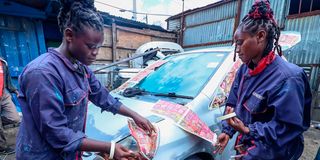
Mechanics clean muddy vehicle doors using stagnant floodwater outside spare-parts shops in the Grogan area along Kirinyaga Road in Nairobi following heavy rains.
Photo credit: Wilfred Nyangaresi | Nation Media Group
These mechanics had developed crucial technical skills repairing military vehicles, ships, and equipment in areas like Mbagathi, Gilgil, and even as far as Burma, before returning to the city and establishing their trade on what is now Kirinyaga Road.
These early mechanics, many of whom lived in makeshift settlements collectively referred to as “City Carton”, created not only a place of work but a community, one that would later face displacement as authorities attempted to reorganise the city.
They were eventually relocated to Huruma, an estate named to reflect the compassion and sympathy after the Nairobi council cleared the “City Carton” shanties at Grogan and resettled displaced mechanics and their families on the outskirts of the city.
County’s relocation plans
But the act did not fully resolve their economic dependence on Grogan, prompting many to maintain ties with or eventually return to their original place of work.
Over time, this persistence transformed Grogan into a critical node within the city’s transport ecosystem, supporting the rise of informal transport systems that would later evolve into the matatu industry, and embedding the area within the city’s economic fabric in ways that made it difficult to remove without disrupting the networks that depended on it.
In 1964, as Nairobi grappled with rapid growth and mounting pressure to impose order on its central areas, Mr Charles Njonjo, then a young legal officer, drafted proposals aimed at clearing what officials viewed as disorderly and incompatible uses of prime urban land, including the cluster of mechanics operating along Grogan.
He argued that “the central area of the city must be reserved for proper commercial and administrative development.”
Former Attorney General Charles Njonjo.
Photo credit: Evans Habil | Nation Media Group
He insisted that activities such as open yard mechanical repairs were “unsightly, unhygienic, and inconsistent with the image of a modern capital.”
Although the proposal sounded good, in 1965 it was diluted by practical concerns, leaving loopholes that undermined enforcement and allowed the trade to persist, a pattern that has endured for decades.
Subsequent attempts to regulate or dismantle the Grogan mechanics economy have struggled against the same entrenched realities. In 2020, for instance, the Nairobi Metropolitan Service (NMS) announced similar efforts to relocate the mechanics to a separate piece of land along Thika Road.
For many of the mechanics who have spent decades at Grogan, the county’s relocation plans feel distant and abstract, communicated more through headlines than direct engagement.
Those on the ground describe a continuity that stretches across generations and ties their livelihoods firmly to the site.
Mr Jared Omondi, for instance, started working at the site as a young boy and he has spent close to 20 years repairing vehicles.
“We only see it in the news. This is where most of us have grown and we are on this place because our parents and great grandparents stayed here. Some of us came here young and our clients know this place. We cannot move elsewhere,” Mr Omondi told the Nation.
Mr Erick Otieno Gumo, who has also worked there for 18 years, frames relocation as a practical impossibility rather than a policy question, asking how customers accustomed to the convenience of the city centre would follow them to a place like Ziwani which lacks the same visibility and accessibility.
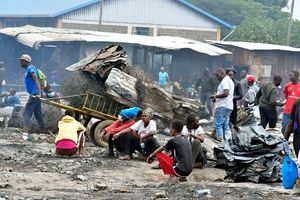
A man inspects a vehicle that had been swept by floodwaters in the Grogan area of downtown Nairobi on Sunday, March 15, 2026.
Photo credit: Dennis Onsongo | Nation Media Group
He explains that their presence in Grogan is sustained by proximity to clients who can easily drop off vehicles and proceed with their day, a dynamic that underscores the deeper challenge facing the city in attempting to shift not just people but the patterns of movement and trust that have defined the area for decades.
“How do you tell your client that they need to bring their vehicles to Ziwani. There is nobody who knows that place. The reason we are here is because of the proximity to the town. Most of the clients in town just drop their vehicles here and head to work,” Mr Otieno argues.
The county government, however, insists that the mechanics will be involved in the relocation process and that there will be public participation.
“There will be a public participation for all those who will be affected by the relocation plans and the exercise will be carried out in a humane way. We must also acknowledge that, as much as they are earning a living, we need to protect their lives as well,” Mr Sakaja said regarding the relocation plans by the county government.
Kirinyaga Road may carry a post-independence name, but beneath it lies the imprint of Grogan, the settler who first claimed and reshaped the land, setting in motion a chain of transformations that continue to shape present Nairobi, and as the city once again seeks to redefine the space, it is confronted by a familiar question about whether what has been built over time can be easily undone or whether, as history has often shown, it must instead be negotiated with.