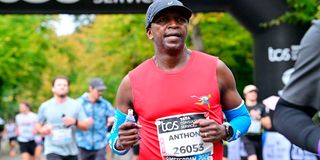
If Anthony Wafula’s legs could talk, they would brag all day long. Last month, they achieved something they had never done before: carrying him through all 42.195 kilometres of the TCS Amsterdam Marathon.
In the cold, windy Amsterdam, the 48-year-old crossed the line in three hours and 40 minutes, completing a marathon on his third attempt. Earlier attempts had been thwarted by injury and bad weather.
“It was a first, and it was a fulfilment of something I’ve been chasing,” he said. “The whole idea was to finish alive and then use common sense; that if things don’t work, you adjust your goals.”
Mr Wafula had trained for 13 weeks, a period he likens to “being in school for a full term”. His coach had set a target of 3:26. He reached the 21-kilometre mark in a personal-best 1:48, but the weather and the unfamiliar territory demanded a recalculation at the final stages.
“When you start getting to 35km, your body starts telling you, ‘Boss, what are you doing?’ Things start shutting down slowly,” he said. “I struggled from kilometre 36, but I was so determined to finish.”
The Amsterdam race, a World Athletics Platinum Label event, is known for a flat, fast course beginning and ending at the Olympic Stadium and passing the centuries-old national museum, the Amstel River, the Vondelpark public park, among other features. He was there for a cause. Representing the Rotary Club of Ngong Hills, he ran to raise money for Olkeri Primary School in Kajiado County. The appeal seeks to improve early-childhood classrooms and sanitation for a school population of more than 500 pupils.
“We want to give them a better learning environment, make the ECD classes friendlier to children and do bigger programmes around sanitation,” he said.
By Tuesday noon, the campaign had raised Sh260,624 towards the $10,000 (Sh1.3 million) target. The club plans to approach businesses around Ngong and is inviting help in cash or kind. Cement, tools, classroom-renovation services and volunteer labour would all count.
Olkeri came onto the club’s radar after its headteacher, who Mr Wafula says had helped transform the Arap Moi Primary School in Rongai, asked for support. Club members assessed the school and spoke with stakeholders, who identified the priorities.
Anthony Wafula, an international development expert, communications consultant and recreational runner, during the Amsterdam Marathon on October 18, 2026.
Photo credit: Pool
Mr Wafula belongs to a growing community of Kenyan recreational runners. His journey began during the Covid-19 movement restrictions, when members of his Rotary club escaped cabin fever by hiking Ngong Hills. Trips to Mt Longonot and Kilimambogo followed, then climbing Mt Kenya and, later, Mt Kilimanjaro.
Running was initially a way to build endurance for the mountains. After summiting Kilimanjaro, his group asked what the next difficult thing might be.
The 2022 Standard Chartered Nairobi Marathon supplied the answer, with the initial target being the half-marathon. He was underprepared. Cramps struck, and he walked the final six kilometres. An unstructured attempt to improve ended five weeks later with a torn calf muscle.
Joining a running club changed his understanding of the sport. At his first club outing, he signed up for 21km and chased runners who described their speed as “easy pace”.
“After 10 kilometres, you are sweating, your heart rate has gone up, and guys are simply running at a very easy conversational pace,” he recalled.
A fellow runner introduced him to a coach who put him on a structured programme that entails, among others, base-building, long runs, a 10km time trial and speed sessions. Thanks to the coaching, he got to understand how concepts like sleep, diet, shoes, hydration, strength and recovery interplay with running.
“You start learning much more about yourself, much more about the science of running,” Mr Wafula said. “Absolutely nothing” is won, he joked, because “you’re competing against yourself”. The reward is becoming fitter, faster and able to run farther.
His Covid-era start reflects a wider shift. A 2021 World Athletics study across 10 countries, including Kenya, found that 13 per cent of runners surveyed had started during the first pandemic year, while 22 per cent said they ran more often because of Covid-19. Being a recreational runner does not come cheap. Mr Wafula estimates that a full training cycle may require three pairs of shoes: one for daily running, one for speed work and one for race day. At Sh15,000 to Sh20,000 a pair, the footwear bill alone can reach at least Sh45,000. Then come running kit, gels and supplements, race registration, physiotherapy and gym sessions. An overseas marathon adds flights and accommodation.
“Recreational runners, unlike elites, pay to run. The elites are paid to run. It’s expensive, but people say this is probably the only good reason for you to travel and see the world.”
Money is only one obstacle. Runners with day jobs must squeeze their mileage into early mornings or evenings, then search for safe, even surfaces. Mr Wafula cites mugging, boda boda riders’ menace, broken roads and harassment of runners – especially women – as everyday hazards. Whenever Nyayo Stadium is closed, he said, speed sessions are disrupted, and runners crowd alternatives such as Jaffery’s.
“We don’t see any investment coming in to give us good tracks that can make it easy for us to run peacefully in a secure environment,” he said.
The lack of ideal places to run is an enduring problem across Nairobi. A 2025 report on the city’s recreational-running boom described clubs drawing hundreds of participants while still contending with inadequate infrastructure and safety concerns. For Mr Wafula, what makes runners stay the course despite the setbacks is the reason they are doing it.
Anthony Wafula during the Amsterdam Marathon on October 18, 2026.
Photo credit: Pool
“You think about the cause: you’re running for your health. You are probably just running for the love of it, to stay active and to keep away diseases. When you think about the motivation, it keeps you going.”
Away from running, Mr Wafula is a trained teacher who chose a different path after finishing his studies. He moved through non-profit work, broadcasting and international development, helping establish Radio Waumini in 2003 and later serving as the Kenya Broadcasting Corporation’s head of radio. He then worked at Internews and spent 13 years at Hivos. He is now chief of strategy and partnerships at Amplify Girls Africa and also undertakes private communication work.
“I always call myself an international development person because what I do is create programmes and raise resources that can make a difference,” he said.
He uses the initials “PP” before his name to mean “Past President”, a Rotary title he retains after leading the Rotary Club of Ngong Hills. He has also served as an assistant governor. During the challenging final kilometres in Amsterdam, he wrote on LinkedIn that he remembered “my why”, which is the children of Olkeri and the club supporting them. More exploits on the road await, as he already has an entry for the 2027 Cape Town Marathon.