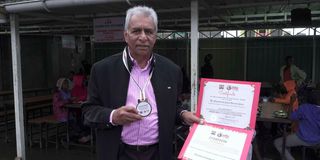
When the COVID-19 pandemic struck in 2020, Shamsher Gilani had only recently retired from a four-decade career as finance director of Gilani’s Supermarket.
Yet, while many people would have welcomed the opportunity to slow down, he found himself taking on a new responsibility: ensuring that vulnerable children and families in Nakuru’s informal settlements did not go hungry.
Since then, the Hot Kitchens, which serve free meals daily in the Kisulisuli and Rhonda informal settlements, have provided more than 2,414,000 meals to needy families and children. The initiative grew out of the Street Children’s Assistance Network of Nakuru (SCANN), a charitable organisation Shamsher has steered for more than a quarter of a century.
When we meet in his office on a cloudy Friday afternoon in November, I learn that the building housing his office was his last major project before retirement. Located in the heart of Nakuru’s central business district, the commercial building overlooks Gilani’s Supermarket.
Even in retirement, Shamsher shares the office with his three brothers, all of whom have retired from the family business. For him, however, the office remains an important base from which SCANN’s daily activities are coordinated.
“There was no plan for us retired directors to work here. We have always been a close-knit family. We have been in business together, and it is good to see us together in retirement, spending time together. We have made it a ritual to get together here every day and have coffee on the balcony as we chat. It is nice to be able to do that,” he says.
For more than a century, the Gilani family has built a legacy in Kenya through its involvement in industry and business, spanning the colonial and post-colonial periods. Gilani’s Supermarket, now 52 years old, one of the oldest supermarkets in the country, is headquartered in Nakuru and has never opened any branch outside the city.
“We did not want to lose control over the daily running of the business and that’s what has sustained and grown the supermarket to date that is one being run by the third generation of the family.”
Shamsher Gilani at SCANN Hot kitchen in Rhonda Estate, Nakuru.
Shamsher, 71, was born and raised in Nakuru. He attended St Xavier’s Primary School before proceeding to Menengai High School for his O-levels and Jamhuri High School in Nairobi for his A-levels. He later travelled to the United Kingdom, where he qualified as a chartered accountant. Upon returning to Kenya, he joined the family business, where he first confronted the plight of street children in Nakuru.
“While running the supermarket, we found that a lot of street children came there. We would give them perishable foodstuff that would not stay fresh overnight. After doing this for a while, we asked ourselves what we were achieving by giving these children food every day.” It was a question that stayed with him, gradually developing into a determination to find a lasting solution.
The family’s charitable roots can be traced to his father, Gulam Hussein Gilani, whom Shamsher says established a home for orphaned girls in India. His own commitment, however, was also shaped by personal experiences growing up in Nakuru.
“There have always been street children in the streets, even when we were growing up. Some of them were our friends. We used to play with them after school, and we realised how fortunate we were because we never lacked anything. It was painful to see some of them picking food from garbage.”
What began as an effort to provide food soon developed into a broader ambition to help children escape the circumstances that had brought them to the streets. Beyond supplying milk and bread, Shamsher wanted to give them an opportunity to build independent and more secure futures.
“The plan was that we were going to educate these children. We believed that by educating them, they would be independent someday.”
In 1997, SCANN was registered as a children's home. Three years later, on January 1, 2000, Shamsher and his team went into the streets to bring in the first 25 children. That initial group would open the door to more than 500 children who have since received care, education and support through the institution.
What Shamsher had not anticipated was that he would remain at the helm of SCANN for the next 26 years. His original plan was to have other charitable organisations represented on the board, including the Salvation Army, which donated the premises where the institution has operated for more than two decades. At its busiest, SCANN has accommodated 160 children.
“When I was putting this organisation together, my idea was that the initial 25 children would be looked after by the charitable organisations that were part of the board. In the 26 years I have been chairman, nobody has wanted to take up this responsibility. It requires you to be working 24/7.”
For Shamsher, his privileged upbringing has never been a reason to distance himself from the less fortunate. Instead, it has strengthened his conviction that those who have more should do more for others.
“I have never had to go out to beg for food or scavenge for food in garbage. I see children doing that because they have nowhere else to go. It is humbling. It makes me understand how fortunate I am in my life.”
The biblical principle, “To whom much is given, much is required,” appears to capture the philosophy behind his charitable work. He challenges the notion that philanthropy should involve giving away only what one can spare.
“We have been brought up to understand that if you have a lot of money, that money is given to you in trust so that you can take care of other people, and that is what we are doing.”
He also has little interest in the public recognition that often accompanies charitable work. For years, SCANN operated largely outside the public spotlight, guided by what he describes as a commitment to doing good without seeking applause. That changed this year, when he was recognised as a national hero during the Mashujaa Day celebrations in Eldoret for his contribution to philanthropy.
“I am not in this business of charity to get recognised by the people around me. I ended up receiving the Heroes Award in philanthropy 26 years down the road. All our charity work is done quietly, without people knowing about it. I am doing this for myself. God recognises what I am doing. It pleases me to see success in my children.”
The impact of SCANN is reflected in the lives of the children who have passed through its doors. Of the 530 children who have benefited from the institution, more than 300 have completed secondary school, 200 have been reunited with their families, and 57 have proceeded to university.
For Shamsher, taking a child to university has always involved faith in their potential, even when the decision has raised difficult questions about how limited resources should be distributed.
“I remember the SCANN board debating whether it was the right decision to take one child to university or use those resources to take care of 20 other children. Seventeen years ago, we took our first child to university. His name is John Ndolo, and he joined Egerton University to pursue a course in healthcare.
We are also proud of one of our children, Dr David Kanyingi, who is now working as a surgeon at the Nakuru County Teaching and Referral Hospital. The children who have gone beyond Form Four have pursued courses in computers, business, education and healthcare.”
However, SCANN is approaching another significant transition. Following the government’s 2022 policy decision to phase out children’s homes over the next decade, the institution is expected to close its doors as a residential children’s home by 2032.
For Shamsher, the transition has coincided with an opportunity to rethink how the organisation can continue supporting vulnerable children without necessarily housing them. The Hot Kitchens, established during the pandemic, have become a central part of that shift.
“My wife Avni and I have talked about how long we can carry on with this work. It is a blessing in disguise that the government wants us to close the SCANN centre. When we pick up a child, that child becomes my responsibility for 10 to 15 years. We are now taking up projects such as school rehabilitation.”
SCANN has consequently begun renovating dilapidated public schools and providing uniforms and stationery to pupils in institutions struggling with rising enrolment and inadequate infrastructure.
“We have found public schools without toilets, water or basic infrastructure such as classrooms. Children do not have school uniforms or educational materials. We have built classrooms and toilets so that children can stay in school. We are empowering children and their families so that they do not end up in the streets.”
The Hot Kitchens also support the government’s objective of keeping orphaned and vulnerable children within family settings. Shamsher believes that providing meals to struggling households helps prevent children from leaving home to beg on the streets.
“Nearly all the people who come to the kitchen have a home, but they do not have food. We open our kitchen at 5pm when the children come from school. This way, we are keeping children at home and not on the streets.”
The two kitchens in Rhonda and Kisulisuli can accommodate a combined total of 400 people at any given time. A team of 10 employees prepares approximately 120 kilogrammes of ugali daily, serving an average of 1,418 people. Together, the kitchens feed more than 40,000 people every month, approximately two-thirds of them children.
Serving such numbers requires careful financial management. The monthly food bill exceeds half a million shillings. Sponsoring meals at either kitchen costs Sh17,500, while dry food supplies are purchased from Gilani’s Supermarket at discounted rates. Vegetables are sourced from a contracted local farmer who supplies kale and cabbages at a weekly cost of Sh64,000.
“Most of our donors sometimes choose to celebrate their loved ones by supporting meals at the Hot Kitchens. In October, we spent Sh549,844.”
Shamsher Gilani at SCANN Hot kitchen in Rhonda Estate, Nakuru.
With a calculator in hand, Shamsher explains the figures behind the initiative, demonstrating the attention he pays to every contribution.
“The average cost per meal in the two kitchens is Sh17.52, while the average cost of food per meal is Sh12.51.”
The journey has not been without challenges. From managing difficult behaviour among children at the home to responding to government inspectors’ concerns about the institution’s facilities, Shamsher says the experience has tested his patience but strengthened his resolve.
“Just like in a normal family, where sometimes there are errant children, we have had our share too. We have had government inspectors coming to the home, complaining about giving the children one blanket instead of two. We have had to answer questions about why a mattress is stained. At one time, we were asked to give the children a bigger TV. But, on the whole, we have managed to overcome the hurdles and move on.”
Looking at the wider charitable landscape in Nakuru, Shamsher worries about the difficulty of attracting younger people to organisations that demand sustained personal commitment.
“Youngsters do not have the time we had in our younger days. With technology and the way businesses run today, it requires someone to be there full-time. People do not have time for charity work. We are not getting the new generation to come and work in these charities.”
Although he still works seven days a week, he attributes this largely to his sense of responsibility towards SCANN. Unlike a business, where operations follow structured opening and closing hours, caring for vulnerable children and families demands constant attention.
“It is just the responsibility that comes with looking after human beings. When you have a family, you cannot close the doors like in business. I just have to be there 24/7. SCANN is my family, so we always find a way of keeping things running even in our absence.”
He nevertheless makes time to travel whenever he can, using the opportunity to unwind from the demands of his work. Despite having visited many parts of the world, he remains deeply attached to Nakuru, the city that shaped his life and career.
“I am where I am because of Nakuru and the people of Nakuru. I would not pick any other place in the whole world over Nakuru. You look at the weather; you cannot compare it to any other place in the world.”
For someone who has spent decades managing resources and overseeing charitable projects, transparency and accountability remain central to his philosophy. His training as a Chartered Accountant has helped him maintain clear financial records and keep donors informed about how their contributions are spent.
“I hope the people who have worked with me feel that their money is well spent and that they get the blessings from the charity we carry out on their behalf,” he concludes.