‘Before I built a wall I’d ask to know what I was walling in or walling out’, wrote the American poet, Robert Frost – ‘and to whom I was like to give offense.’ I thought about these lines on a Friday morning, a few weeks ago.
Lut and I were with Ben Koros, Nature Kenya’s staff member who is the administrator of Friends of City Park – that precious wedge of green land between Limuru Road and Wangari Maathai Road. We had gone to the park with Ben for a talk about its past, present and future.
The history is very well told in the guidebook, ‘City Park: The Green Heart of Nairobi’. It was in 1923 that part of what was called the Municipal Forest was cleared and designated for public recreational use – in those days, the ‘public’ meant only Europeans. It was given the name City Park.
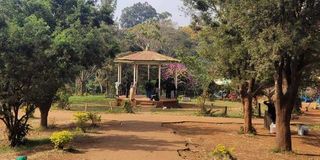
In the next few years, a pavilion and a bandstand were built in the clearing, a bowling green was created, a network of footpaths was laid out, and the swamp-lined river was canalised. It became like many Victorian town parks that can be found across England.
After the Second World War (1939-1945) the park became particularly popular with the Asian community living nearby. But the glory period began in 1947, when Henry Powell (‘Peter’) Greensmith was appointed Nairobi’s Parks Superintendent. He was certainly an excellent green-smith.
Over the next 19 years – till his retirement two years after Independence – he established the beautiful formal gardens, the fish pond and a kei-apple maze. It became a place for entertaining prestigious visitors to Kenya such as the British Queen Elizabeth, the Queen Mother and the Indian philosopher-statesman, Sarvepalli Radhakrishnan.
1n 1926, three years after the founding of City Park, the population of Nairobi was estimated to be about 30,000; in 1950 it was 137,456; now, it is estimated at 5,766,990. Given such an urban expansion, it isn’t surprising that the green space of City Park came under threat by legitimate city developers and illegitimate land grabbers.
In recording the efforts to protect the park, I think there are three significant dates. First, in December 1996, an advertisement appeared in the Daily Nation announcing the formation of a volunteer group called Friends of City Park, which has the objectives of upgrading visitor facilities, developing an information and education programme and making the park a secure and pleasant place to visit.
Second, in 2009, its really big win came when the park was gazetted as a National Monument protected under the Museums and Heritage Act. Third, in August 2016, the Friends of City Park held a stakeholders’ consultative forum to draw up an action plan that would ensure the park’s future.
And so, Ben took us to show how the park is right now. We walked to the famous bandstand and across surrounding lawns. Ben pointed out the unusual white jacaranda tree, he explained how the fish pond is being renovated, and we saw the more durable green benches and green waste bins made from recycled plastic.
I had been on bird walks and tree walks in the more forested parts of the park; I had been a few times to visit the Murumbi Memorial Garden and the cemeteries; I had never been to this main public area.
Even though it was a weekday morning, there were lots of people there: children playing, old men resting, families picnicking, Sykes monkeys scrounging. Not so good, there was quite a lot of litter, despite the waste bins.
We walked to the Bowling Green Restaurant for a coffee and a relaxed talk with Ben. I asked him why he thinks the park is so important. ‘It’s important because it is one of the few green spaces in the city’ he said.
‘And there is a bit of wildness here – the remnant of the old forest. And that is special for people living in the city – especially for children.’ With regard to the activities of the Friends of City Park, clearly a lot of renovation has been done. But I asked what challenges still exist.
He pointed out that, with so many stakeholders involved – the Kenya Government, the Nairobi County Council, the Kenya Forest Service, the Friends – an effective coordinating management structure has still to be put in place. So it is not at all easy to get aspects of the current master plan implemented.
I asked Ben about key aspects of the plan. ‘First of all, it has brought some order to the thinking about City Park. And a crucial recognition in the planning was that this is a free park. It is used by about 6,000 people every day – all kinds of people. It is also a thoroughfare. So some system of fencing is called for.’ I quoted the Robert Frost poem I mentioned at the beginning of this article.
I suggested that in putting up a fence you have to consider who or what you are keeping in and who or what you are keeping out. Clearly, you want to protect the amazing bio-diversity that is a key feature of the park.
Also, if fenced, the security would be enhanced, and it would be more difficult for those who have eyes on grabbing some of the land. But, with so many stakeholders involved, it is possible that the fence would cause offense to a few.
As it is now, City Park is a people’s park. That it should remain so, was the dream of those – including representatives from local and national government, Nature Kenya, Friends of City Park, the community – who attended the stakeholders’ consultative forum back in 2016.
This is how that dream was described by Professor Bettina Ng’weno in her report of the forum: ‘We wish that in five years City Park will be clean, safe and accessible to all and especially children.
It will have cultural, educational and nature activities. It will be conserved in spirit, content and function as a biodiverse and historic park with secure boundaries.’