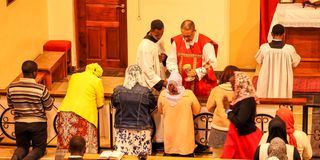
The priest approaches the altar slowly. His back remains turned to the congregation. Latin chants float through the sanctuary. Women cover their heads with veils.
The faithful kneel to receive Holy Communion directly on the tongue. No one claps. No one raises their hands. No one dances. Inside Holy Cross Catholic Church in Nairobi's Lavington neighbourhood, worship feels less like a modern Sunday service and more like a journey into another century.
To the common eye, there is little to suggest controversy. The crucifix hangs where one would expect it, at the front centre of the church. The prayers are recognisably Catholic. The rosaries, statues and incense are familiar. Yet this quiet parish has suddenly found itself at the centre of one of the Catholic Church's biggest controversies after the Vatican declared that bishops ordained by the Society of St Pius X (SSPX) without papal approval had incurred latae sententiae (automatic excommunication). Kenya's bishops have since warned Catholics that attending SSPX priories, including at Holy Cross Catholic Church, places them outside full communion with Rome.
Fr. Louis Gravrand, School Chaplain, Deputy Director and Vicar at Holy Cross Catholic Church in Lavington, Nairobi, on July 9, 2026.
Photo credit: Wilfred Nyangaresi | Nation Media Group
"The Society of St Pius X is a group of traditionalist Christians who say they want to abide by the orthodox way of being Catholic. They want to live the purity of the Catholic faith, which is a good thing," says Archbishop Maurice Muhatia Makumba of Kisumu. "But they have one big problem. I would like you to listen to me clearly. The Society of St Pius X has a very big problem. They do not want to listen to the Holy Father. If you do not listen to the Holy Father, can you remain a Catholic? You cannot remain a Catholic."
The Archbishop's warning was directed not merely at the society's leadership but at ordinary Catholics increasingly drawn to its chapels.
The SSPX (Society of St Pius The 10th) was founded in 1970 by French Archbishop Marcel Lefebvre. Its members insist it is preserving the Catholic faith exactly as it has always been taught. But, the Vatican says the society has crossed a line by refusing to accept key teachings of the Second Vatican Council, and by consecrating bishops without the pope’s approval.
Caught in the middle are ordinary Catholics, some confused, others defiant.
Fr. Louis Gravrand, School Chaplain, Deputy Director and Vicar inside Holy Cross Catholic Church in Lavington, Nairobi, on July 9, 2026.
Photo credit: Wilfred Nyangaresi | Nation Media Group
"I am aware that one or two of our Christian faithful in this Archdiocese [of Kisumu] have been misguided to join this group, thinking it is the same as being Catholic," Bishop Muhatia said. "It is not the same. It is not the same as being Catholic to cross over to the Society of St Pius X."
To understand the issues at the heart of this full-blown controversy, I went to the Holy Cross church. There, I met Fr Louis Gravrand, who agreed to speak to me after making a quick call to the parish priest, who at the time of our interview was in France.
Inside Lavington's Holy Cross Church and the Catholic movement challenging Pope Leo’s authority
Before a single question was asked, Fr Louis had one request. "Shall we begin with a prayer?"
Standing in a quiet spot beside the church, he solemnly made the Sign of the Cross. As a lifelong Catholic, I instinctively followed. Together we prayed the Hail Mary before beginning the interview.
A worshipper prays inside Holy Cross Catholic Church in Lavington, Nairobi, on July 9, 2026.
Photo credit: Wilfred Nyangaresi | Nation Media Group
Nearly an hour later, after discussing excommunication, papal authority, Vatican II and the future of the Society of St Pius X, Fr Louis once again paused the conversation. He made the Sign of the Cross, and together we prayed the Glory Be. Only then did the interview end.
It was a small but revealing moment. For Fr Louis, every conversation about the Church begins and ends the same way—with prayer.
"We are fully Catholic," he says. "We love the Pope. We pray for him every day. We acknowledge him as the Supreme Pontiff of the Catholic Church. They call us schismatic, but we are not schismatic."
Ordained in France and posted to Kenya in 2020, Fr Louis is among four priests serving what has become the SSPX's only parish in the country. Every Sunday, roughly 600 faithful gather for Mass. The church operates a Cambridge curriculum school with 202 pupils, runs catechism classes for children and adults, and is building larger facilities to accommodate its growth.
In a separate interview conducted on June 5 with Michael Matt, the editor of The Remnant, a Catholic newspaper in the United States and posted on YouTube and on the church’s social media pages, Fr Pierre Champroux, the priory’s priest in charge, says the congregation continues to expand despite the Vatican's declaration.
Fr. Peter Champroux (centre) celebrates evening Mass at the altar of Holy Cross Catholic Church in Lavington, Nairobi, on July 10, 2026.
Photo credit: Wilfred Nyangaresi | Nation Media Group
"Many of our faithful tell us they cannot go back. They feel they have rediscovered something that was taken away from them. Some even get angry. They say, ‘you mean this (catholic tradition) is what has been stolen from us? And we are discovering this after more than 30 years that such a treasure was stolen from us?’”
To understand why, one must first understand what happens at Holy Cross—and how different it is from the Catholic Mass celebrated in most parishes today.
The SSPX rejects the Novus Ordo, the form of Mass introduced after the Second Vatican Council in the 1960s. Instead, it celebrates the Traditional Latin Mass (TLM), often called the Tridentine Mass, which has remained largely unchanged for centuries.
At Holy Cross, all the Eucharistic prayers are recited in Latin. The priest faces the altar rather than the congregation. Gregorian chant replaces contemporary hymns. Communion is received kneeling and on the tongue, never on the hands. Women commonly wear head coverings. The atmosphere is marked by prolonged silence and ritual precision.
Fr. Louis Gravrand, School Chaplain, Deputy Director and Vicar, during an interview at Holy Cross Catholic Church in Lavington, Nairobi, on July 9, 2026.
Photo credit: Wilfred Nyangaresi | Nation Media Group
"Can you imagine if a pilot faces the passengers during a flight? There would be a crash. That is why we all face the altar during Mass, and the Mass we celebrate has been said for nearly 1,500 years," says Fr Louis. "When we speak to God, we use the language of the Church."
For him, the issue is not nostalgia but theology. "The Mass is first and foremost the renewal of the sacrifice of Jesus on Calvary," he says. "Today, there is much more emphasis on gathering together as a community and much less on sacrifice. The first difference you can see is that I am wearing a cassock. I cannot remove it. But today, some catholic priests, when they go to the mall, they wear ordinary clothes. You cannot tell that that is a priest.”
The differences, however, go beyond liturgy and clothing. The Second Vatican Council, convened by Pope John XXIII between 1962 and 1965 and attended by more than 2,500 Catholic bishops and church leaders from around the world, sought to modernise aspects of Catholic life and improve engagement with the contemporary world. It encouraged wider use of local languages in worship, promoted dialogue with other Christian denominations and religions, and allowed lay people to have a more expanded role in church life. The SSPX has long argued that many of these reforms weakened Catholic identity.
"We are refusing to follow reforms that we believe are destroying the Church today," says Fr Louis. "The new Mass removed many things from the old Mass and opened the door to practices that were never there before."
A bookshop inside Holy Cross Catholic Church in Lavington, Nairobi, on July 9, 2026.
Photo credit: Wilfred Nyangaresi | Nation Media Group
But Archbishop Muhatia sees the issue differently. "They don’t want to celebrate Mass in Dholuo or even in English. They say they want Mass to be celebrated only in Latin. But the Church, through the Holy Father, says that is not true. Mass may be celebrated in any language so long as it has been approved by the Church. Dholuo has been approved for the celebration of Mass."
For the Archbishop, however, language is not the heart of the matter. Authority and obedience is.
"The biggest mistake they made recently is this. Every Catholic bishop must be appointed by the Holy Father. If you claim to be Catholic and you ordain someone to become a bishop without the authority of the Pope, you are excluding yourself from the Church."
That act, he says, triggered the penalty known in canon law as latae sententiae excommunication.
"Recently, they ordained bishops without the authorisation of Pope Leo XIV. Because of that, according to the law of the Church, they have incurred automatic excommunication. They have excluded themselves from the Catholic Church."
"It has affected us because we deeply love the Pope," says Fr Louis. "Everything we are doing is for him. This tradition does not belong to us, it belongs to the Church."
A hymn book and liturgical music stand overlook the sanctuary inside Holy Cross Catholic Church in Lavington, Nairobi, on July 9, 2026.
Photo credit: Wilfred Nyangaresi | Nation Media Group
To many Catholics, the dispute can seem confusing. After all, the Society of St Pius X celebrates Mass, administers the sacraments and insists it has never left the Catholic Church. So what exactly is at the heart of the disagreement?
Vatican analyst Justin McLellan says the Society of St Pius X occupies what many canon lawyers describe as an "irregular canonical status" within the Catholic Church, a situation that has long puzzled ordinary Catholics. While the Vatican recognises the validity of many sacraments celebrated by SSPX priests because they were validly ordained, the society does not exercise ministry in full communion with the Church and generally operates without the canonical faculties required by Church law. Successive popes, he notes, have sought dialogue with the movement, hoping to heal the decades-old rift without compromising the authority of the papacy or the teachings of the Second Vatican Council.
Congregants during an evening Mass at Holy Cross Catholic Church in Lavington, Nairobi, on July 10, 2026. Worshippers stand and kneel in prayer during the liturgical celebration.
Photo credit: Wilfred Nyangaresi | Nation Media Group
McLellan, in a recent interview with DW, said the latest dispute is no longer merely about celebrating Mass in Latin. The Catholic Church itself permits the Traditional Latin Mass under certain conditions, and Pope Francis even granted SSPX priests the ability to validly hear confessions during the Jubilee Year before extending that permission indefinitely. The deeper issue, McLellan argues, is ecclesial authority: Whether a group can legitimately reject aspects of Vatican II, ordain bishops without papal mandate, and still claim full communion with Rome. For the Vatican, he says, preserving Catholic unity ultimately depends not only on shared doctrine and liturgy but also on communion with the Pope as the successor of St Peter.
Back to Holy Cross church, Fr Louis argues that the society's sacraments remain valid even if Rome considers many of them illicit.
"The Mass is valid, but they say it is not allowed," he says. "We are living in what we believe is a state of necessity in the Church today."
A statue of a saint is displayed inside Holy Cross Catholic Church in Lavington, Nairobi, on July 9, 2026.
Photo credit: Wilfred Nyangaresi | Nation Media Group
Among parishioners, the debate is not merely theological; it is deeply personal.
Stephen Mutuba*, a congregant we met at the church, dismisses suggestions that traditional worship is incompatible with African identity.
"That is the most racist thing anyone can say," he says. "That someone would think we want to include all aspects of our culture into the liturgy. That we want to dance and sing and entertain ourselves during the liturgy?"
Purity Kavidza, another member of the Holy Cross church, says she discovered the society not through theological study but through what she describes as divine intervention. She recalls dreaming of being inside a small church where a priest blessed worshippers in what she thought was Italian. Years later, she walked into Holy Cross and realised the language she had heard in her dream was Latin. Today she makes all her prayers, including the Rosary in the language.
"I just love praying in Latin. It has a certain solemnity and discipline to it. But don't come here expecting to be entertained. We give the utmost reverence to this house of God and to what it represents."
She says she left her former parish and even moved from Syokimau shortly after discovering Holy Cross church.
"I love it so much, and my faith has really grown here. The truth is that the new church failed me in my faith journey. I remember at the time I was in an abusive marriage and was really struggling with my four children. When I went to my priest, he told me to stay in that marriage. He didn’t seem to care that it was a come-we-stay marriage. But when I came here, I was made aware that staying in such a union is mortal sin.”
A worshipper prays inside Holy Cross Catholic Church in Lavington, Nairobi, on July 9, 2026.
Photo credit: Wilfred Nyangaresi | Nation Media Group
Kavidza walked out of the marriage shortly after this discovery and is now raising her four children alone. She is unmoved by the Vatican's recent declaration. "This is the true Church, and I am not bothered at all by what anybody says. Nobody can take the Mass away from us."
Like many SSPX faithful, she believes modern Catholicism has lost contact with its roots. "Most Catholics don't know their faith or the traditions of the Church they follow. They just go with the crowd. It is like the wide road and the narrow road. Many are on the wide path."
Her loyalty to tradition, she insists, should not be confused with disobedience. “Let me give you an example. You have your father, whom you respect very much, and you strive to obey him at all times. If he tells you to go into prostitution to provide for the family, will you do it? That is exactly what is happening here. We are not disobedient; we are refusing to accept wrong teachings.
That conviction helps explain why Holy Cross continues to attract new members despite the controversy. Fr Champroux says many Catholics arrive searching for certainty.
A view of the Holy Cross Catholic Church in Lavington, Nairobi, on July 9, 2026.
Photo credit: Wilfred Nyangaresi | Nation Media Group
“A few bishops are trying to teach reverence to the Eucharist, but I wouldn’t say it is fantastic. The faithful are still very catholic, very good, very generous, very willing to receive any kind of good doctrine, but the clergy is not giving it,” he said in an interview last month at the church’s grounds.
The church's appeal mirrors a broader global trend. Across Europe, North America and parts of Africa, younger Catholics have increasingly embraced traditional liturgy, Gregorian chant and older devotional practices. Some see it as a reaction against a culture they consider spiritually shallow. Others view it as a search for stability in an era of rapid change. Yet for Church leaders, attachment to tradition cannot come at the expense of unity with the Pope.
"My advice to you is to stay away from that group," Archbishop Muhatia says. “Stay away because going to be with them means being against the Holy Father, being against Pope Leo XIV who is the vicar of Christ, the successor of Saint Peter, [who] has been given the keys of the kingdom to represent the Church, and on him, the rock, the Church has been built. You cannot be a Catholic and disobey the Pope." That, ultimately, is the question confronting Holy Cross Church.
A statue of Virgin Mary stands at Holy Cross Catholic Church in Lavington, Nairobi, on July 9, 2026.
Photo credit: Wilfred Nyangaresi | Nation Media Group
Despite the great divide, Bishop Muhatia says a path to reconciliation is possible. “The Holy Father has given steps on how those bishops and the priests operating under them can be welcomed back in the Catholic Church. They can only come after fulfilling certain conditions.”
But Fr Louis is not eager to take that route. He sees the Vatican's declaration as invalid and believes the society remains fully Catholic despite the sanctions.
"We have not separated ourselves from the Church. We are looking at this condemnation as invalid and unfair. I do not see the need to ask to come back because we believe we have never left. We pray that one day we will get a Pope who will accept the truth, and I hope that will be Pope Leo XIV. "
As afternoon sunlight streamed through the stained-glass windows, another family quietly enters the church. A little girl dips her fingers into the holy water, genuflects beside her mother and kneels before the tabernacle. Outside Holy Cross Church, the debate over tradition and obedience continues to divide Catholics. Inside, the Latin chants rise once more.
"If I die today, the Vatican will not even know that I have died. It will be between my God and me," says Purity Kavidza.*
Part 2 of this story runs on Sunday 19, 2026