A post from the Kenya Museum Society re-ignited my interest in what must be one of the most re-told lion stories, in print and in films – about the man-eating lions of Tsavo. It was advertising an event at the Nairobi National Museum: a tour of the museum’s Taxidermy Department and a talk by Alan Patterson, the surviving heir of Colonel John Henry Patterson, who supervised the construction of the Uganda Railway and who wrote his memoir, The Man-Eaters of Tsavo .
I read Colonel Patterson’s book many years ago. I didn’t like it at all; I thought it was little more than a string of tales about hunting not only lions but also many of Kenya’s animals, first around Tsavo and then along the railway line until it reached Nairobi. However, reading it again in the days before Alan Patterson’s scheduled talk, I now have a very different opinion of his ancestor’s book.
I was particularly appreciative of the Colonel’s direct and clear writing style. This is from his opening account of his arrival by sea at Mombasa on March 1, 1898: ‘The old town was bathed in brilliant sunshine and reflected itself lazily on the motionless sea; its flat roofs and dazzlingly white walls peeped out dreamily between waving palms and lofty coconuts, huge baobabs and spreading mango trees…’
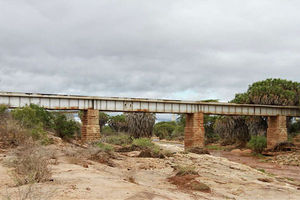
Patterson had arrived to take up his position as the railway’s engineering supervisor. His first posting was to Tsavo, where he was to take charge of the line’s construction, where the key task was to build a bridge over the Tsavo River.
He spent his first night there in a small palm hut which had no door. Remembering it, he wrote: ‘If I had realised that at that very time two savage brutes were prowling round, seeking whom they might devour, I hardly think I should have slept so peacefully in my rickety shelter.’
However, Patterson was soon to realise that he had to take up another task – to rid the area of what he called ‘most voracious and insatiable man-eating lions’. It was a dangerous and frustrating task that took him nine months to complete. After only a few days in Tsavo, he was told that two of the Indian workers had mysteriously disappeared from one of the surrounding camps, and it was believed that they had been taken by lions.
He at first found it difficult to believe the story – until three weeks later one of his Sikh officers – called jemadars – had been seized in his tent during the night, dragged off and eaten. Patterson followed the lion’s tracks until he found this: ‘The ground all round was covered with blood and morsels of flesh and bones, but the jemadar’s head had been left intact, save for the holes made by the lion’s claws on seizing him, and lay a short distance away from the other remains, the eyes staring wide open with a startled, horrified look in them.’
It soon became clear that there were two man-eaters – two rogue male lions that were terrorising the huge camps. With work seriously interrupted and a growing number of railway workers deserting, Patterson knew that he had to deal with the crisis. For months, he sat up night after night in trees or on flimsy scaffolding he had made. The workers thought the lions were actually devils sent to stop the construction of the railway; Patterson came to feel that they had an uncanny way of knowing his plans. But, eventually, he was able to shoot both of them – but not before they were believed to have killed over 140 victims.
With regard to the Kenya Museum Society’s event on February 7, Alan Patterson was not able to make his presentation; he was unable to get his Kenyan visa in time. It would have been particularly interesting because he has reviewed the journal his ancestor kept during his time working on the Uganda Railway. In his review, Alan Patterson suggests that the claim that there were over a 100 victims could well be an exaggeration because, based on the journal, the number is more likely to have been around 30. However, it should also be noted that the journal refers only to Indian workers, and it is likely that the casualties were higher among the African workers but their deaths hadn’t been documented.
Nevertheless, the American wildlife ecologist, Professor Julian Kerbis gave a fascinating talk on the natural history of the man-eaters, based on a research paper he and Thomas Gnoske published in the Journal of East African Natural History back in 2001. One hundred years ago, Colonel Patterson sold the skulls and torn skins of the two lions to the Chicago Field Museum of Natural History. It was found that the primary culprit had a broken tooth, which might have disadvantaged him when hunting his normal prey.
In the cavities of this tooth and the exposed canines of both lions, hairs were found that indicated the man-eating diet. However, it was recognised that there could have been other factors that caused the lions to attack humans. It was a time when rinderpest seriously depleted cattle and buffalo, which were the primary prey of the Tsavo lions.
Also, the Tsavo ‘nyika’ or wilderness was thick thorn scrub. This could have made the lions’ normal hunting very difficult, so they found raiding the railway workers’ camps a much easier strategy. Finally, the researchers’ study of relevant literature showed that the man-eating witnessed by Colonel was not an isolated happening at Tsavo. It had been going on for many years and it continued well after the two man-eaters were killed.
Along with Professor Kerbis’ talk, Dr Ogeto Mwebi and Bernard Agwanda, two Kenyan scientists, explained the work of the current MELT project of the National Museum of Kenya. It is a project that is carrying out further research related to the Tsavo man-eaters, leading to more documentation, an exhibition and a diorama based on the world’s most notorious lion story.
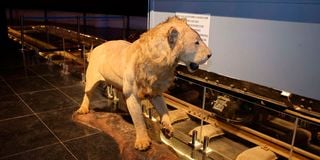
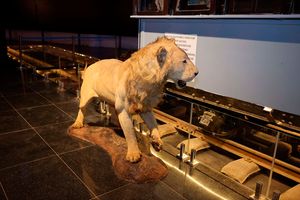
We then visited the Taxidermy Department, to see the museum’s work in preparing skins and mounting many of Kenya’s animals that can be seen in museums across the country. The two lions in the photograph were seen in the Taxidermy Department in Nairobi, not in Chicago.