It was the third time my niece, Helen, had been to Kenya. The first was in 1990; the second in 2013; this last time was a few weeks ago.
Before she came, I asked her what she wanted to do or see. The first thing she said was that she would like to visit the Ark, because her parents had told her how exciting it was when they went there.
Second, she had never managed to see a wild lion. Third, some of the places I have written about in my column, especially those associated with characters she has read about.
I have often recommended the Ark when we have had visitors here for only a short time and when they would like to see Kenya’s wildlife. There is often drama there on its saltlick. We have seen elephants mating, buffalos fighting, a leopard passing, lions hunting. One American tourist went away thinking she had seen a polar bear. It was when Jamie was the guide in charge. A big hyena crossed in the distance and his fur was glowing in the saltlick lights.
‘Heh, is that a polar bear?’ she cried out. Instead of laughing, Jamie said ‘Wow, you are lucky. Really lucky. You know, each year the polar bears migrate between the Arctic and the Antarctic. Very occasionally they pass through here. We are all really lucky tonight!’ She looked impressed. No-one let Jamie down by laughing.
So, I thought Helen would have a good chance of seeing her first lion in the wild – forgetting that, right now, there are no lions in the Aberdare National Park. Anyway, even before game viewing at the Ark, the lunch at the Aberdare Country Club is special and, if you are lucky, the view of Mount Kenya is spectacular. Talking afterwards about that lunchtime, Helen said ‘I thought it was wonderful – the atmosphere of the place, looking out to the mountain, the beautiful gardens around it, the terraces down to the swimming pool. You could almost feel that the family that built it was still there.’
Then there was the bus ride up to the Ark, first through small shambas and soon through the forest. I was hoping that it would still be as I remembered it. Yes, the three viewing platforms overlooking the water hole and the saltlick were still there; there was still a roaring log fire in the main lounge; the small bedrooms were even neater and smarter than before. As for the visiting animals, there were less than on all my previous times.
As Jamie once told me, he felt like the director of a play, who couldn’t know which of the actors would put in an appearance. However, there was still drama on the saltlick. Three young bull elephants spent a very long time with us. And they put on a good act.
Sometimes, it looked as if they were playfighting; sometimes, as they nudged each other or intertwined their tusks, they seemed to be showing affection. The bit-players were a lone crusty-looking male buffalo, a few salt-licking bushbuck, wild pigs called giant forest hogs, a pack of marauding hyenas in the distance, a pair of crested cranes strutting across the saltlick, Egyptian geese on the water and a very patient black-headed heron hunting at the water’s edge.
In the late afternoon, we were invited to see birds being fed from a tray of food, back down the walkway to the lodge. ‘It was an incredible sight,’ Helen says in her blog. She notes a white-browed robin chat, speckled mouse birds, yellow weaver birds, a silvery-cheeked hornbill and – her favourite – a beautiful green and blue turaco. It didn’t join in the feeding frenzy on the food tray; it stayed on a branch, looking down its beak as if rather disgusted at what she was seeing. ‘That was all so stunning,’ Helen said, when we sat down for dinner.
So, she didn’t see a lion at the Ark. The second chance was near the end of her two weeks here. We had taken her to the Nairobi National Park. We started in our usual way – a drive up to the Impala Observation Point overlooking the plains below.
It was rather disappointing because of the early morning mist. The only living thing spotted was a lonely ostrich. But the breakfast coffee and sandwiches went down well. So did we, as we made for Oloonjura Ridge and then on to Hippo Pools.
It was for a giraffe that we first stopped the car for Helen to take its photograph. It was quite far from the road, and I knew there would be much better photoshoot opportunities. True, on the way to the Hippo Pools we stopped many times: for an impala harem, a small herd of buffalos, a rhino foursome, zebras crossing the road and, of course, close-ups of giraffes. At the pools, there were two lazing crocodiles, a motionless terrapin, a monitor lizard close to the path – but no hippos. Those we saw when we moved east to the Athi Basin Dam.
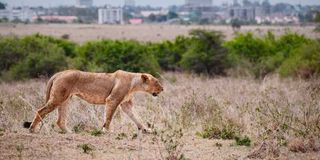
But still no lion. Then, at a point where Helen, for the umpteenth time, was photographing giraffes, she suddenly cried out ‘Lion!’. Sure enough, there she was – a lioness, about 20 metres from the track. She looked at us for a while, yawned, and slowly moved behind our car and lost herself in the bush. Mission accomplished. Our mission, not the lion’s.
This is how Helen described the experience in her blog to friends and relatives back in the UK. ‘How can so many natural and wild wonders exist so close to the city. These plains are vast, and they are protected – preserving the sights and their wildlife that we have enjoyed today.’