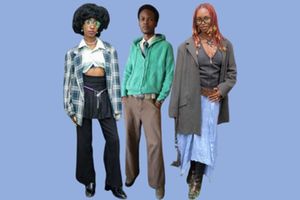
What to wear should be a personal decision, more so in this age of “my body, my choice”, yet there are times when concepts such as “dress your age” or “things to stop wearing after 30” reinforce the unwritten rules that still govern clothing choices today.
On TikTok, a middle-aged Kenyan woman shares an outfit transition, moving from a boxy, neutral-coloured ensemble that would traditionally be considered more acceptable for her age, to a shorter, more fitted and revealing dress, accessorised with colourful, trendier pieces and a more pronounced make-up look.
“Nobody can tell me nothing,” she declares defiantly, brushing off accusations of suffering a midlife crisis. And while the style she embraces may be considered more youthful, she appears more comfortable, confident, and put together in it, which begs the question: is there such a thing as dressing your age? And what does it really mean?
For Neomi Ng’ang’a, founder and creative director at Style by Neomi Bridal Fashion House, dressing your age is less about following a set of rules and more about understanding who you are at a given stage of life.
“Your style should evolve with you, but it should still feel like you. I believe clothing should communicate confidence, personality, and intention. I don’t think anyone should wake up one day and suddenly feel like they have to dress differently simply because they have reached a certain age. It is more about refining your style as you grow – knowing what suits your body, your lifestyle, your personality, and the person you have become.”
Award-winning stylist and creative economy entrepreneur Connie Aluoch also shifts the emphasis away from a number, preferring to think of dressing in terms of the different seasons of life.
Fashion expert Connie Aluoch, the founder of Connie Aluoch Styling Management.
Photo credit: Pool
“I look at it more as seasons than age,” she says, explaining that those seasons can include different seasons of adulthood as well as circumstances such as maternity, perimenopause, or menopause. But, she adds, context matters.
“A 24-year-old working in a law firm will definitely dress differently from a 24-year-old working in advertising,” she says.
The same applies as people get older. A lawyer in her 40s may have different expectations placed on her wardrobe compared to someone in the creative industry of the same age. What is considered appropriate, therefore, may have less to do with the number on a person’s birth certificate and more to do with where they are, what they do and how they want to present themselves.
This further suggests that there are no styles, silhouettes or individual pieces that are inherently limited to one particular age group. “I don’t believe fashion has an expiry date,” says Ms Ng’ang’a. “You don’t have to give up colour, shorter hemlines, statement jewellery, prints, fitted cuts, or playful styles simply because you have crossed a particular age. What may change instead is how you style it. You might pair a bold piece with something more understated, or choose the style in a more sophisticated fabric or silhouette.”
This is particularly relevant as trends are increasingly worn across different generations. But rather than adopting an entire trend from head to toe, Neomi suggests incorporating one element that speaks to you into your existing wardrobe. That way, the trend becomes part of your personal style rather than your style becoming the trend.
“I always say, don’t wear the trend, interpret the trend,” she says. “For example, if sheer dressing is trending, you can bring in a sheer sleeve, textured fabric, or a subtle sheer panel, rather than wearing a completely sheer outfit.”
Similarly, adopting a more mature or sophisticated style doesn’t have to mean being boring, serious, and predictable.
“As people mature, there is often a greater appreciation for proportion and structure, making fit and construction more important than how much skin is showing,” she says. “But you can have beautiful tailoring and still play around with colour, interesting accessories, texture, prints or unexpected details. The sweet spot is when the foundation of your look is polished, but there is still something that feels you distinctly.”
Ms Aluoch argues that dressing your body shape is the more important consideration, alongside what the wearer is trying to achieve with their look.
“A 40-or 50-year-old who looks great can wear a crop-top,” she says. “Similarly, a younger lady trying to look more mature can look good for a dinner in a classic, floor-length gown, or with a more sophisticated hairstyle or make-up that gives off a more mature look.”
For all the practical considerations that go into getting dressed, however, both experts say confidence remains central to how a person carries a look.
“Confidence in your skin is very important,” Connie says. “Regardless of your age, body size, and shape.”
According to Neomi, that confidence comes from knowing yourself and, in turn, changes how you carry yourself. Rather than dressing for validation, you dress with intention.
“You can put two women in the same outfit and get two completely different results,” she says. “When you are comfortable in what you’re wearing, you don’t spend the entire evening adjusting your dress or wondering whether people approve of it.”
For Neomi, that confidence also challenges the idea that looking youthful or sophisticated is necessarily about the clothes themselves. Youthfulness, she argues, is an energy, as is sophistication.
But while both challenge age alone as a fashion guide, Neomi believes that women continue to face particular scrutiny over how they dress as they grow older.
“Women are often expected to look youthful, but at the same time, they are told not to dress ‘too young,’” she says. “Men are generally given more freedom to age naturally and develop a signature style without as much commentary about whether their clothes are appropriate for their age, and I think we need to give women the same freedom to evolve, experiment, and express themselves.”
Connie, however, sees the scrutiny as increasingly extending to men as well. For her, expectations around age and appearance are no longer confined to women, as more people pay attention to fitness, grooming and personal style.
“I think these days it goes both ways,” she says. “Everyone is keeping fit, taking care of themselves or trying as best they can.”
She believes social media has played a role by making images of people at different stages of life more visible, while also exposing them to new ideas about how they can look and dress.
Ultimately, both experts point to a more personal definition of style that allows for change without demanding that people leave parts of themselves behind.
“I think we need to stop treating age as a fashion restriction. You don’t need permission from a number to enjoy fashion,” Neomi says.