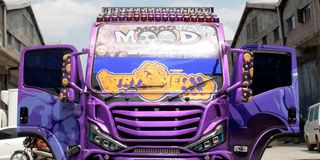
When my colleagues and I arrive at the garage along Lunga Lunga Drive in Nairobi’s Industrial Area, we find ‘Mood’ in a dusty yard. The headlights are still on, that’s the first thing we notice.
Outside, a few guys, mechanics, are hunched over the bumper, working on the lights. Wires hang loose and exposed as they install a new set of lighting.
Even the onlookers cannot get enough of it. Workers from a silo next door keep sneaking glances at Mood. A few take selfies beside it, some older Kenyans too.
Mood: The rolling nightclub featuring an MC and a DJ
A passing boda boda guy slows down, squints at the graffiti on the public service vehicle (PSV), lets out a low whistle, then rides off shaking his head. Even traffic cops pull up mid-interview to get a look.
Mood, which was launched last Friday, is a whole scene.
The matatu or nganya, depending on which generation you come from, has not yet started carrying passengers, but it’s already trending on TikTok, WhatsApp statuses, and Instagram reels.
It was unveiled last weekend with razzmatazz: fog machines, neon lights and a playlist that one could assume it is a Friday night at Quiver, popular nightclubs in Nairobi.
However, today, the music’s off. The AC hums faintly. The seats still smell new.
“I’m DJ Slyze, real name Daniel Mbugua,” the deejay who will be behind the decks says.
“My deck is right next to the driver, and I’m basically like a co-driver,” he chuckles.
Daniel Mbugua also known as DJ Slyze.
Photo credit: Francis Nderitu | Nation Media Group
To anyone stepping into Mood, the presence of a live DJ booth might seem surreal, but for DJ Slyze, it’s a work station that makes him among the first deejays to infuse music and nganya culture.
“I don’t think there’s any other matatu out there, not just in Nairobi, but even countrywide, that has a DJ booth inside, and an MC as well,” he says.
“We’re taking things a notch higher. The MC will be the hypeman, and I’ll be doing my live mixes.”
Unlike club gigs where deejays often plan transitions and sound cues ahead of time, DJ Slyze says Mood’s playlists will flow more organically.
“In terms of me having a playlist for the first ride? I don’t have one prepared. As you know, deejays don’t prepare playlists. We go with the vibe. We read the audience. And in this case, our audience is passengers.”
He sees himself responding to moods in motion. “Let’s say it’s the morning hours and people are headed to work, I’ll play some gospel songs, some soft or relaxed music. You can’t be hitting people with heavy reggae or dancehall all the time. It has to match the moment.”
“I have a lot of exclusive mixes that I plan to play. I’ve got tons of mixes,” he says, hinting at how Mood might become a platform for breaking unreleased DJ sets.
“For road trips, our playlist will change, too. And I’ll be doing live mixes on TikTok. We’ve got cameras installed that will capture everything. After that, I’ll post the sessions on my channels.”
The obvious question arises: with all the bumps and potholes Nairobi’s roads are known for, how will a deejay manage to stay stable while mixing live?
“We thought of that,” he says. “The setup was designed well. We ensured that even when we hit potholes or go over speed bumps, my setup won’t shift or mess up my mixes. Everything is secured.”
The interior design of a public service vehicle nicknamed Mood pictured at a garage along Lunga Lunga Road in Nairobi on July 24, 2025.
Photo credit: Francis Nderitu | Nation Media Group
“We also have a plan to bring in Kenyan artistes to perform, a kind of pop-up show on wheels. There are so many dope artistes in Kenya, and Bien [among the highest paid musicians in Kenya] is top on our list,” DJ Slyze says.
“Matatu culture and the DJ industry fall under one umbrella,” he says. “The up-and-coming deejays need these kinds of spaces. That’s part of what this is about.”
A DJ deck instlled on the passenger front seat of a PSV nicknamed Mood.
Photo credit: Francis Nderitu | Nation Media Group
“And if I have another gig, I’ll assign someone to stand in for me. But this mat? This setup? This is mine,” he says.
David Nzeke is the conductor for Mood. Nzeke didn’t get into the job through any formal training or application.
“I became a conductor just by knowing people,” he says. “I had a friend who was a conductor and ended up introducing me to his circle of conductors, and that’s how I ended up here.”
That was four years ago. Since then, Nzeke has hopped on and off dozens of mats, but he says Mood is something different.
Leonard Kituu (right), the driver and his conductor David Nzeke.
Photo credit: Francis Nderitu | Nation Media Group
“Working in a mat everyone is talking about feels really nice,” he says. “Everyone is taking photos of us, you even saw what happened during last week’s launch at the KICC. The buzz was evident. We’ve even had people come to the garage to take photos of it. I’m a happy man.”
While the attention has mostly been positive, not everyone is a fan.
“Reactions are good, although we’ve had haters as well speaking ill about us. You will have enemies everywhere,” he says.
As for fare? “Right now, it’s Sh150,” he says. “Something the common man can afford.”
Behind the wheel, sits Lenny, full name Leonard Kituu. He’s been in the matatu industry since 2019.
Mood, he says, has been a long time coming.
“This thing has been in the works— being designed— since December last year. It was bought last year, too,” Lenny explains. He says when he first saw the graffiti concept, he knew they had something special.
While its signature purple and moody emojis have sparked assumptions that it targets female commuters, Lenny clarifies that wasn’t the intention.
“Yes, the colour is a bit ‘girly’ in nature,” he says. “Even the drawn emojis… they show the kind of mood you’re in. But we didn’t necessarily target ladies. We just wanted a vibe everyone would want to be associated with.”
There has been debate about the route, with Ongata Rongai seen as the best suited. The route they picked, Embakasi to CBD, Lenny says, is a strategic one.
“It isn’t that busy, has passengers, and it brings me money,” he says. “The roads are passable, near, manoeuvring them is easy, and there’s less traffic.”
But the Embakasi route has other matatus too. He says he’s not blind to competition in the industry.
“Everything has competition, always. Learn that and keep it in the back of your mind. People will always want to outdo you, regardless. You just have to do your part. Nothing comes easy.”
When asked about what he’s bringing to the table, beyond cool wheels and flashy lights, he doesn’t hesitate.
“In this industry, you need to show who the driver is. Be someone willing to work with society. You need to be a good role model, not just a driver,” he says. “Show people what’s next, apart from just being a driver. Be disciplined too, man.”
“Just know what brought you to work. Know what sorts of bills you will receive, whether as a conductor or a driver. Do your work and go home. Leave the rest to the haters.”
“Because as a driver, I should know what’s happening back there.”
“For backup power. “It is backup power,” Lenny explains. “We have a lot of lights, music, screen, A/C, all-consuming power.”