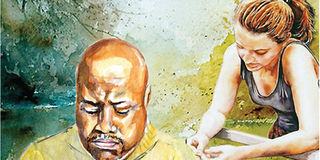
I was in Edinburgh talking to an ex-patient of mine who now lives in Glasgow. I had gone there to meet the President of the Royal College of Surgeons of Edinburgh and seek support for The College of Surgeons of East, Central and Southern Africa – Cosecsa.
The idea of a local college germinated because of the brain drain our region suffers from. Some of our doctors who go to the UK, Canada and US for post-graduate studies fail to return home to serve their motherland. Prime Minister Raila Odinga recently lamented in the press and I quote:
“The government spends a lot of money to train just one doctor – yet those doctors leave almost immediately for greener pastures abroad, leaving us exposed. It is a trend we must reverse.” This brain drain mainly occurs when doctors go to obtain higher qualifications abroad.
While working there, they receive higher salaries, find better research facilities and above all enjoy higher standards of life for their family with better health and education facilities. Naturally they fail to come back or return and leave soon after. One way to reverse this trend is to provide post-graduate education locally and thus retain them here where they can serve their own country.
The aim of Cosecsa is to precisely do that in the nine countries which constitute the college and give them a qualification acceptable and registered everywhere. That way they also learn how to work within the resources available locally. Of course they can go for short periods to polish their training and see the technical advances in the developed world.
Being a fledgling institution, Cosecsa is seeking help with basic surgical skill courses, lecturers, examiners and e-learning from well established colleges in London, Dublin and Edinburgh.
I was on one such mission and felt very upbeat after a fruitful and productive meeting in the Scottish capital. It was on the last day of my stay there that I decided to ring Marion and find out how she was getting on. “So when do we see you in Nairobi?’ I asked.
“Not for a long time,” Marion replied betraying her disappointment. “I am afraid, for me Africa is in the past. I don’t think I want to come to Kenya for a long long time; perhaps when the past has receded into amnesia. Until then, I don’t want to renew my relationship with anyone, in what was once my home!”
“Don’t you miss the Kenya sun?” I tried to lure her. “I do,” replied Marion. “In fact right now, there is five feet of snow outside my door in Glasgow and I don’t even want to think of the lovely sun in Kenya.”
I had known Marion for a long time in Nairobi. She was a teacher at one of our renowned convent schools and had taught our daughter Geography when she was doing her ‘A’ levels. At some point in time, the convent school allowed boys to join girls in the higher forms and our son also had the benefit of being taught by her.
Apart from her academic excellence, Marion had a way with boys and girls of high school age and was a role model. Naturally, we met Marion often to discuss our children’s progress and this happy rapport matured into a family friendship.
As often happened those days, family lawyers, doctors and teachers were invited regularly to private and corporate social functions and we often met Marion and her husband Jeremiah -- Jerry for short -- on these occasions. So when she was brought to the casualty department one night with an emergency surgical problem, she asked for me.
“I have a lady here who knows you and would like you to come and see her,” said Dr Okoth, the doctor on duty, and gave me her name. “Oh yes, she is a family friend,” I said. “What’s the problem?” “Sudden severe abdominal pain,” Dr Okoth stated, a common emergency surgical complaint.
“No vomiting but has not moved her bowels for the last three days.” I waited because knowing how methodical Dr Okoth was, he was now going to embark on the physical findings. “On examination, she has a distended abdomen -- like a drum,” he added the African touch. “It is tender all over and I cannot hear any bowel sounds.”
“She is in the X-ray department having it done, as I speak. By the time you arrive, it will be ready.” As I drove to the hospital, Marion’s past social history occupied my mind.
“I met Jerry when he came from Kenya to study in Edinburgh,” she mentioned once at a sundowner where we had met. “He was doing his PhD in English literature with a view to obtaining a chair at one of the universities back home and I was doing my degree in teaching. We met at a university dinner dance and just clicked.
“Nobody was more surprised than me when, after a few weeks, he proposed and I accepted. I had been brought up in the Scottish highlands where my parents lived and still do,” she added.
“My parents thought that distance, cultural and ethnic differences and also the weather were going to be disparate for me. Marriage is a difficult institution. Why make it more difficult?” my father cautioned me. I was their only daughter and Jerry had swept me off my feet and eventually they decided not to stand in my way. So here I am,” she completed her story.
“And?” she understood the significance of my monosyllabic question. “I am so happy I am here. I love Kenya and its people,” she had said. By the time I reached the hospital, the X-rays had arrived and Dr Okoth put them on the viewing box as soon as I had finished seeing Marion. Jerry was pacing the corridor like an “expectant” father.
“She has a volvulus,” I said when I went back to the cubicle and sat Jerry down by the side of Marion’s couch. “What’s a volvulus?” Jerry asked. “It is a twist of the pelvic colon -- part of the large intestine,” I replied. “Rather uncommon where Marion comes from but quite common here and in Uganda.
“She is more Kenyan than I am and I am not surprised that she has picked up a local disease!” Jerry remarked. “What do you do for volvulus?” Marion asked. “We have to operate and do so quickly,” I explained. “What we do next depends on what we find inside.
If the colon is viable -- we remove the twisted part and join the remaining colon. We do so because if we just untwist and come out, it will twist again. If, on the other hand, the twisted colon has lost its blood supply and is badly necrotic, we remove it and do a temporary colostomy.” As I saw the couple’s perplexed faces, I elaborated: “We bring the colon out temporarily.”
“How temporarily?” Marion sounded horrified. “May be two to three months,” I replied. “Then we go in, join the colon again and close the colostomy!” “Why don’t you do the same in necrotic colon as you do when the colon is viable?” Jerry asked.
“When the colon is necrotic and has leaked, there is what we call faecal peritonitis and joining the colon will very likely not succeed. The joint will break down causing further soiling inside.” As I saw the point going home, I added: “Our policy in cases like this is to hope for the best and be prepared for the worst.”
When I opened Marion’s abdomen, my optimism vanished. I agonised a long time, both with my head and my heart and ultimately the head won. The reality of the situation dictated colostomy as the safest course. In spite of the warning I had given, both Marion and Jerry were shocked when I told them what I had to do.
“Don’t worry,” I tried to comfort them. “It’s temporary. As soon as your abdomen has recovered from the severe sepsis, which may take anything from 10 to 12 weeks, I will close the colostomy and you will be back to normal.” What happened in those 12 weeks confirmed my oft repeated contention. Like no man is an island, no disease is an isolated incident in a patient’s life. It has antecedents and consequences that go far beyond the patient.
It was long after I had closed the colostomy that Marion decided to disclose the havoc that the temporary exteriorisation of her bowel had wreaked in her life. “I could see the change in him soon after I went home from the hospital after my three weeks’ stay,’’ she said. Her stay was prolonged because she had to be trained in the care of her colostomy.
“Then in the three months at home, while I had the colostomy, I could see the relationship between Jerry and me deteriorating. Finally the children spilt the beans.” She then made a profound statement which could only come from a teacher with her depth of thinking.
“Children are the best judges of their parents because they have a unique opportunity of making a continuous assessment from very close quarters. They told me that while I was in the hospital, something had snapped. I confronted Jerry and he did not deny it. He also confessed that it was somebody from his own childhood who had surfaced and had reignited the flame.”
She then made another profound statement. “After the novelty had worn off, I could see that Jerry missed the trappings of his own ethnicity, his tribal customs, even his food and lifestyle. The words of my father rang true, “marriage is a difficult institution – why make it more so?”’
As I sat there flabbergasted, she concluded: “The children have grown up. They don’t really need two parents who are living together and I have decided to go back home.” “How does Jerry feel about it?” I asked. “Sorry but probably relieved. He seems to have achieved what he was unconsciously hankering after. The physical and psychological impediments caused by colostomy were perhaps the trigger.”