Seeing Dick Mawila walk in stride with Permanent Secretary Dr James Nyikal sent a strong message to participants at a global consultation in a Nairobi hotel last week that children’s right to play was no joking matter.
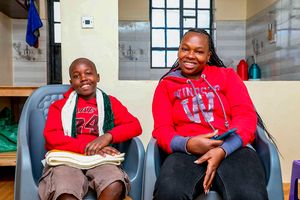
The Standard Six pupil from Vessel of Hope Primary School in Kayole, a high density estate in Nairobi’s Eastlands, told this writer last week that he loves volleyball and football, games he cannot play at his own school because it has no playground.
“We use the Mysa (Mathare Youth Sports Association) field,” his teacher, Christine Kiyaka, explained.
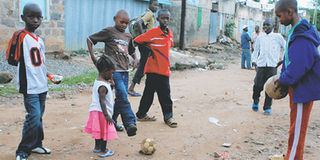
That, in a nutshell, typifies the plight of most children, who are growing up deprived of open spaces to play in.
Dr Nyikal, the Permanent Secretary in the Ministry of Gender, Children and Social Development, told participants at the global consultation on children’s right to play that “Children want to play, but there are no safe playgrounds or facilities.”
Underlining the importance of play to child development, Dr Nyikal, who is a paediatrician, told Living that the development of children who don’t play is retarded. “Their physical growth and personality development is affected since play brings about social interaction.”
According to the doctor, children deprived of play might not find it easy to talk and work with people.
“They are isolated and tend to be loners.” Although he adds a comforting note that “They’ll eventually get there”, he insists that the physical, social and mental development of children deprived of play will not be as fast as that of those allowed to play.
His assertion evokes the bleak situation of today’s urban child, rich or poor, who is growing up deprived of the open spaces that their parents and grandparents took so much for granted.
A typical up-market estate is marked by concrete walls and electric fences more reminiscent of a garrison than a home. Irrespective of the size of the compound on which the home stands, nothing can substitute for children’s interaction with their peers.
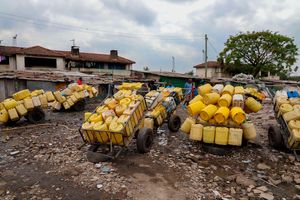
The poor urban child is worse off, because chances that she or he will be locked indoors all day are high. The results of such options are often catastrophic. Cases of children burning to death in houses as they experiment with matches and stoves are common.
“In Kenya today, one of he major impediments to children’s freedom to play is the increasing cases of child abuse, abduction and trafficking. Children are often abused or abducted while playing. Such cases have forced parents to restrict their children indoors, or to play within their limited compounds when out of school.”
But even that does not guarantee children’s safety. “Cases of child minder colluding with abductors are known. Most abductors demand huge sums of money as ransom to release the captives,” the PS noted.
Clearly, children’s right to play, as enshrined in Article 31 of the UN Convention on the Rights of the Child, which is identical to article 12 of the African Charter on the Rights and Welfare of the Child, exists more on paper than in reality.
The article reads: “State Parties recognise the right of the child to rest and leisure, to engage in play and recreational activities appropriate to the age of the child and to participate freely in cultural rights and the arts.
“State Parties shall respect and promote the right of the child to participate fully in cultural and artistic life and shall encourage the provision of appropriate and equal opportunities for cultural, artistic, recreational and leisure activity.”
During last week’s consultation, the co-convener, Creche — Centre for Research, Communication and Gender in Early Childhood Education — displayed cultural artefacts, which in bygone days served both as utility vessels and as playthings.
Take the gourd, for instance. Girls used it for fetching water, but they could also put seeds or little pebbles in it and simply shake it for amusement.
The same goes for the catapult. Boys of the yesteryears derived much fun from the simple -weapon with a leather loop from which a stone could be “fired”. They learned marksmanship and at the same time used the slings to kill birds for supper.
Play and work easily intermingled, unlike today when young boys like Mawila have to “borrow” playgrounds.
Aware of the interplay between work and leisure, Dr Pamela Kola, the International Play Association coordinator, who is also the executive director of Creche, described play as “a key factor in children’s wellbeing and holistic development”.
She said: “We should give it due priority in our school curriculum, in homes, in constructing roads, estate developments, leisure and recreational facilities” — a point that the PS also mentioned in his keynote address at the meeting.
According to Dr Nyikal, the majority of the world’s children are exposed to hazards such as polluted water, open drainage and sewers in congested and crowded surroundings.
Children regard those as playgrounds and our photo library is replete with pictures of children playing in broken sewers, oblivious of the danger they are putting themselves in.
The consultation brought together representatives of research institutions, government ministries, nursery and kindergarten teachers, parents, social workers, planners, designers, architects and curriculum developers.
Also included were those working with displaced people, prisons, hospitals and refugee representatives as well as NGOs involved in advocacy for children’s rights — all with a thing or two to say about children’s right to play.
As Dr Nyikal challenged them to lobby for concrete steps to promote, protect and support children’s right to play, a participant took issue with the current education curriculum, which is so loaded that it denies children their right to play.
Children are already asking questions about the curriculum, and Dr Nyikal gave the example of his child who asked him why he had to check homework.
His response, that “it would be too much for the teacher” was countered with, “If the teacher has no time to mark the homework, why does she think my parents have the time? If she cannot mark it, then she should not give us the homework.”
The Children’s secretary in the Gender ministry, Prof Jacqueline Oduol, shared concerns over the quality of education children are getting, which is undermining their right to play and by extension, their creativity.
She expressed the need “to encourage and support teachers to unleash children’s creativity”. There was a need, she said, to create more awareness of children’s right to play.
Ms Hellen Kimathi, a curriculum developer at the Kenya Institute of Education, turned the heat on parents, accusing them of denying their children the right to play.
Responding to the question on why children have to go to school “even on Sundays”, Ms Kimathi explained that the curriculum allowed for play but that teachers were exam-focused.
“They like the formal ABCs. Parents, too, don’t want their children at home; they push them to the teachers,” she said, adding that the curriculum allows for physical education and games.
According to her, social, moral values, respect, and even numbers can be taught to children through play. Ms Kimathi accused teachers of being part of the conspiracy to deprive children of play.
Anppcan director Dr Philista Onyango shared the view that there was a conspiracy between parents and teachers to deny children their right to play.
At school meetings, she said, “You will be isolated if you advocate for children’s right to play, yet it is an important area of children’s development.”
Dr Onyango, who heads the African Network for the Prevention and Protection Against Child Abuse and Neglect stressed the need to go beyond the rhetoric and come up with a policy to protect children’s right to play.
“Nothing will happen without policy,” she said, which in turn calls for resources.
The PS invited participants to ride on the Children’s Act, which is in the final stages of revision, and the national policy on children, which is being developed, to factor in the consultation’s concerns.
“If we have very basic fundamental issues from this meeting, they can be input at the Cabinet level,” he said, and called on partners at the meeting to join hands in evolving a policy on children’s right to play.
He confirmed Dr Onyango’s claim that unless concerns like getting developers to create open spaces for children to play were integrated into policy and budgeted for, the participants’ aspirations would not work.
“Governments the world over are pushed by people, who are always ahead of government,” the PS told the participants, adding: “We are open to your suggestions. Bring concrete proposals and they will go into the children’s policy and the Children’s Act.”
The PS stressed the importance of citizens’ action to protect open spaces, many of which end up in grabbers’ hands. Strong neighbourhood associations, he said, are needed to protect safe open spaces for children to play in.
“A world without play is not a world fit for children,” Dr Nyikal said.