Hello

Your subscription is almost coming to an end. Don’t miss out on the great content on Nation.Africa

Ready to continue your informative journey with us?

Hello

Your premium access has ended, but the best of Nation.Africa is still within reach. Renew now to unlock exclusive stories and in-depth features.

Reclaim your full access. Click below to renew.

From frying crisps in the kitchen to soft drinks giant

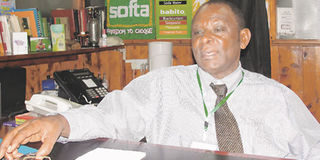
Peter Kuguru. Photo/ERIC WAINAINA

A mention of Peter Kuguru quickly brings to mind the soft drinks brand, Softa, which the businessman has come to be associated with.

According to the proprietor, the brand enjoys a 10 per cent share of the local soft drinks market and has steadily grown from 2001.
But this is not where the story ticks; it is how he started his business in the first place that is more interesting. “I started from scratch in 1970 when I was frying crisps from the family kitchen and relied on hawkers to sell my products,” he says.

“It was a struggle but I eventually managed to enter into fermented beer — Kibuku Sorgum Sake — which I later abandoned in 1985 to enter into soft drinks manufacturing,” he adds. And it has not been an easy ride for this employer whose business supports 75,000 families directly.

He says it has been a laborious effort of stone by stone art to be where he is today, where his revenue base runs into millions of shillings.

What other investments do you have? 

I am in real estate and also laying the foundation to process carbonated drinks. I am in the milling industry too, where I am behind various flour brands in the market.

How did you raise your first capital? 

From my crisps business and a boost from my father. The moment I was able to have a balance sheet and an account budget, I approached ICDC Bank in 1975 and got a loan of Sh2 million.

I channelled it into my budding investment and soon managed to buy a station wagon and then a pickup to supply my goods. Through denying myself the comforts of a good life and securing more credit from financiers, I rose slowly to become what I am today. 

What have been the challenges? 

Business is a challenge and its tides move in waves. Sometimes it is good and other times it leaves you disappointed. The trick is in prudent management and foresight to anticipate certain happenings.

The pulls and pushes of business are the thrill that define good managers. At the end of the day, patience and sharp decisions have kept me afloat. During the periods of dark clouds, instead of despairing, I always kept my eye open for a silver lining.

That has seen me abandon some expansion projects and embrace newer ones, while venturing beyond one specialisation. Besides, as a staunch Christian, I rely on God’s inspiration. 

Are government policies encouraging to local investors? 

Sorry to say, the government has been indifferent to local investors. It has been laying too much emphasis on direct foreign investors.

But with the new Constitution, business rights have been entrenched and we hope to see a change of attitude in policy formulation. We can only hope that the new dispensation will unlock local investors’ potential.

The government should realise that we invest for the local tax and employment benefits, unlike competitors who rely more on expatriates and offloading profits to foreign countries. 

What is a priority in policy formulation? 

We need an anti-trust law that will instil discipline in the way competition is played out. The Monopolies Act that is enforced by Treasury has only been regulating business mergers.

We lack a clause to rein in unfair trade practices among competitors. The cost of business infrastructure in Kenya is high. Electricity, water, taxation, and interest rates have to be lowered if businesses are to thrive.

What has your lowest moment in business been? 

The 2008 post-election violence. All of a sudden the market became tricky as it was being controlled by ethnic bias.

In parts of the country, I lost investments and within a month, the violence had downsized our returns by 50 per cent. That was an era of political stupidity that saw us retreat to ground zero.  

Where do you see your company in Vision 2030? 

By year 2030, I expect to have a 25 per cent market share in soft drinks as well as reasonable inroads in milling and real estate sectors. 

Why the high risk brand promotions like ‘Buy One Get One Free’?

It is a very powerful promotion exercise that has instant results on sale volumes. This is because customers are lured through sampling in the giveaways.

We want to keep on hammering that we break market monopolies to bring in freedom of choice in the soft drinks industry. Towards this, I channel Sh10 million quarterly. 

You also harbour political interests. Are politics and investments compatible? 

I come from a political family and it is only natural that I retain political traits. In business, I rely on professional human resource to keep things moving.

At individual level, I chart a political fortune. For now, we can only wait and watch how the political scene shapes out.

The new Constitution’s implementation will define the political game. Before that happens, I’m worrying more about my investments.


