It was a big dream; owning a car.
It was big because the year was 1931 and the dreamers were two young hawkers lugging bags of assorted vegetables in the Asian districts of Nairobi.
It was an even bigger dream considering that transport in Nairobi then was mainly by hand-pulled rickshaws and ox-drawn carts mostly used by whites.
No African owned a car then and that is why Mr Gerald Gikonyo Kanyuira and his friend were in a class of their own when they pooled Sh150 each to buy a Sh300 Austin.
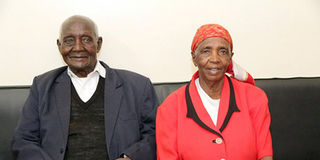
It was this ambition that has defined the life of Mr Gikonyo, who celebrated his 100th birthday last week.
Even with a century under his belt, Mr Gikonyo remains actively in charge of the day-to-day running of his business empire as the chairman of a section of the Rwathia group of companies, which has over 500 employees.
The companies boast such investments in Nairobi as Magomano Hotel, New Kinangop Hotel, Timboroa Hotel, Alfa Hotel, Rwathia Distributors — a beer distribution company — and numerous other businesses, especially in real estate.
Despite his age, Mr Gikonyo still walks with a robust gait as he moves around the corridors of Alfa Hotel from where he directs his large empire put together through decades of hard work and dogged determination.
With a vivid memory, Mr Gikonyo laces the story of his life with refreshing wit and humour. He admits that he is polygamous, having married four wives. Of the four, only Wangari survives.
With his four wives, Mr Gikonyo sired 23 children.
Naturally, it follows that he has numerous grandchildren, great grandchildren and great great grandchildren. So how many are these?
They are so many that you would require an auditor to verify the actual number,” he tells Lifestyle.
His first-born is Mr Stephen Karanja, born in 1936, while his last-born son, Mr Javed Kamau, was born in 1972.
The companies he co-founded with friends and relatives mainly from his Rwathia village in Murang’a County started with his first salary of Sh4.
I therefore had to find ways of assisting my foster mothers in my upkeep and that of my younger brother.
It is from there that I went to the Mathari Catholic Mission where I got a job as a farm-hand on their coffee plantation,” he recalls.
Back then, Sh4 was a princely sum.
With his savings he invested in goats, which he would later sell to facilitate his relocation to Nairobi in the mid 1920s.
In Nairobi he secured employment with Kenya Planters’ Co-operative Union with a salary of Sh20 per month.
I would then make coffee for sale to my colleagues up to 4 am, after which I would proceed to Marigiti (now Wakulima market) to buy vegetables to hawk to mainly Asian families.
I would knock off at 2 pm. That would leave me with two hours to sleep before reporting for duty,” he said.
In 1931, he left employment for full-time business. He partnered with his village mate Solomon Karanja to secure a hawking licence.
The same year, he put up a shop back home at Githioro in Rwathia, in partnership with his step-brother Gikonyo Muthuri.
In time, they diversified from hawking to selling charcoal and wattle barks.
His big break came in 1947 when some friends approached him to contribute capital to start a hotel in Majengo.
“The required sum was Sh3,000. I had only Sh700 so I had to borrow the balance from friends.
My partners were Wacai wa Muhu, Gatu wa Kirubi, Kimani wa Gathere and Macharia Kirubi.
Wacai and I were put in charge of the hotel on a full time basis,” he explains.
At the time, Africans were restricted by colonial laws to living and doing business in Nairobi’s Eastlands.
Africans, disillusioned by being treated by colonialists as third class citizens in their motherland, were beginning to agitate for independence.
The following decade turned out to be the most tempestuous since the establishment of the Kenya colony.
Like other Kenyans, Mr Gikonyo and his partners were caught up in the tumultuous events of the 1950s.
“Every Kenyan had suffered the indignities that came with discrimination, dislocation and disenfranchisement.
When the Mau Mau war broke out, many Kenyans went to the forest from where the war against the colonialists was being waged.
Those of us who had the means gave financial assistance to the fighters,” he says.
In 1952, a state of emergency was declared.
The colonial authorities arrested and detained thousands of Kenyans. Mr Gikonyo was among those detained at Manyani.
It was under such circumstances that his first-born son, Karanja, found himself in a train headed for Central Kenya.
Once outside the city, the teenager decided he wasn’t going back to the village.
He jumped from the moving train, dodged bullets fired in his direction by police officers on guard in the moving train and disappeared into a thicket.
Many of the businesses Mr Gikonyo and his friends had established went up in flames as Kenyans fought for independence.
Contrary to a widely-held belief, Rwathia is not owned by one man.
They are several businesses owned by people from mainly the same village with cross- cutting shareholding.
For instance, some hold shares in a particular hotel while they might hold no shares in the next.
Shrewd businessmen, with more than 10 hotels along River Road, all establishments have names from all parts of Kenya.
“We wanted to create a sense of ownership to all communities from around the country,” says Mr Gikonyo.
He has mentored many successful businessmen including Equity Bank chairman Peter Munga, who at one time worked in one of Mr Gikonyo’s hotels as a casual labourer.
For a start, he appreciates the importance of vehicular transport even though he dislikes cars.
When it finally parked in for good during one trip to Kirinyaga, it had wiped out all my savings.
Any money I had left was only that held in debt by my various customers,” he says.
For the next 20 years after that, nobody could persuade him to invest in a vehicle.
However, in 1948, he and his partners bought a Ford whose main purpose was to fetch water for their hotels.
They owned two buses called Mwijoyo and Kayu and he doesn’t have a particularly happy memory about that venture.
And just to demonstrate his aversion for cars, he has never driven one because he doesn’t know how to.
It has been variously stated that a good diet is the key to a long life, but Mr Gikonyo disagrees.
He says the only thing he cannot eat is metal. That, and roast meat.
“These days I only eat boiled meat. I also enjoy traditional foods and vegetables. Something else; I don’t eat because it is time for lunch or dinner.
I eat when I’m hungry,” he says.
And he no longer takes alcohol. Well, not completely.
A bit of the Kikuyu traditional drink, muratina, can be thrown into the mix.
He has been unable to shake off the habit of sniffing ground tobacco, which was popular with people of his generation.
“To be allowed to sniff tobacco, I had to give elders a goat and a pot of beer.”
Unlike men of his means, he doesn’t have any hobbies like golf.
He has never taken a break from business — okay, once a year he retreats to the village for a month.
All those years, he has never rented a residential house.
His current abode is in one of his hotels in the city centre from where he keeps the wheels of his companies humming along.