Even women who identify as heterosexual do get sexual arousal from fellow women
I don’t engage my seatmates in conversation when flying, but this time, I had quite a talkative seatmate. Because we were going to be together for eight hours across the Atlantic Ocean anyway, it was only logical to be friendly, so I smiled and answered every question she asked.
Her name was Fredina and she had been spending time in Africa as well as in the US. We talked about general things like the weather, then she asked what I do for a living. Her face brightened when I said I am a doctor who treats sex problems.
“So, what is your take on lesbianism?” she immediately asked.
“Well, it is a choice people make and who am I to judge?” I answered, wondering whether she was lesbian.
“I have tasted both worlds – lesbian and straight, and I can tell many stories about the experience,” she said enthusiastically.
While in Africa, Fredina had become attracted to an African man. She believed it was true love. They started a relationship but along the way she discovered that the man was married and had two children.
“I can’t really say that the man hid his marital status from me. He talked about it freely the day I asked about it.”
Fredina decided to be a second wife. She said the man was initially uncomfortable about the whole arrangement but after a while, he accepted it.
Fredina was introduced officially to the family, including the man’s wife. Because she was white, the family thought she had made a great sacrifice to be a second wife and they all tried to make her comfortable.
The next two years were full of fun for her. She was fully satisfied with her sexual experiences in the marriage. She enjoyed the African way of love.
She went for safari with her man. There was so much warmth in the family, everybody doing their best to care for her.
Unfortunately, her man developed cancer and was dead six months later. Fredina flew back to America to restart her life. She got an international job that allowed her to travel back to Africa once in a while. This trip was one of her business trips to Africa, her former home.
“But I lost feelings for men. I felt my husband betrayed me by dying so suddenly and too soon. I have never forgiven him” Fredina said.
Back in America, she remained aloof, avoiding any serious social engagements. Two years after the death of her husband she was approached by a woman for a relationship. She did not know how to respond.
Although she had lost feelings for men, she had not thought of engaging with women. But the woman was quite friendly and kept making advances and showing care.
“We have now been married for a year and it has been an experience to reckon,” she explained. She then went on to talk about how different her sexual experience had been in the two instances.
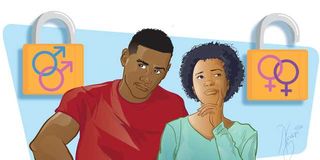
Fredina’s story raises the question of whether people have the power to determine their sexual orientation; to decide to be heterosexual at one point or change over to homosexuality at another point.
This is a difficult question that scientists have tried answering for decades and opinion is divided.
One thing is however clear. At conception we are all the same with a predetermination to grow into females.
The Y-chromosome, found only in those who are destined to be males, triggers some chemical changes and this causes growth of male organs and influences the way the brain develops.
It has been found that a man’s brain is quite different from a woman’s because of the Y-chromosome effect.
It is this effect of the Y-chromosome on brain growth that makes males be attracted to women later in life, in heterosexual relationships.
It is thought that gay men have some other genes that complicate the Y-Chromosome effect so that such men intrinsically have brains that maintain sexual attraction to fellow men.
The biological theory, therefore, is that men have no control over who they ultimately get attracted to because it is predetermined through the genes and chemical interactions that happen within a few weeks of conception.
On women, the theory is that they have a stronger social influence on making sexual choices. Most social systems encourage women to engage in relationships that lead to childbearing and the founding of a family.
Most women therefore go for heterosexual sexual choices. Studies, however, show that even women who identify as strongly heterosexual do get sexual arousal from fellow women.
Researchers have therefore concluded that women’s sexual orientation is more socially influenced than male sexuality, which is more biologically predetermined.
I could not find a better theory to explain Fredina’s sexual relationships other than this biological theory.
As we disembarked from the plane to go our separate ways, I asked her if she would ever be heterosexual again.
“Well, for now my options are open, if my current marriage does not work I can go for either gender,” she answered.