In a quiet corner of Kajiado County, amid chirping birds and the low hum of bees, Murugi Kairu is living her dream. At first glance, her 0.75-acre greenhouse farm may seem modest. But a walk around the lush green paths tells a different story.
“This is my peace. My purpose. My way of appreciating nature,” she says.
Here, passion meets purpose. Compost piles coexist with banana trees. A small apiary hums with activity. Strawberries, pixies, hibiscus, and sweet bananas bloom around the greenhouses, not just for human consumption, but also as food for the bees.
“When there is food and the bees pollinate, the fruits grow healthier and sweeter. You can taste the difference.”
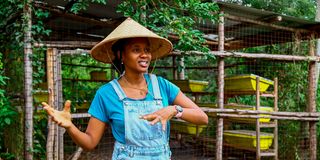
Murugi Kairu, a beekeeper at her farm in Kajiado County, during the interview on June 26, 2025.
Photo credit: Wilfred Nyangaresi
Murugi is not your average beekeeper. The 33-year-old mother of one is a qualified finance professional who abandoned the corporate path to pursue a career centred on waste, healing, and sustainability. Her journey began not with honey, but with garbage.
“I used to walk from Kilimani to Strathmore, and I could smell the stench of garbage from a mile away. It was everywhere. That’s when I started researching how organic waste could be repurposed. I discovered black soldier flies.” These tiny insects break down organic waste and turn it into rich compost.
"Fifty per cent of the waste in Kenya is food waste. Black soldier flies are the perfect solution to that problem,” Murugi says. “I envisioned an insect farm, with just flies and bees.” This fascination with insects eventually led her to the world of bees – nature’s ultimate recyclers, pollinators, and producers.
In 2023, Murugi enrolled in a week-long training at the National Beekeeping Institute in Nairobi. With zero farming background but armed with a bold vision, she invested Sh180,000 to purchase 30 beehives.
“I was not so sure about the outcome. I simply knew that I wanted to farm differently, organically, mindfully." That impact came sooner than expected. Her first harvest yielded 15 kilogrammes of honey from a single hive. “I felt like I had won the lottery,” she says.
Murugi currently manages 11 colonised hives. Some are placed on trees around her farm, others are housed in a purpose-built apiary designed to protect the colonies from predators like honey badgers and baboons.
“Keeping bees isn’t just about putting up a box and waiting for honey. You need to create an ecosystem. Bees need food, water, warmth, and a clean environment.”
To support this, she has planted pollinator-friendly fruits and herbs, harvested rainwater to boost soil fertility with natural nitrogen, and implemented underground composting—burying food waste directly into the soil to nourish her crops.
Murugi Kairu, a beekeeper at her farm in Kajiado County, during the interview on June 26, 2025.
Photo credit: Wilfred Nyangaresi
At one corner of her farm lies a compost heap made of dried grass and kitchen waste from her home, covered in clear plastic. “The plastic cover keeps rainwater out and traps heat to speed up decomposition,” she says.
Murugi is a strong advocate for chemical-free farming. “If you buy food from my farm, it’s 100 per cent organic. No insecticides. No fungicides. Just nature doing its thing.” She believes chemical fertilisers are not only expensive in the long run but also harmful to both the soil and our bodies.
“Our health is a reflection of the soil our food grows in. If the soil is poisoned, so are we,” she warns. This philosophy has won her a loyal following. “People are starting to care more about what they eat. They want toxin-free food, and they’re willing to pay for it.
“Bees love warmth. Heavy rains wash away nectar and pollen, which means the bees can’t collect enough food. That delays pollination and honey production.”
It typically takes between four and five months for bees to be ready for another harvest. And maintaining the hives is a full-time job. “Every two months, I hire a professional beekeeper to clean the hives because dirty hives attract pests and diseases.”
Lessons from the hives
“Start small. Even if it’s one beehive or one potted plant, just start. Learn and grow from there,” she advises, adding that it takes time and everyone's journey is different.
Finding land was another challenge. “Urban areas are too congested and expensive. I settled in Kajiado because I needed enough space and peace for both the bees and me.” Finding the right workers has also been tough for her. “You can’t just hire anyone. Beekeeping is a skill. A wrong move can ruin the whole colony,” she explains.
Beehives belonging to Murugi Kairu at her farm in Kajiado County.
Photo credit: Wilfred Nyangaresi
Murugi’s finance background helped her approach the farm like a business. You need a plan,” she says. “Know how many hives you want, how many workers you’ll need, and most importantly, how long you can go before making money. It will take money before you make money. Have savings or another income stream to sustain you,” she says. Murugi warns that the honey industry is full of fake products.” A kilo of honey now goes for between Sh800 and Sh1,500, but a lot of what’s out there isn’t real,” she cautions.
A 2021 Kenya Bureau of Standards study found that 46 per cent of honey samples were adulterated with sugar, jaggery or water.
She also notes that only 20 per cent of Kenya’s honey production potential is being realised, with only a fraction being exported. Her solution? Education and transparency.
“I use my social media to engage people about beekeeping and to share my journey. I like TikTok because it is interactive and reaches more people.
“There’s very little beekeeping knowledge among farmers. That’s a huge opportunity. People are selling homemade bee products in large quantities—honey, wax, propolis, venom but they need training to do it right.”
A business idea borne from the stench of garbage
Beyond honey
“I want to start making organic skincare products from beeswax and propolis. There’s a lot of potential in that space.