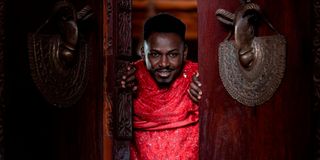
You’ve probably heard the fresh hit Taya lighting up the airwaves over the past few weeks. Once again, Okello Max (Julius Mcrymboh Okello) proves his mastery, seamlessly blending soulful vocals with a modern Afro-fusion sound that feels both nostalgic and refreshingly new.
This is exactly what he has come to be known for – heartfelt songwriting and an effortless ability to bridge tradition with contemporary rhythm
I come from a small village in Kisumu called Kanyakwar, that is where I grew up.
When my father retired, life took a rough turn. I come from a very big family. My father has three wives. From my mother alone, we are seven children.
When he retired, I had just completed high school at Homa Bay High, and I had to find a way to make ends meet. I took blue-collar jobs, working at construction sites, mjengo, and even waiting tables at a kibandaski.
Those became my main sources of income until my father opened a small car wash. I took over its day-to-day running, and in between clients, I would pick up my guitar and try to perfect my skill.
One thing about our big family is that we always bonded over music. We would sit together and sing hymns, and that’s how my love for music was born.
During the toughest times, music became our refuge. I still remember my mother saying how much she cherished those nights when, even if there was no meal, we could all sit together and sing. It was our way of finding light in the dark. I am sure neighbours wondered how happy we always were, you wouldn’t even know we were going to bed hungry.
Because of that, music has become a part of us. Many of my family members are great singers but I do it as a profession. I realised early in my career that music can actually pay because I began earning very early.
I honed my guitar skills after joining the Moi University school band. That is also where I polished my vocals and earned my first stage name ‘Max yule wa band’.
I have always considered Dela Maranga a key figure in my musical breakthrough. She gave me my first real platform, inviting me to be her background vocalist at two of her shows in 2017. I gave it my all and soon, referrals started coming in.
By 2019, I was featured as a background singer on ‘Extravaganza’ the iconic Sauti Sol and Sol Generation collaboration. That year, I released my debut single ‘Kiss’ which performed remarkably well. From there, I just kept building up.
The slow, soulful element in my music is deeply influenced by the Coast. Before my father retired, he was transferred to Lamu and that’s where I was first exposed to Swahili music and taarab. It has a rich, emotional and captivating sound. I also noticed that the people around me connected most when I leaned into that soulful style, so I made it part of my musical identity.
That also explains why my Swahili is far more fluent than my native Dholuo. I actually learned to speak Swahili first, long before I mastered Dholuo which is probably why blending the two comes so naturally in my music. Even today, people still joke that my Dholuo sounds funny, that I have a tweng in it and that I must be a ‘cool kid’.
People often say I am a ladies’ man. My team jokes that I should lean into it, be the ‘sex symbol’, the smooth lover boy and honestly, I get where they’re coming from. Women are my my biggest supporters and I love them. But just for the record, I’m not single.