Rachael Waithera famously known as Rakeeri to her huge social media following, has the calm, collected presence of someone who has endured and survived trying times. Behind her beautiful smile is a story of resilience, selflessness and intense maternal love, one that has unfolded over 15 long years beside her daughter.
Rachael’s daughter has Osteodysplasia, a condition where a child’s bones grow or develop abnormally. In 2009, shortly after she got married, Rachael gave birth to a baby girl. The pregnancy was smooth without any complications.
“When she turned seven months, I realised that my baby’s legs were very weak,” she says.
During the next clinic visit, her daughter, Sharon Njeri, was diagnosed with rickets and put on supplements to help manage the condition. No improvements were observed. What followed was a whirlwind of hospital visits and doctors’ consultations.
“At nine months, I began to get really worried. She couldn’t hold her neck up.” She says.
On another clinic visit shortly afterwards, Sharon was diagnosed with Cerebral Palsy (CP), a neurological condition which affects the brain, leading to challenges with movement, posture and muscle control.
Normally, a three-year-old child should be walking with ease. But this was not the case with Rachael’s child. It is because of this that she, together with her husband, visited a specialist in a hospital in Kijabe. This marked the beginning of their daughter’s arduous medical journey. The baby was given special shoes to help straighten her legs.
“As I was leaving the hospital, I saw another mum carrying her child with plastered legs. After a brief chat with her, she referred me to an orthopaedic hospital where my child was diagnosed with Osteodysplasia.”
Osteodysplasia is a condition where a baby’s bones grow abnormally, and can only be corrected through surgery. For Sharon’s case, one surgery was not enough. She needed to undergo several surgeries as hers was a recurring condition.
After eight unsuccessful surgeries, Rachael looked for another facility where her child could take therapy sessions.
She landed at Naromoru Disabled Children’s Home, where Sharon underwent three more surgeries. In 2024, she underwent her final surger,y and it was successful.
Rachael Waithira with her daughter Sharon Njeri at their home.
Photo credit: Pool
The facility handles children with orthopaedic conditions aged between two and 15. They offer corrective surgeries and post-palliative care with the help of physiotherapists and assistive devices.
For 10 years, she was in and out of the hospital in Kijabe, and the condition kept recurring.
“I remember the first surgery when she was just three years old. I was so scared, but I had to be strong for her,” says Racahel.
She remembers carrying her crying child during lunch hours to pass the time since the baby had to avoid feeding before going to the theatre. For more than two hours, she would wait for her small baby to come out of the theatre room. But by the sixth surgery, she had overcome the fear.
“2021 was the darkest point of my life. Due to Covid-19 restrictions, I couldn’t travel to be with Sharon. Being at home with my child alone in the hospital was very tough,” she says.
10 years later, although she was scared of having another baby, Rachael conceived her second child, Sheila Njeri. Sheila offered a new source of support for her mum, and shortly afterwards, Rachael left her job as a banker to attend to her elder daughter’s special needs.
Rachael says that through her journey, she has learned to ignore other people’s opinions.
“Negative thinking is worse than cancer. It will eat you up,” she says.
Over the years, Rachael has learned how to dress wounds, massage Sharon after physiotherapy, negotiate with doctors on the best course of treatment and mobilise harambees (fundraisers) among family and friends.
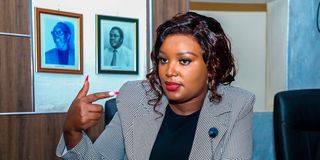
Racheal Waithira, also known as Rakeeri, is a mother of two daughters. During an interview at the Nation Centre in Nairobi.
Photo credit: Lucy Wanjiru | Nation
The highest amount they’ve ever spent on a singular surgery was Sh300,000. One hospital visit could set her back more than Sh9,000 courtesy of medications, physiotherapy and x-ray procedures.
“One external fixation surgery (a procedure where pin-like plates are used to keep fractured bones stable and in alignment costs Sh88,000. It was a lot of money. I think God sends angels because total strangers have helped us at critical moments,” she says.
“Marriage is a learning process. It is like a book where every chapter has its own lessons. I appreciate my husband for standing with me throughout, and I admire the bond she has with Sharon.
“I’m also glad that Sharon hasn’t faced any rejection or bullying at school. She loves science and wants to become a nurse,” Rachael says, her face lighting up. “She is in her second year of secondary school, and her performance has been outstanding despite the numerous hospital visits.
“What keeps me going is my faith in God and Sharon herself. This girl has confidence. She doesn’t feel sorry for herself. She laughs, dreams big, and encourages me. How can I give up when she hasn’t?”
Sharon, now 15, is walking, though with a slight limp. She is expected to use crutches for three months to help her bones achieve the required density.
“She is fully aware of her condition and emotionally stable. She even encourages other children with the same condition. Mothers should go to heaven directly, whether they have a special child or not,” she concludes with a smile.
Understanding osteodysplasia
Dr Joseph Theuri, a paediatric orthopedic surgeon, explains that Osteodysplasia includes a wide range of diseases where bones don’t grow as they should, such as dwarfism and rickets.
“When the bones do not grow normally, they could assume abnormal shapes, deformities or shortness. Other organs such as the skin, the spine and spinal cord, brain, and heart could be affected depending on the specific disease,” he explains, noting that the disease is very rare and difficult to treat.
“Many of these diseases are genetic and can be inherited, but it does not mean that any person with the condition will get a child with the same. He advises parents to look out for early signs such as abnormalities of the shape of the head or face, flattened nasal bridge and receding cheeks.
“Other symptoms include abnormal curves of the legs (bow legs, knock knees) and the arms, short arms and legs, short fingers (dwarfism) and brittleness of bones, where bones break easily.”
Racheal Waithira, also known as Rakeeri, is a mother of two daughters. During an interview at the Nation Centre in Nairobi.
Photo credit: Lucy Wanjiru | Nation
Dr Theuri adds that deformities of the spine and abnormal skin markings, especially dark patches, should be accorded immediate medical attention.
“It is important to encourage parents not to make any conclusions until the doctor sees the child and makes a diagnosis because doctors have to look at a combination of these clinical features and also look at imaging studies, such as X-rays before they can give a diagnosis.”
Dr Theuri notes a child may live a normal life after treatment, depending on the particular disease and its severity.
“For those with the condition, we usually evaluate how a deformity is affecting function and then tailor the surgical intervention to what can improve the function. Surgery can correct deformities to make the limbs straighter so that function can be improved.
“Medical treatment is used if there is a metabolic reason for bone growth abnormality, such as in rickets, where we give calcium and Vitamin D, or in brittle bones. We also give some medication to improve bone mineral density (bisphosphonates) can help strengthen the bones.”
Dr Theuri says special doctors for children with physical disabilities and deformities are few in the country, although recently there has been a lot of training of orthopaedic surgeons in the country.