
The rise of Kenya’s modern cocktail movement has also positioned gin as the go-to spirit for flavour play, experimentation, and elegance.

Gin is enjoying a renaissance in Kenya’s urban nightlife: Poured over ice, stirred into cocktails or simply sipped with tonic. Once a quiet classic, the spirit has re-emerged as a marker of taste, identity and experience, becoming central to how people socialise.
According to Zipporah Ndung’u, Senior Brand Manager at East Africa Breweries Limited, gin’s enduring appeal lies in its ability to meet consumers exactly where they are.
“Gin meets consumers at a point of need, which is more around taste and accessibility. Accessibility is both in terms of cost and availability. How easy is it for a consumer to buy the product? That’s something that has really worked for brands,” she says.

East African Breweries Limited (EABL) Senior Brand Manager Zipporah Ndung’u during an interview at EABL headquarters along Thika Road, Nairobi, on November 18, 2025.
The rise of Kenya’s modern cocktail movement has also positioned gin as the go-to spirit for flavour play, experimentation, and elegance.
“We also happen to be in a situation where we are seeing a rise of cocktail culture, and that mixability allows consumers to get to enjoy gin in whatever taste and flavour they want.”
The modern gin drinker
Today’s gin drinker is far from one-dimensional. Ms Ndung’u describes the category as one of the most versatile in the spirits market, appealing across lifestyles and age groups without demanding a single identity.
“Gin doesn’t have one specific demographic because of how easy it is to consume,” she says. “But it has a diverse portfolio of consumers. There’s the everyday drinker who wants simplicity and no fluff. Then there’s the sophisticated consumer for whom a drink is a lifestyle expression. They want both classics and customised serves.”
For some, a simple gin and tonic or a splash of bitter lemon is enough. For others, the choice is more deliberate: A Negroni, a martini or a bespoke cocktail designed to be as photogenic as it is flavourful.
Gender patterns also emerge. Ndung’u notes that women tend to show a stronger affinity for gin compared to other spirit categories.
“Women have a higher affinity for gin. It fits as a drink and lifestyle representation. Men’s needs are a bit simpler. For them, it’s a simple serve. They do not desire something that looks complicated or colourful,” Ms Ndungu says.

Women tend to show a stronger affinity for gin compared to other spirit categories.
That distinction has fuelled flavour innovation and the move toward easier drinking formats. The ready-to-drink formats like canned gin & tonic are gaining traction as consumers look for convenience without compromising on quality.
“The category has become so popular. There are so many players coming into this space and there is a fight to differentiate yourself. The differentiation we’re seeing majorly is flavour innovation. Luxury brands are also leaning into craft, producing small batches to create desirability,” she says.
Botanicals are also becoming a defining competitive frontier, especially in Africa.
“Botanicals are a huge thing now. Kenya and Africa as a whole has such a rich repository of botanicals. There’s definitely an opportunity to make local marks in a way similar to what Agave has done to tequila in Mexico,” Ms Ndung’u says.
Globally, gin distillers are experimenting with exotic botanicals of herbs, fruits and spices as they try to push their flavour boundaries in ways that go beyond the traditional juniper base.
Consequently, the craft gin, especially artisanal, small-batch interpretations, is booming with consumers wanting spirits that have traceable ingredients.
The mix
For mixologists, gin’s appeal lies in its creative freedom. Liam Wanyeki, a bartender at a Karen-based bar, says gin offers far more flexibility than most spirits.
“With rum or vodka, you will have to work with specific character profiles. Gin gives you variety because you can pull flavour in so many directions,” he says.
He goes on to explain that rum leans on sweet with its molasses base and vodka tends to be more neutral, disappearing into the mixer. Gin, however, retains its ground even when making cocktails with botanicals like the citrus peel, rosemary, and other exotic spices.
“They want sophistication, yes, but they also want fun. They want a drink that looks good on a table, tastes layered, and feels premium without being intimidating,” he adds.
Among his gin signatures is the Karura breeze that is made from any Kenyan gin, tamarind, lemongrass syrup and tonic. His Savannah spritz is from citrus gin, mango puree, sparkling water and dried orange. Then there is the Mount Kenya Negroni which is gin infused with local herbs, vermouth and a spiced bitters twist.
“Kenyan gin has this interesting taste that rum and vodka can’t give you. It’s fresh, it’s aromatic and has an identity.”
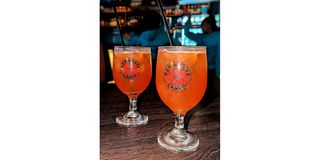
“Let’s beGin” cocktail made with gin, southern comfort, lime grenadine syrup & fresh orange juice at The Belvedere grill. Photo | Pool
He also notices that consumers are becoming more curious. They ask about the origin of the gin, how it was distilled, what botanicals are inside.
Kenya’s social patterns are evolving alongside drinking habits. Traditional after-work pub meetups are increasingly giving way to day parties, brunches and themed gatherings.
“The face of socialising has really changed. There’s a lot of day parties, brunches, thematic parties and we are going into spaces that are reflective of what the consumer sees as desiring to enjoy,” Ms Ndung’u says.
During the festive season, she observes a balanced appetite across the gin portfolio.
“It is a mix of both sophistication and the classics,” she says. “Gifting drives premium ranges, but gatherings lean toward the classics because they are very shareable. Ready-to-go options are also quite good for people who want to carry enough, especially those going on a road trip. The whole range gets to be experienced.”
Although she agrees that the sales fluctuate as consumers explore a broader repertoire of spirits, gin remains a key growth category.
A glimpse of what is loved on the shelves
Kenya’s gin market is bursting with colourful mix of homegrown craft labels and global favourites that have found loyal fans.
Among those leading is Gilbey’s Mixed Berries Gin, a fruity variant that has become a go-to for those who enjoy sweeter profiles and playful cocktails.
On the more artisanal end, Kenyan Originals (KO) Gin have their KO Classic and KO Tambuzi variants that represent Kenyan botanicals of bitter orange leaves, lemongrass, hibiscus, baobab, ginger, peanuts and even mango.
Then there’s 58 Gin which is loved by bartenders for its versatility. Their two main styles, their 5.8 Classic and 5.8 Spiced Orange come with suggested serves like “The Bird” that pairs classic gin with honey, ginger syrup, lime and tonic. “Red Zone” leans tropical with pineapple juice, basil, and a spiced kick of Tabasco if you dare.
But perhaps the most celebrated of them all is Procera Gin from a Kenyan distillery. It carries earthy and nutty notes that can’t be replicated anywhere. Equally ambitious is the Mara Edition Gin that sits in the premium category, with its craft production and unique flavours.
For everyday enjoyment, Kibao Gin remains a household favourite, especially when it comes to its affordability.
There’s also a newcomer that’s turning heads, the Bloedlemoen Gin, which is originally distilled in South Africa. Bloedlemoen draws its spirit from 10 botanicals, including the Tarocco blood orange, and is made in a London Dry style.
According to Cutler Palmer Drinks SA, on the nose, it teases citrus and juniper while on the palate, there’s warm nutmeg and cassia and it finishes with a lingering blood-orange note of a citrus crescendo that lives up to its name. There’s also a luxurious Amber variant, infused with locally foraged fynbos and honey bush for a richer and more aromatic character. In Kenya, the bottle sells for about Sh3,700 for the 750 ml.
Follow our WhatsApp channel for breaking news updates and more stories like this.